Thank you for visiting SNEWPapers!
Sign up free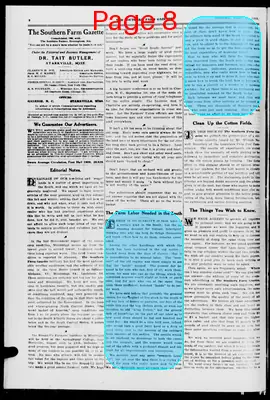
Editorial
August 21, 1909
The Southern Farm Gazette
Starkville, Oktibbeha County, Mississippi
What is this article about?
Editorial from August 21, 1909, argues that the South needs trained, intelligent farm laborers to replace inefficient workers, overcome slavery's legacy of disdain for manual work, and improve agriculture, especially livestock. Calls for training Southern boys to fill this role.
Clipping
OCR Quality
95%
Excellent
Full Text
The Farm Labor Needed in the South
Saturday, August 21, 1909.
There is no scarcity of farm labor of a certain kind in the South; but the increasing demand for trained, intelligent, thinking men who can both do things themselves and teach others how to do them, remains unsatisfied.
Among the other handicaps with which the South has been burdened is the old notion—handed down from the days of slavery—that it is discreditable to do manual labor. The "overseer" of the old regime was there simply to see that the "hands" worked. The present day demand is for men who can, first of all, work themselves, for men who can do the things which the untrained negroes would slight or botch or patch over, and for men who can at the same time train these inefficient, indolent "hands" to do better work.
We have said before that probably the greatest reason for our neglect of live stock in the South is not our lack of fences or pastures, our fear of the cattle tick and the hog cholera germ, or even our devotion to old "King Cotton," but the general lack of knowledge on the part of our labor as to how good stock should be fed and handled and cared for. He would be a very bold man, indeed, who would turn a good dairy herd or a flock of good sheep over to the mercies of the ordinary farm laborers of this section. The results would, in all likelihood, be disastrous to both the owner and the animals; and the negroes would come out of the affair with a profound disgust and distrust for all improvements and innovations.
We scarcely need any more "common laborers"; but all over the land there is a crying demand for men who really know how to farm.
We have thousands more plowmen than are really needed for the acreage that is cultivated; but most of them don't know how to plow.
Can the ordinary farm hand of the South be trusted to keep a plow in good shape, to run it level and true, and to adjust it to the demands of the soil and the team so as to get the best results with the least expenditure of muscular force?
Next to men who will farm for themselves along improved lines, the South needs to-day men trained for managers and foremen, and, yes,—for plain workmen. Dairymen, stockmen, gardeners, orchardists, men who really know how to feed a team, to hitch it up and to drive it, men who really know how to break the land, how to harrow it, how to run a planter or a weeder or a mowing machine—for all these there is an increasing and an unsatisfied demand in the South to-day.
Such laborers we must have; and they will either come from other sections or be trained at home.
There are thousands of Southern boys, too, who need just such training. Shall we not at least make an effort to let them have it?
Saturday, August 21, 1909.
There is no scarcity of farm labor of a certain kind in the South; but the increasing demand for trained, intelligent, thinking men who can both do things themselves and teach others how to do them, remains unsatisfied.
Among the other handicaps with which the South has been burdened is the old notion—handed down from the days of slavery—that it is discreditable to do manual labor. The "overseer" of the old regime was there simply to see that the "hands" worked. The present day demand is for men who can, first of all, work themselves, for men who can do the things which the untrained negroes would slight or botch or patch over, and for men who can at the same time train these inefficient, indolent "hands" to do better work.
We have said before that probably the greatest reason for our neglect of live stock in the South is not our lack of fences or pastures, our fear of the cattle tick and the hog cholera germ, or even our devotion to old "King Cotton," but the general lack of knowledge on the part of our labor as to how good stock should be fed and handled and cared for. He would be a very bold man, indeed, who would turn a good dairy herd or a flock of good sheep over to the mercies of the ordinary farm laborers of this section. The results would, in all likelihood, be disastrous to both the owner and the animals; and the negroes would come out of the affair with a profound disgust and distrust for all improvements and innovations.
We scarcely need any more "common laborers"; but all over the land there is a crying demand for men who really know how to farm.
We have thousands more plowmen than are really needed for the acreage that is cultivated; but most of them don't know how to plow.
Can the ordinary farm hand of the South be trusted to keep a plow in good shape, to run it level and true, and to adjust it to the demands of the soil and the team so as to get the best results with the least expenditure of muscular force?
Next to men who will farm for themselves along improved lines, the South needs to-day men trained for managers and foremen, and, yes,—for plain workmen. Dairymen, stockmen, gardeners, orchardists, men who really know how to feed a team, to hitch it up and to drive it, men who really know how to break the land, how to harrow it, how to run a planter or a weeder or a mowing machine—for all these there is an increasing and an unsatisfied demand in the South to-day.
Such laborers we must have; and they will either come from other sections or be trained at home.
There are thousands of Southern boys, too, who need just such training. Shall we not at least make an effort to let them have it?
What sub-type of article is it?
Agriculture
Labor
What keywords are associated?
Farm Labor
Southern Agriculture
Worker Training
Livestock Care
Manual Labor Stigma
What entities or persons were involved?
South
Negro Laborers
Southern Boys
Editorial Details
Primary Topic
Need For Trained And Intelligent Farm Labor In The South
Stance / Tone
Advocacy For Training Southern Farm Workers And Boys
Key Figures
South
Negro Laborers
Southern Boys
Key Arguments
South Lacks Trained, Intelligent Farm Workers Who Can Perform And Teach Tasks
Legacy Of Slavery Discourages Manual Labor Among Whites
Untrained Negro Laborers Are Inefficient And Resistant To Improvements
Neglect Of Livestock Due To Labor's Lack Of Knowledge In Feeding And Care
Demand For Skilled Farmers, Managers, Foremen, And Workmen In Various Agricultural Roles
Southern Boys Need Training To Meet This Demand