Thank you for visiting SNEWPapers!
Sign up free
Literary
May 17, 1827
Phenix Gazette
Alexandria, Virginia
What is this article about?
First-person narrative of Gaspar Wesseling's execution procession in Wittenberg, false pardon hope, hanging, revival via alchemist's elixir by a priest, leading to extreme old age and reflection on past sins amid veneration by locals.
Merged-components note: Continuation of the story 'Gasper Wesseling' across components, same topic and narrative flow.
Clipping
OCR Quality
75%
Good
Full Text
GASPER WESSELING.
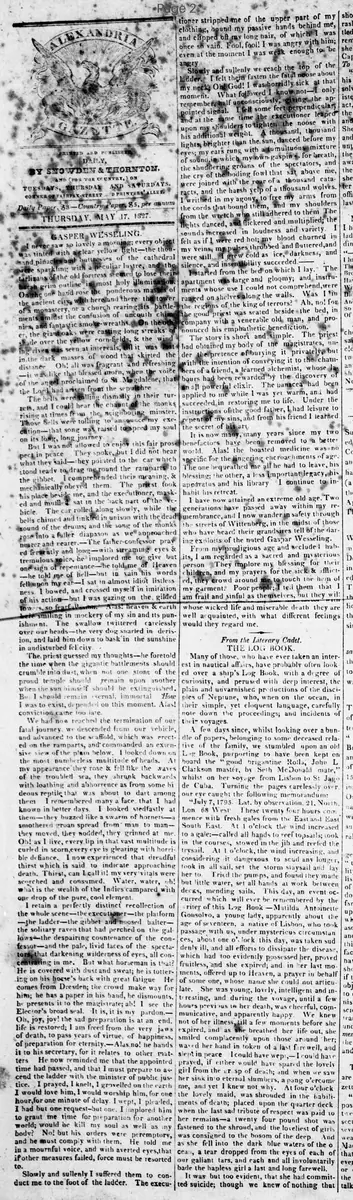
I never saw so lovely a morning; every object was lighted with a clear yellow light—the thousands of pinnacles and buttresses of the cathedral were sparkling with a peculiar lustre, and the battlements of the old fortress seemed to lose their harsh grim outline in most holy illumination. On the one hand rose the ponderous masses of the ancient city, with here and there the tower of a monastery, or a church rearing its battlements amidst the confusion of uncouth chimneys, the giant oaks were casting long streaks of shade over the yellow corn-fields, and fantastic smoke-wreaths. On the other hand riven was seen at intervals, in it was lost shade over the yellow corn-fields, & the wind of the angels proclaimed to St. Magdalene, that it was like that blessed morn, when the voice of the Lord had arisen from the sepulchre—rising at times from the neighboring minster. The bells were tolling dismally in their turrets, and I could hear the chaunt of the monks. Those bells were tolling to announce my execution—that song was raised to speed my soul on its long, long journey.
But I was not allowed to enjoy this fair prospect in peace. They spoke, but I did not hear what they said: they pointed to the car which stood ready to drag me round the ramparts to the gibbet. I comprehended their meaning, & mechanically obeyed them. The priest took his place beside me, and the executioner, masked, sat in the back part of the vehicle. The car rolled along slowly, while the sound of the drums; and the song of the monks, bells chimed and tinkled in unison with the dead march, rose into a fuller diapason as we approached nearer and nearer. The father-confessor prayed tremulous voice. He implored me to give but one sign of repentance—he told me of Heaven—he told me of hell—but in vain his words fell upon my ear—I sat in almost idiot listlessness. I bowed, and crossed myself in imitation of his action—but I was gazing on the gilded towers, so fearful on Aras: heaven & earth were smiling in mockery of my sin and its punishment. The swallow twittered carelessly over our heads—the very dog snarled in derision, and laid him down to bask in the sunshine in undisturbed felicity.
The priest guessed my thoughts—he foretold the time when the gigantic battlements should crumble into dust, when not one stone of the proud temple should remain upon another, when the sun himself should be extinguished. But I should remain eternal, immortal. How I was to exist, depended on this moment. Alas! conviction came too late.
We had now reached the termination of our fatal journey. We descended from our vehicle, and advanced to the scaffold, which was erected on the ramparts, and commanded an extensive view of the plain below. I looked down on the most numberless multitude of heads. At my appearance they rose & fell like the waves of the troubled sea, they shrunk backwards with loathing and abhorrence as from some hideous reptile that was about to dart among them. I remembered many a face that I had known in better days. I looked steadfastly at them—they buzzed like a swarm of hornets—a smothered groan spread from man to man—they moved, they nodded, they grinned at me. Oh! as I live, every lip in that vast multitude is curled in scorn, every eye is glaring with horrible defiance. I now experienced that dreadful thirst which is said to indicate approaching death. Thirst, can I call it! my very vitals were scorched and consumed. Water, water, oh! what is the wealth of the Indies compared with one drop of the pure, cool element.
I retain a perfectly distinct recollection of the whole scene—the executioner—the platform—the ladder—the gibbet and noosed halter—the solitary raven that had perched on the gallows—the despairing countenance of the confessor—and the pale, livid faces of the spectators, that darkening wilderness of eyes, all concentrating in me. But what horseman is that? He is covered with dust and sweat; he is tottering on his horse's back with great fatigue. He comes from Dresden; the crowd make way for him; he has a paper in his hand, he dismounts, he presents it to the magistrate; ah! I see the Elector's broad seal. It is, it is my pardon. Oh, joy, joy! the sad preparation is at an end. Life is restored; I am freed from the very jaws of death, to pass years of virtue, of happiness, of preparation for eternity.—Alas, no! he hands it to his secretary, for it relates to other matters. He now reminded me that the appointed time had passed, and that I must prepare to ascend the ladder with the minister of public justice. I prayed, I knelt, I grovelled on the earth. I would love him, I would worship him, for one hour, for one minute of delay. I wept, I pleaded, I had but one request—but one. I implored him to grant me time for preparation for another world; would he kill my soul as well as my body? No! but his orders were peremptory, and he must comply with them. He told me in a mournful voice, and with averted eyes, that if other measures failed, force must be resorted to.
Slowly and sullenly I suffered them to conduct me to the foot of the ladder. The executioner stripped me of the upper part of my clothing, bound my passive hands behind me, and clipped off my long hair, of which I was once so vain. Fool, fool! I was angry with him; angry. Slowly and sullenly we reach the top of the ladder. I felt them fasten the fatal noose about my neck: On God! I was horridly sick at that moment. What followed I know not—I only remember half-unconsciously, giving the appointed signal. I fell some feet perpendicular, and at the same time the executioner leaped upon my shoulders to tighten the noose with his additional weight. A thousand, thousand lights, brighter than the sun, danced before my eyes; my ears rung with a tumultuous mixture of sound, in which my own gasping for breath, the cry of the boding owl that sat above me, the shuddering groans of the spectators, and were joined with the roar of a thousand cataracts, and the harsh yelp of a thousand wolves. Lights danced, and flickered and multiplied; the sounds increased in loudness and variety. I writhed in my agony to free my arms from the cords that bound them, and my shoulders from the wretch who still adhered to them. The from the wretch who still adhered to them. I felt as if I were red hot; my blood churned in my veins, my pulses throbbed and fluttered, and were still. I grew cold as ice, darkness, and insensibility succeeded.
apartment was large and gloomy; and, insufferably pained from the burden which I lay. The instruments whose use I could not comprehend, were ranged on shelves along the walls. Was I in the regions of the king of terrors? Ah, no! for I was in company with a venerable old man, and pro-nounced his emphathetic benediction.
The story is short and simple. The priest had obtained my body of the magistrates, under pretence of burying it privately, but with the intention of conveying it to the chambers of a friend, a learned alchemnist, whose labours had been rewarded by the discovery of an all powerful elixir. The panacea had been applied to me while I was yet warm, and had succeeded in restoring me to life. Under the repentance of my sins, and from his friend I learned the secret of his art.
It is now many, many years since my two benefactors have been removed to a better world. Alas! the boasted medicine was no specific for the lingering encroachments of age. The one bequeathed me all he had to leave, his blessing; the other, a less important legacy, his apparatus and his library. I continue to inhabit his retreat.
I have now attained an extreme old age. Two generations have passed away within my remembrance, and I now wander in safety through the streets of Wittenberg, in the midst of those who have heard their grandsires tell of the daring exploits of the noted Gaspar Wesseling. From my prodigious age and secluded habits, I am regarded as a sacred and mysterious person. They implore my blessing for their children, and my prayers for the sick & afflicted, they crowd around me to touch the hem of my garment. Poor people; I tell them that I am frail and sinful as themselves, but they will not believe me. If they knew whose wicked life and miserable death they are well acquainted, with what different feelings would they regard me.
I never saw so lovely a morning; every object was lighted with a clear yellow light—the thousands of pinnacles and buttresses of the cathedral were sparkling with a peculiar lustre, and the battlements of the old fortress seemed to lose their harsh grim outline in most holy illumination. On the one hand rose the ponderous masses of the ancient city, with here and there the tower of a monastery, or a church rearing its battlements amidst the confusion of uncouth chimneys, the giant oaks were casting long streaks of shade over the yellow corn-fields, and fantastic smoke-wreaths. On the other hand riven was seen at intervals, in it was lost shade over the yellow corn-fields, & the wind of the angels proclaimed to St. Magdalene, that it was like that blessed morn, when the voice of the Lord had arisen from the sepulchre—rising at times from the neighboring minster. The bells were tolling dismally in their turrets, and I could hear the chaunt of the monks. Those bells were tolling to announce my execution—that song was raised to speed my soul on its long, long journey.
But I was not allowed to enjoy this fair prospect in peace. They spoke, but I did not hear what they said: they pointed to the car which stood ready to drag me round the ramparts to the gibbet. I comprehended their meaning, & mechanically obeyed them. The priest took his place beside me, and the executioner, masked, sat in the back part of the vehicle. The car rolled along slowly, while the sound of the drums; and the song of the monks, bells chimed and tinkled in unison with the dead march, rose into a fuller diapason as we approached nearer and nearer. The father-confessor prayed tremulous voice. He implored me to give but one sign of repentance—he told me of Heaven—he told me of hell—but in vain his words fell upon my ear—I sat in almost idiot listlessness. I bowed, and crossed myself in imitation of his action—but I was gazing on the gilded towers, so fearful on Aras: heaven & earth were smiling in mockery of my sin and its punishment. The swallow twittered carelessly over our heads—the very dog snarled in derision, and laid him down to bask in the sunshine in undisturbed felicity.
The priest guessed my thoughts—he foretold the time when the gigantic battlements should crumble into dust, when not one stone of the proud temple should remain upon another, when the sun himself should be extinguished. But I should remain eternal, immortal. How I was to exist, depended on this moment. Alas! conviction came too late.
We had now reached the termination of our fatal journey. We descended from our vehicle, and advanced to the scaffold, which was erected on the ramparts, and commanded an extensive view of the plain below. I looked down on the most numberless multitude of heads. At my appearance they rose & fell like the waves of the troubled sea, they shrunk backwards with loathing and abhorrence as from some hideous reptile that was about to dart among them. I remembered many a face that I had known in better days. I looked steadfastly at them—they buzzed like a swarm of hornets—a smothered groan spread from man to man—they moved, they nodded, they grinned at me. Oh! as I live, every lip in that vast multitude is curled in scorn, every eye is glaring with horrible defiance. I now experienced that dreadful thirst which is said to indicate approaching death. Thirst, can I call it! my very vitals were scorched and consumed. Water, water, oh! what is the wealth of the Indies compared with one drop of the pure, cool element.
I retain a perfectly distinct recollection of the whole scene—the executioner—the platform—the ladder—the gibbet and noosed halter—the solitary raven that had perched on the gallows—the despairing countenance of the confessor—and the pale, livid faces of the spectators, that darkening wilderness of eyes, all concentrating in me. But what horseman is that? He is covered with dust and sweat; he is tottering on his horse's back with great fatigue. He comes from Dresden; the crowd make way for him; he has a paper in his hand, he dismounts, he presents it to the magistrate; ah! I see the Elector's broad seal. It is, it is my pardon. Oh, joy, joy! the sad preparation is at an end. Life is restored; I am freed from the very jaws of death, to pass years of virtue, of happiness, of preparation for eternity.—Alas, no! he hands it to his secretary, for it relates to other matters. He now reminded me that the appointed time had passed, and that I must prepare to ascend the ladder with the minister of public justice. I prayed, I knelt, I grovelled on the earth. I would love him, I would worship him, for one hour, for one minute of delay. I wept, I pleaded, I had but one request—but one. I implored him to grant me time for preparation for another world; would he kill my soul as well as my body? No! but his orders were peremptory, and he must comply with them. He told me in a mournful voice, and with averted eyes, that if other measures failed, force must be resorted to.
Slowly and sullenly I suffered them to conduct me to the foot of the ladder. The executioner stripped me of the upper part of my clothing, bound my passive hands behind me, and clipped off my long hair, of which I was once so vain. Fool, fool! I was angry with him; angry. Slowly and sullenly we reach the top of the ladder. I felt them fasten the fatal noose about my neck: On God! I was horridly sick at that moment. What followed I know not—I only remember half-unconsciously, giving the appointed signal. I fell some feet perpendicular, and at the same time the executioner leaped upon my shoulders to tighten the noose with his additional weight. A thousand, thousand lights, brighter than the sun, danced before my eyes; my ears rung with a tumultuous mixture of sound, in which my own gasping for breath, the cry of the boding owl that sat above me, the shuddering groans of the spectators, and were joined with the roar of a thousand cataracts, and the harsh yelp of a thousand wolves. Lights danced, and flickered and multiplied; the sounds increased in loudness and variety. I writhed in my agony to free my arms from the cords that bound them, and my shoulders from the wretch who still adhered to them. The from the wretch who still adhered to them. I felt as if I were red hot; my blood churned in my veins, my pulses throbbed and fluttered, and were still. I grew cold as ice, darkness, and insensibility succeeded.
apartment was large and gloomy; and, insufferably pained from the burden which I lay. The instruments whose use I could not comprehend, were ranged on shelves along the walls. Was I in the regions of the king of terrors? Ah, no! for I was in company with a venerable old man, and pro-nounced his emphathetic benediction.
The story is short and simple. The priest had obtained my body of the magistrates, under pretence of burying it privately, but with the intention of conveying it to the chambers of a friend, a learned alchemnist, whose labours had been rewarded by the discovery of an all powerful elixir. The panacea had been applied to me while I was yet warm, and had succeeded in restoring me to life. Under the repentance of my sins, and from his friend I learned the secret of his art.
It is now many, many years since my two benefactors have been removed to a better world. Alas! the boasted medicine was no specific for the lingering encroachments of age. The one bequeathed me all he had to leave, his blessing; the other, a less important legacy, his apparatus and his library. I continue to inhabit his retreat.
I have now attained an extreme old age. Two generations have passed away within my remembrance, and I now wander in safety through the streets of Wittenberg, in the midst of those who have heard their grandsires tell of the daring exploits of the noted Gaspar Wesseling. From my prodigious age and secluded habits, I am regarded as a sacred and mysterious person. They implore my blessing for their children, and my prayers for the sick & afflicted, they crowd around me to touch the hem of my garment. Poor people; I tell them that I am frail and sinful as themselves, but they will not believe me. If they knew whose wicked life and miserable death they are well acquainted, with what different feelings would they regard me.
What sub-type of article is it?
Prose Fiction
What themes does it cover?
Death Mortality
Moral Virtue
Religious
What keywords are associated?
Execution
Resurrection
Elixir
Alchemist
Wittenberg
Sin
Repentance
Immortality
Literary Details
Title
Gasper Wesseling
Key Lines
I Never Saw So Lovely A Morning; Every Object Was Lighted With A Clear Yellow Light—The Thousands Of Pinnacles And Buttresses Of The Cathedral Were Sparkling With A Peculiar Lustre, And The Battlements Of The Old Fortress Seemed To Lose Their Harsh Grim Outline In Most Holy Illumination.
Those Bells Were Tolling To Announce My Execution—That Song Was Raised To Speed My Soul On Its Long, Long Journey.
It Is, It Is My Pardon. Oh, Joy, Joy! The Sad Preparation Is At An End. Life Is Restored; I Am Freed From The Very Jaws Of Death, To Pass Years Of Virtue, Of Happiness, Of Preparation For Eternity.—Alas, No!
The Panacea Had Been Applied To Me While I Was Yet Warm, And Had Succeeded In Restoring Me To Life.
If They Knew Whose Wicked Life And Miserable Death They Are Well Acquainted, With What Different Feelings Would They Regard Me.