Thank you for visiting SNEWPapers!
Sign up free
Story
February 7, 1907
Forest City Press
Forest City, Potter County, South Dakota
What is this article about?
Dr. Marcus Eustace, now bankrupt and working as a laborer in Widnes, Lancashire, once heroically transfused his own blood to save a dying poor woman, Mrs. Morris, in a risky operation without assistance.
Clipping
OCR Quality
85%
Good
Full Text
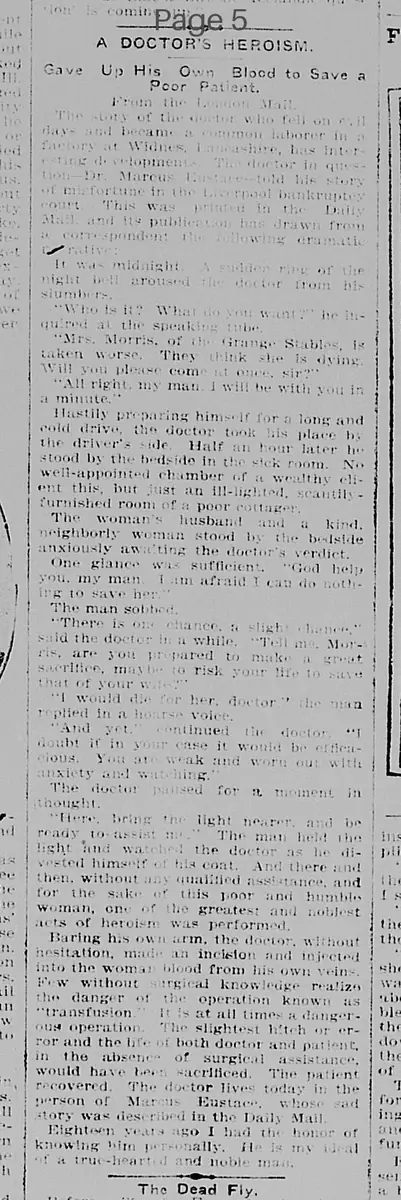
A DOCTOR'S HEROISM.
Gave Up His Own Blood to Save a Poor Patient.
From the London Mail.
The story of the doctor who fell on evil days and became a common laborer in the tar works at Widnes, Lancashire, has interesting developments. The doctor in question—Dr. Marcus Eustace—told his story of misfortune in the local bankruptcy court. This was printed in the Daily Mail and is published here as drawn from a correspondent knowing circumstances.
It was the midnight hour of the night when he was aroused from his slumbers.
"Who is it? What do you want," he inquired at the speaking tube.
"Mrs. Morris, of the Grange Stables, is taken worse. They think she is dying. Will you please come at once, sir?"
"All right, my man. I will be with you in a minute."
Hastily preparing himself for a long and cold drive, the doctor took his place by the driver's side. Half an hour later he stood by the bedside in the sick room. No well-appointed chamber of a wealthy client this, but just an ill-lighted, scantily-furnished room of a poor cottager.
The woman's husband and a kind neighborly woman stood by the bedside anxiously awaiting the doctor's verdict.
One glance was sufficient. "God help you, my man. I am afraid I can do nothing to save her."
The man sobbed.
"There is one chance, a slight one," said the doctor after a while. "Tell me, Morris, are you prepared to make a great sacrifice, may be to risk your life to save that of your wife?"
"I would die for her, doctor," the man replied in a hoarse voice.
"And you," continued the doctor, "I doubt if in your case it would be efficacious. You are weak and worn out with anxiety and watching."
The doctor paused for a moment in thought.
"Here, bring a light nearer, and be ready to assist me."
The man held the light and watched the doctor as he divested himself of his coat. And there and then, without any qualified assistance, and for the sake of this poor and humble woman, one of the greatest and noblest acts of heroism was performed.
Baring his own arm, the doctor, without hesitation, made an incision and injected into the woman blood from his own veins.
Few without surgical knowledge realize the danger of the operation known as "transfusion." It is at all times a dangerous operation. The slightest hitch or error and the life of both doctor and patient, in the absence of surgical assistance, would have been sacrificed. The patient recovered. The doctor lives today in the person of Marcus Eustace, whose sad story was described in the Daily Mail.
Eighteen years ago I had the honor of knowing him personally. He is my ideal of a true-hearted and noble man.
Gave Up His Own Blood to Save a Poor Patient.
From the London Mail.
The story of the doctor who fell on evil days and became a common laborer in the tar works at Widnes, Lancashire, has interesting developments. The doctor in question—Dr. Marcus Eustace—told his story of misfortune in the local bankruptcy court. This was printed in the Daily Mail and is published here as drawn from a correspondent knowing circumstances.
It was the midnight hour of the night when he was aroused from his slumbers.
"Who is it? What do you want," he inquired at the speaking tube.
"Mrs. Morris, of the Grange Stables, is taken worse. They think she is dying. Will you please come at once, sir?"
"All right, my man. I will be with you in a minute."
Hastily preparing himself for a long and cold drive, the doctor took his place by the driver's side. Half an hour later he stood by the bedside in the sick room. No well-appointed chamber of a wealthy client this, but just an ill-lighted, scantily-furnished room of a poor cottager.
The woman's husband and a kind neighborly woman stood by the bedside anxiously awaiting the doctor's verdict.
One glance was sufficient. "God help you, my man. I am afraid I can do nothing to save her."
The man sobbed.
"There is one chance, a slight one," said the doctor after a while. "Tell me, Morris, are you prepared to make a great sacrifice, may be to risk your life to save that of your wife?"
"I would die for her, doctor," the man replied in a hoarse voice.
"And you," continued the doctor, "I doubt if in your case it would be efficacious. You are weak and worn out with anxiety and watching."
The doctor paused for a moment in thought.
"Here, bring a light nearer, and be ready to assist me."
The man held the light and watched the doctor as he divested himself of his coat. And there and then, without any qualified assistance, and for the sake of this poor and humble woman, one of the greatest and noblest acts of heroism was performed.
Baring his own arm, the doctor, without hesitation, made an incision and injected into the woman blood from his own veins.
Few without surgical knowledge realize the danger of the operation known as "transfusion." It is at all times a dangerous operation. The slightest hitch or error and the life of both doctor and patient, in the absence of surgical assistance, would have been sacrificed. The patient recovered. The doctor lives today in the person of Marcus Eustace, whose sad story was described in the Daily Mail.
Eighteen years ago I had the honor of knowing him personally. He is my ideal of a true-hearted and noble man.
What sub-type of article is it?
Heroic Act
Biography
Medical Curiosity
What themes does it cover?
Bravery Heroism
Moral Virtue
Recovery
What keywords are associated?
Blood Transfusion
Doctor Heroism
Patient Rescue
Medical Risk
What entities or persons were involved?
Dr. Marcus Eustace
Mrs. Morris
Morris
Where did it happen?
Widnes, Lancashire
Story Details
Key Persons
Dr. Marcus Eustace
Mrs. Morris
Morris
Location
Widnes, Lancashire
Story Details
Dr. Marcus Eustace performs a dangerous blood transfusion from his own veins to save the life of a dying poor patient, Mrs. Morris, without assistance, risking his own life.