Thank you for visiting SNEWPapers!
Sign up free
Story
June 26, 1919
The Chesterfield Advertiser
Chesterfield, Chesterfield County, South Carolina
What is this article about?
In Columbia, South Carolina, on June 23, State Warehouse Commissioner W.G. Smith encourages farmers to build warehouses for the state system to protect cotton from weather and fire damage, offering free plans and noting the system can cover additional 500,000 bales at low cost.
Clipping
OCR Quality
98%
Excellent
Full Text
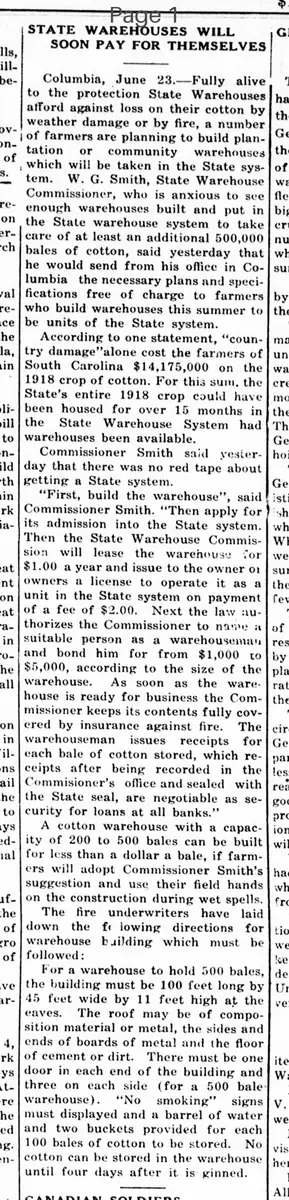
STATE WAREHOUSES WILL SOON PAY FOR THEMSELVES
Columbia, June 23.-Fully alive to the protection State Warehouses afford against loss on their cotton by weather damage or by fire, a number of farmers are planning to build plantation or community warehouses which will be taken in the State system.
W. G. Smith, State Warehouse Commissioner, who is anxious to see enough warehouses built and put in the State warehouse system to take care of at least an additional 500,000 bales of cotton, said yesterday that he would send from his office in Columbia the necessary plans and specifications free of charge to farmers who build warehouses this summer to be units of the State system.
According to one statement, "country damage" alone cost the farmers of South Carolina $14,175,000 on the 1918 crop of cotton. For this sum, the State's entire 1918 crop could have been housed for over 15 months in the State Warehouse System had warehouses been available.
Commissioner Smith said yesterday that there was no red tape about getting a State warehouse.
"First, build the warehouse", said Commissioner Smith. "Then apply for its admission into the State system. Then the State Warehouse Commission will lease the warehouse for $1.00 a year and issue to the owner or owners a license to operate it as a unit in the State system on payment of a fee of $2.00. Next the law authorizes the Commissioner to name a suitable person as a warehouseman and bond him for from $1,000 to $5,000, according to the size of the warehouse. As soon as the warehouse is ready for business the Commissioner keeps its contents fully covered by insurance against fire. The warehouseman issues receipts for each bale of cotton stored, which receipts after being recorded in the Commissioner's office and sealed with the State seal, are negotiable as security for loans at all banks."
A cotton warehouse with a capacity of 200 to 500 bales can be built for less than a dollar a bale, if farmers will adopt Commissioner Smith's suggestion and use their field hands on the construction during wet spells.
The fire underwriters have laid down the following directions for warehouse building which must be followed:
For a warehouse to hold 500 bales, the building must be 100 feet long by 45 feet wide by 11 feet high at the eaves. The roof may be of composition material or metal, the sides and ends of boards or metal and the floor of cement or dirt. There must be one door in each end of the building and three on each side (for a 500 bale warehouse). "No smoking" signs must be displayed and a barrel of water and two buckets provided for each 100 bales of cotton to be stored. No cotton can be stored in the warehouse until four days after it is ginned.
Columbia, June 23.-Fully alive to the protection State Warehouses afford against loss on their cotton by weather damage or by fire, a number of farmers are planning to build plantation or community warehouses which will be taken in the State system.
W. G. Smith, State Warehouse Commissioner, who is anxious to see enough warehouses built and put in the State warehouse system to take care of at least an additional 500,000 bales of cotton, said yesterday that he would send from his office in Columbia the necessary plans and specifications free of charge to farmers who build warehouses this summer to be units of the State system.
According to one statement, "country damage" alone cost the farmers of South Carolina $14,175,000 on the 1918 crop of cotton. For this sum, the State's entire 1918 crop could have been housed for over 15 months in the State Warehouse System had warehouses been available.
Commissioner Smith said yesterday that there was no red tape about getting a State warehouse.
"First, build the warehouse", said Commissioner Smith. "Then apply for its admission into the State system. Then the State Warehouse Commission will lease the warehouse for $1.00 a year and issue to the owner or owners a license to operate it as a unit in the State system on payment of a fee of $2.00. Next the law authorizes the Commissioner to name a suitable person as a warehouseman and bond him for from $1,000 to $5,000, according to the size of the warehouse. As soon as the warehouse is ready for business the Commissioner keeps its contents fully covered by insurance against fire. The warehouseman issues receipts for each bale of cotton stored, which receipts after being recorded in the Commissioner's office and sealed with the State seal, are negotiable as security for loans at all banks."
A cotton warehouse with a capacity of 200 to 500 bales can be built for less than a dollar a bale, if farmers will adopt Commissioner Smith's suggestion and use their field hands on the construction during wet spells.
The fire underwriters have laid down the following directions for warehouse building which must be followed:
For a warehouse to hold 500 bales, the building must be 100 feet long by 45 feet wide by 11 feet high at the eaves. The roof may be of composition material or metal, the sides and ends of boards or metal and the floor of cement or dirt. There must be one door in each end of the building and three on each side (for a 500 bale warehouse). "No smoking" signs must be displayed and a barrel of water and two buckets provided for each 100 bales of cotton to be stored. No cotton can be stored in the warehouse until four days after it is ginned.
What sub-type of article is it?
Historical Event
What themes does it cover?
Misfortune
Triumph
What keywords are associated?
State Warehouses
Cotton Storage
South Carolina Farmers
Warehouse Commissioner
Fire Protection
Cotton Damage
What entities or persons were involved?
W. G. Smith
Where did it happen?
Columbia, South Carolina
Story Details
Key Persons
W. G. Smith
Location
Columbia, South Carolina
Event Date
June 23
Story Details
Farmers plan to build warehouses for the state system to protect cotton from damage; Commissioner Smith provides free plans, outlines simple admission process, insurance, and negotiable receipts; highlights past damage costs and low building expenses.