Thank you for visiting SNEWPapers!
Sign up free
The National Intelligencer And Washington Advertiser
Washington, District Of Columbia
What is this article about?
The French Moniteur on July 10, 1804, denies rumors of Napoleon's plans to annex Italian Republics, Lucca, Etruria, Papal States, Naples, Sicily, Switzerland, Holland, and Hanover, asserting France's respect for neighbors' independence and moderation in past treaties.
Clipping
OCR Quality
Full Text
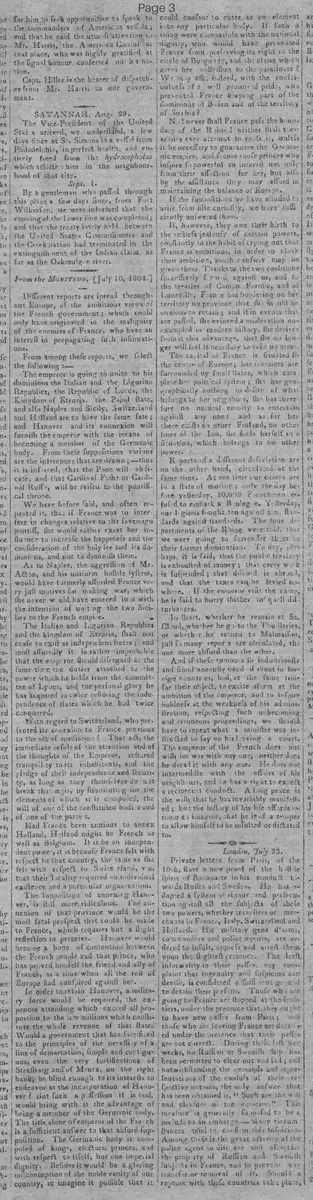
Different reports are spread throughout Europe, of the ambitious views of the French government; which could only have originated in the malignity of the enemies of France, who have an interest in propagating such insinuations.
From among these reports, we select the following:
The emperor is going to unite to his domains the Italian and the Ligurian Republics, the Republic of Lucca, the Kingdom of Etruria, the Papal state, and also Naples and Sicily. Switzerland and Holland are to have the same fate; and Hanover and its connexion will furnish the emperor with the means of becoming a member of the Germanic body. From these suppositions various are the inferences that are drawn;—thus it is inferred, that the Pope will abdicate, and that Cardinal Fesch or Cardinal Ruff, will be raised to the pontifical throne.
We have before said, and often repeated it, that if France was to interfere in changes relative to the sovereign pontiff, she would rather exert her influence to increase the happiness and the consideration of the holy see and its dominions, and not to diminish them.
As to Naples, the aggression of Mr. Acton, and his uniform hostile system, would have formerly afforded France very just motives for making war, which she never would have entered into with the intention of uniting the two Sicilies to the French empire.
The Italian and Ligurian Republics and the kingdom of Etruria, shall not cease to exist as independent states; and most assuredly it is rather improbable that the emperor should disregard at the same time the duties attached to the power which he holds from the committee of Lyons, and the personal glory he has acquired in twice restoring the independence of places which he had twice conquered.
With regard to Switzerland, who presented its annexation to France previous to the act of mediation? That act, the immediate result of the attention and of the thoughts of the Emperor, restored tranquility to its inhabitants, and the pledge of their independence and security, as long as they themselves do not break that pact, by substituting or the elements of which it is composed, the will of one of the constituent bodies and of one of the parties.
Had France been anxious to annex Holland, Holland might be French as well as Belgium. If it be an independent power, it is because France felt with respect to that country, the same as he felt with respect to Switzerland, viz. that their locality required an individual existence and a particular organization.
The supposition of annexing Hanover, is still more ridiculous. The annexation of that province would be the most fatal prospect that could be made to France, which requires but a slight reflection to perceive. Hanover would become a bone of contention between the French people and that prince, who has proved himself the friend and ally of France, at a time when all the rest of Europe had conspired against her.
In order to retain Hanover, a military force would be required, the expenses attending which exceed all proportion to the few millions which constitute the whole revenue of that state.
Would a government that has sacrificed to the principles of the necessity of a line of demarcation, simple and contiguous, even the very fortifications of Strasburg and of Mentz, on the right bank, be blind enough to its interests to endeavor at the incorporation of Hanover? But such a possession it is said, would bring with it the advantage of being a member of the Germanic body. The title alone of emperor of the French is a sufficient answer to that absurd supposition. The Germanic body is composed of kings, electors, princes, and with respect to itself, but one imperial dignity. Besides it would be a glaring misconception of the noble vanity of our country, to imagine it possible that it could consent to enter as an element into any particular body. If such a thing were compatible with the national dignity, who would have prevented France from preserving its right to the circle of Burgundy, and the claim which gives her possession to the palatinate?
We may ask, indeed, with the consciousness of a well grounded pride, who prevented France keeping part of the domains of Baden and of the territory of Suabia?
No! never shall France pass the boundary of the Rhine! neither shall their armies ever attempt to cross it, unless it be necessary to guarantee the Germanic empire, and secure those princes who inspire so powerful an interest not only from their affection for her, but also by the assistance they may afford in maintaining the balance of Europe.
If the suppositions we have alluded to arise from idle curiosity, we have sufficiently answered them.
If, however, they owe their birth to the restless jealousy of certain powers, constantly in the habit of crying out that France is ambitious, in order to cloak their ambition, another answer may be given them. Thanks to the two coalitions successively formed against us, and to the treaties of Campo Formio, and of Lunéville. France has bordering on her territory no province that she would be anxious to retain; and if in events that are past, she evinced a moderation unparalleled in modern history, she derives from it this advantage, that she no longer will feel it necessary to take up arms.
The capital of France is situated in the centre of Europe; her frontiers are surrounded by small states, which complete her political system; she has geographically nothing to desire of what belongs to her neighbours, she has therefore no natural enmity to entertain against any one: and as for her there exists no other Finland, no other lines of the sun, she finds herself in a situation, which belongs to no other power.
Reports of a different description are on the other hand, circulated at the same time. At one time our camps are in a state of mutiny; only the day before yesterday, 30,000 Frenchmen refused to embark at Boulogne. Yesterday, our legions fought ten against ten, standards against standards. The four departments of the Rhine were told that we were going to surrender them to their former domination. To day, perhaps, it is said, that the public treasury is exhausted of money; that every work is suspended; that discord is abroad. and that the taxes can be levied nowhere. If the emperor visit the camp. he is said to hurry thither to quell disturbances.
In short, whether he remain at St. Cloud, whether he go to the Thuilleries, or whether he return to Malmaison, just as many reports are circulated, the one more absurd than the other.
And if these rumours so industriously and simultaneously handed about in foreign countries, had, at the same time for their object, to excite alarm at the ambition of the emperor, and to inspire boldness at the weakness of his administration, respecting such unbecoming and erroneous proceeding, we should have to repeat what a minister was instructed to say on his leaving a court.
The emperor of the French does not wish for war with any one, neither does he dread it with any one. He does not intermeddle with the affairs of his neighbours, and he has a right to expect a reciprocal conduct. A long peace is the wish that he has invariably manifested: but the history of his life affords us room to imagine, that he is of a temper to allow himself to be insulted or dictated to.
What sub-type of article is it?
What keywords are associated?
What entities or persons were involved?
Where did it happen?
Foreign News Details
Primary Location
Europe
Event Date
July 10, 1804
Key Persons
Outcome
french government denies rumors of annexations and asserts commitment to independence of neighboring states and desire for peace.
Event Details
The Moniteur refutes European rumors of French Emperor's plans to annex Italian and Ligurian Republics, Lucca, Etruria, Papal States, Naples, Sicily, Switzerland, Holland, and Hanover, emphasizing France's past moderation, respect for sovereignty, and rejection of expansion beyond the Rhine; also counters false reports of internal French unrest.