Thank you for visiting SNEWPapers!
Sign up free
Story
January 25, 1879
Colored Citizen
Fort Scott, Topeka, Bourbon County, Shawnee County, Kansas
What is this article about?
George T. Angell exposes widespread food adulterations like lead in pepper and acid in vinegar in a paper to Boston's American Social Science Association, urging protection against these harmful practices.
Clipping
OCR Quality
98%
Excellent
Full Text
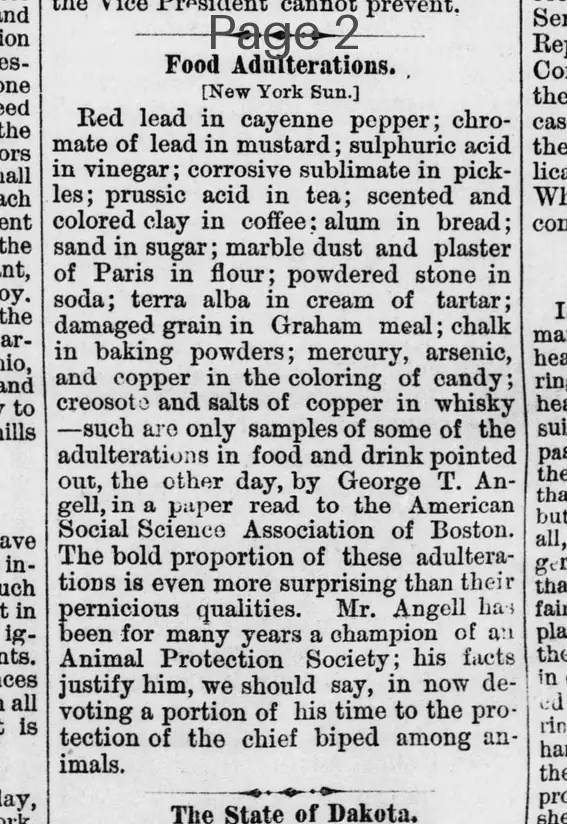
Food Adulterations.
[New York Sun.]
Red lead in cayenne pepper; chromate of lead in mustard; sulphuric acid in vinegar; corrosive sublimate in pickles; prussic acid in tea; scented and colored clay in coffee; alum in bread; sand in sugar; marble dust and plaster of Paris in flour; powdered stone in soda; terra alba in cream of tartar; damaged grain in Graham meal; chalk in baking powders; mercury, arsenic, and copper in the coloring of candy; creosote and salts of copper in whisky -such are only samples of some of the adulterations in food and drink pointed out, the other day, by George T. Angell, in a paper read to the American Social Science Association of Boston.
The bold proportion of these adulterations is even more surprising than their pernicious qualities. Mr. Angell has been for many years a champion of an Animal Protection Society: his facts justify him, we should say, in now devoting a portion of his time to the protection of the chief biped among animals.
[New York Sun.]
Red lead in cayenne pepper; chromate of lead in mustard; sulphuric acid in vinegar; corrosive sublimate in pickles; prussic acid in tea; scented and colored clay in coffee; alum in bread; sand in sugar; marble dust and plaster of Paris in flour; powdered stone in soda; terra alba in cream of tartar; damaged grain in Graham meal; chalk in baking powders; mercury, arsenic, and copper in the coloring of candy; creosote and salts of copper in whisky -such are only samples of some of the adulterations in food and drink pointed out, the other day, by George T. Angell, in a paper read to the American Social Science Association of Boston.
The bold proportion of these adulterations is even more surprising than their pernicious qualities. Mr. Angell has been for many years a champion of an Animal Protection Society: his facts justify him, we should say, in now devoting a portion of his time to the protection of the chief biped among animals.
What sub-type of article is it?
Curiosity
Deception Fraud
What themes does it cover?
Deception
Moral Virtue
What keywords are associated?
Food Adulteration
Lead In Spices
Acid In Vinegar
Health Risks
Consumer Protection
What entities or persons were involved?
George T. Angell
Where did it happen?
Boston
Story Details
Key Persons
George T. Angell
Location
Boston
Event Date
The Other Day
Story Details
George T. Angell reads a paper to the American Social Science Association detailing various food adulterations such as red lead in cayenne pepper, chromate of lead in mustard, sulphuric acid in vinegar, and others, highlighting their surprising prevalence and harmful qualities.