Thank you for visiting SNEWPapers!
Sign up free
The Salt Lake Herald
Salt Lake City, Salt Lake County, Utah
What is this article about?
Dynamite explosions on January 25, 1885, damaged Westminster Hall, House of Commons, and Tower of London in London, causing $700,000 in damage and injuring two policemen. Suspect Cunningham, an Irish-American, arrested; heightened security and international reactions follow.
Clipping
OCR Quality
Full Text
A "Suspect" with a Number of Aliases Held in Custody for the Crime.
The Blow-up.
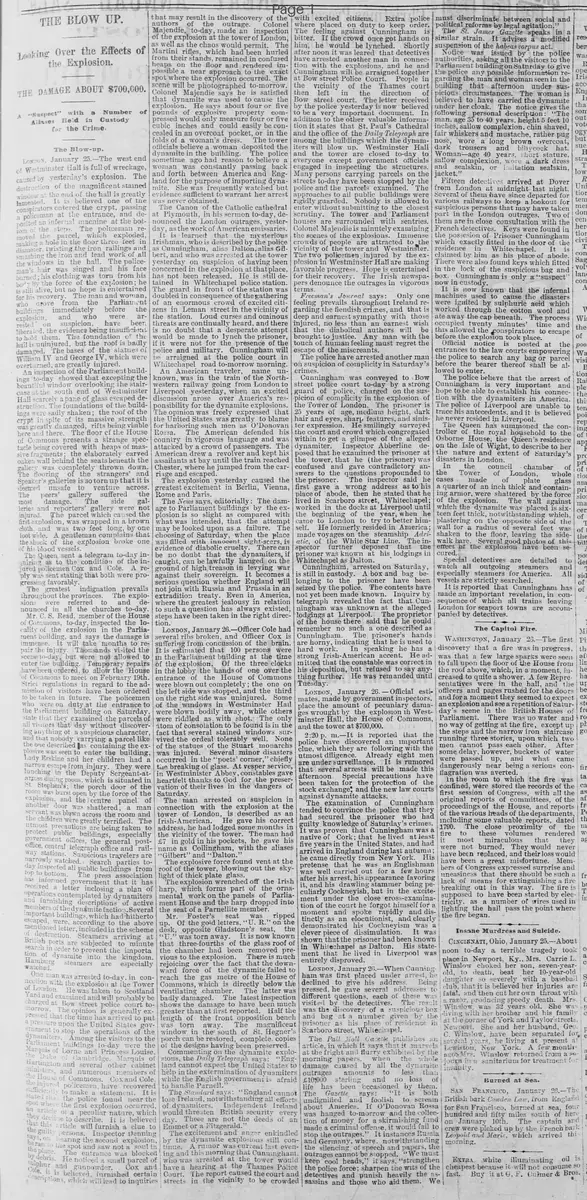
London, January 25.—The west end of Westminster Hall is full of wreckage, caused by yesterday's explosion. The destruction of the magnificent stained window at the end of the hall is greatly lamented. It is believed one of the conspirators entered the crypt, passing a policeman at the entrance, and deposited an infernal machine at the bottom of the steps. The policeman removed the parcel, which exploded, making a hole in the floor three feet in diameter twisting the iron railings and smashing the iron and lead work of all the windows in the hall. The policeman's hair was singed and his face burned; his clothing was torn from his body by the force of the explosion; he is still alive, but no hope is entertained for his recovery. The man and woman, who drove from the Parliament buildings immediately before the explosion, and who were arrested on suspicion, have been liberated, the evidence being insufficient to hold them. The foundation of the hall is uninjured, but the roof is badly damaged. The bases of the statues of William IV and George IV, which were overturned, are greatly injured. An inspection of the Parliament buildings to-day showed that excepting the beautiful window overlooking the staircase at the south end of Westminster Hall scarcely a pane of glass escaped destruction. The foundations of the buildings were sadly shaken; the roof of the crypt in spite of its massive strength was greatly damaged, rifts being visible here and there. The floor of the House of Commons presents a strange spectacle being covered with heaps of massive fragments: the elaborately carved oaken wall behind the seats beneath the gallery was completely thrown down. The flooring of the strangers' and Speaker's galleries is so torn up that it is deemed unsafe to venture across. The peers' gallery suffered the most damage. The side galleries and reporters' gallery were not injured. The parcel which caused the first explosion, was wrapped in a brown cloth and was two feet long, by one foot wide. A gentleman complains that the shock of the explosion broke one of his blood vessels. The Queen sent a telegram to-day inquiring as to the condition of the injured policemen Cox and Cole. A reply was sent stating that both were progressing favorably. The greatest indignation prevails throughout the provinces. The explosions were referred to and denounced in all the churches to-day. Mr. C. S. Read, member of the House of Commons, to-day, inspected the locality of the explosion in the Parliament building, and says the damage is immense. It will take months to repair the injury. Thousands visited the scene to-day, but were not allowed to enter the building. Temporary repairs have been ordered, to allow the House of Commons to meet on February 19th. Strict regulations in regard to the admission of visitors have been ordered to be taken in future. The policemen who were on duty at the entrance to the Parliament building on Saturday, state that they examined the parcels of all visitors that day without discovering anything of a suspicious character, and that nobody carrying a parcel like the one described as containing the explosive was seen to enter the building. Lady Erskine and her children had a narrow escape from injury. They were lunching in the Deputy Sergeant-at-arms's dining room, which is situated in St. Stephen's; the porch door of the room was burst open by the force of the explosion, and the centre panel of another door was shattered, a man servant was blown across the room and the children were greatly terrified. The utmost precautions are being taken to protect public buildings, especially government offices, the general post-office, central telegraph office and railway stations. Suspicious travelers are narrowly watched. Search parties to-day inspected all public buildings from top to bottom. The press association has informed government that it has received a letter inclosing a plan of operations contemplated by dynamiters and furnishing descriptions of active members of the dynamite faction. Several important buildings, which had hitherto escaped, were, according to the above mentioned letter, included in the scheme of destruction. Steamers arriving at British ports are subjected to minute search in order to prevent the importation of dynamite into the kingdom. Hamburg steamers are especially watched. One man was arrested to-day, in connection with the explosion at the Tower of London. He was taken to Scotland Yard and examined and will probably be charged at Bow street police court to-morrow. The opinion is generally expressed that the time has arrived to put a pressure upon the United States government to stop the operations of the dynamiters. Among the visitors to the Parliament buildings to-day were the Marquis of Lorne and Princess Louise, the Duke of Cambridge, Marquis of Hartington and several other cabinet ministers, and numerous members of the House of Commons. Cox and Cole, the injured policemen have sufficiently recovered to make a statement. It is stated that the police found near the spot where the first explosion occurred, an article of a peculiar nature, which they decline to describe. It is that this article will furnish a clue to the guilty persons. Inspector Denning says, on hearing the second explosion, he ran to the place to the spot and saw not a soul in the entrance was blocked by debris. He noticed small parcel of sulphur and gunpowder. Cox and Cole it is believed furnished certain descriptions, which will lead to inquiries that may result in the discovery of the authors of the outrage. Colonel Majendie, to-day, made an inspection of the explosion at the tower of London, as well as the chaos would permit. The Martini rifles, which had been hurled from their stands, remained in confused heaps on the floor and rendered impossible a near approach to the exact spot where the explosion occurred. The scene will be photographed to-morrow. Colonel Majendie says he is satisfied that dynamite was used to cause the explosion. He says about four or five pounds of explosive property compressed would only measure four or five cubic inches and could easily be concealed in an overcoat pocket, or in the folds of a woman's dress. The tower officials believe a woman deposited the dynamite in the building. The police sometime ago had reason to believe a woman was constantly passing back and forth between America and England for the purpose of importing dynamite. She was frequently watched but evidence sufficient to warrant her arrest was never obtained. The Canon of the Catholic cathedral at Plymouth, in his sermon to-day, denounced the London outrages, yesterday, as the work of American emissaries. It is learned that the mysterious Irishman, who is described by the police as Cunningham, alias Dalton, alias Gilbert, and who was arrested at the tower yesterday on suspicion of having been concerned in the explosion at that place, has not been released. He is still detained in Whitechapel police station. The guard in front of the station was doubled in consequence of the gathering of an enormous crowd of excited citizens in Leman street in the vicinity of the station. Loud curses and ominous threats are continually heard, and there is no doubt that a desperate attempt would be made to lynch the prisoner, if it were not for the presence of the police and military. Cunningham will be arraigned at the police court in Whitechapel road to-morrow morning. An American traveler, name unknown, was in the train of the North-western railway going from London to Liverpool yesterday, when an excited discussion arose over America's responsibility for the dynamite explosions. The opinion was freely expressed that the United States was greatly to blame for harboring such men as O'Donovan Rossa. The American defended his country in vigorous language and was attacked by a crowd of passengers. The American drew a revolver and kept his assailants at bay until the train reached Chester, where he jumped from the carriage and escaped. The explosion yesterday caused the greatest excitement in Berlin, Vienna, Rome and Paris. The News says, editorially: The damage to Parliament buildings by the explosion is so slight as compared with what was intended, that the attempt may be looked upon as a failure. The choosing of Saturday, when the place was filled with innocent sight-seers, is evidence of diabolic cruelty. There can be no doubt that the dynamiters, if caught, can be lawfully hanged on the ground of high treason in levying war against their sovereign. It becomes a serious question whether England will not join with Russia and Prussia in an extradition treaty. Even in America, where the greatest jealousy in relation to such a question has always existed, steps have been taken in the right direction. London, January 26.—Officer Cole had several ribs broken, and Officer Cox is suffering from concussion of the brain. It is estimated that 100 persons were in the Parliament building at the time of the explosion. Of the three clocks in the lobby the hands of one over the entrance of the House of Commons were blown out completely; the one on the left side was stopped, and the third on the right side was uninjured. Some of the windows in Westminster Hall were blown bodily away, while others were riddled as with shot. The only atom of consolation to be found is in the fact that several stained windows survived the ordeal tolerably well. None of the statues of the Stuart monarchs was injured. Several minor disasters occurred in the "poets' corner," chiefly the breaking of glass. At vesper service, in Westminster Abbey, constables gave heartfelt thanks to God for the preservation of their lives in the dangers of Saturday. The man arrested on suspicion in connection with the explosion at the tower of London, is described as an Irish-American. He gave his correct address, he had lodged some months in the vicinity of the tower. The man had £7 in gold in his pockets, he gave his name as Collingham, with the aliases "Gilbert" and "Dalton." The explosive force found vent at the roof of the tower, blowing out the skylight of thick plate glass. The explosion wrenched off the Irish harp, which forms part of the ornamental work on the panels of Parliament House and the harp dropped into the seat of a Parnellite member. Mr. Foster's seat was ripped up. Of the gold letters, "U. R." on the desk, opposite Gladstone's seat, the "U." was torn away. It is now known that three-fourths of the glass roof of the chamber had been removed previous to the explosion. There is much rejoicing over the fact that the downward force of the dynamite failed to reach the gas metre of the House of Commons, which is directly below the ventilating chamber. The latter was badly damaged. The latest inspection shows the damage to have been much greater than at first reported. Half the length of the front opposition bench was torn away. The magnificent window in the south of St. Hegner's porch can be restored, complete, copies of the designs having been preserved. Commenting on the dynamite explosions, the Daily Telegraph says: "England cannot expect the United States to help in the extermination of dynamiters while the English government is afraid to handle Parnell." The Standard says: "England cannot lose Ireland, notwithstanding all efforts of dynamiters. Independent Ireland would threaten British security every day. These are not the deeds of an Emmet or a Fitzgerald." The excitement and anger enkindled by the dynamite explosions still continue. A rumor was current last evening and this morning that Cunningham, who was arrested at the tower would have a hearing at the Thames Police Court. The report caused the court and streets in the vicinity to be crowded with excited citizens. Extra police were placed on duty to keep order. The feeling against Cunningham is bitter. If the crowd once got hands on him, he would be lynched. Shortly after noon it was learned that detectives have arrested another man in connection with the explosions, and he and Cunningham will be arraigned together at Bow street Police Court. People in the vicinity of the Thames court then left in the direction of Bow street court. The letter received by the police yesterday is now believed to be a very important document. In addition to the other valuable information it states that St. Paul's Cathedral and the office of the Daily Telegraph are among the buildings which the dynamiters will blow up. Westminster Hall and the tower are closed to-day to everyone except government officials engaged in inspecting the structures. Many persons carrying parcels on the streets to-day have been stopped by the police and the parcels examined. The approaches to all public buildings were rigidly guarded. Nobody is allowed to enter without submitting to the closest scrutiny. The tower and Parliament houses are surrounded with sentries. Colonel Majendie is minutely examining the scenes of the explosions. Immense crowds of people are attracted to the vicinity of the tower and Westminster. The two policemen injured by the explosion in Westminster Hall are making favorable progress. Hope is entertained for their recovery. The Irish newspapers denounce the outrages in vigorous terms. Freeman's Journal says: Only one feeling prevails throughout Ireland regarding the fiendish crimes, and that is deep and earnest sympathy with those injured, no less than an earnest wish that the diabolical authors will be brought to justice. Any man with the touch of human feeling must regret the escape of the miscreants. The police have arrested another man on suspicion of complicity in Saturday's crimes. Cunningham was conveyed to Bow street police court to-day by a strong guard of police, charged on the suspicion of complicity in the explosion of the Tower of London. The prisoner is 25 years of age, medium height, dark hair and eyes, sharp features, and sinister expression. He smilingly surveyed the court and crowd which congregated within to get a glimpse of the alleged dynamiter. Inspector Abberline deposed that he examined the prisoner at the tower, that he (the prisoner) was confused and gave contradictory answers to the questions propounded to the prisoner. The inspector said he first gave a wrong address as to his place of abode, then he stated that he lived in Scarboro street, Whitechapel; worked in the docks at Liverpool until the beginning of the year, when he came to London to try to better himself. He formerly resided in America; made voyages on the steamship Adriatic, of the White Star Line. The inspector further deposed that the prisoner was known at his lodgings in Whitechapel as Dalton. Cunningham, arrested on Saturday, is still in custody. A box and bag belonging to the prisoner have been seized by the police. The contents have not yet been made known. Inquiry by telegraph revealed the fact that Cunningham was unknown at the alleged lodgings at Liverpool. The proprietor of the house there said that he could remember no such a one described as Cunningham. The prisoner's hands are horny, indicating that he is used to hard work. In speaking he has a strong Irish-American accent. He admitted that the constable was correct in his deposition, but refused to say anything further. He was remanded until Tuesday. London, January 26. —Official estimates, made by government inspectors, place the amount of pecuniary damages wrought by the explosion in Westminster Hall, the House of Commons, and the tower at $700,000. 2:20 p. m.—It is reported that the police have discovered an important clue, which they are following with the utmost diligence. Already eight men are under surveillance. It is rumored that several arrests will be made this afternoon. Special precautions have been taken for the protection of the stock exchange, and the new law courts against dynamite attacks. The examination of Cunningham tended to convince the police that they had secured the prisoner who had guilty knowledge of Saturday's crimes. It was proven that Cunningham was a native of Cork; that he lived at least five years in the United States, and had arrived in England during last autumn; he came directly from New York. His pretense that he was an Englishman was well carried out for a few hours after his arrest, his appearance favoring it, and his drawling stammer being peculiarly Cockneyish, but in the excitement under the close cross-examination of the court he forgot himself for a moment and spoke rapidly and distinctly as an elocutionist, and clearly demonstrated his Cockneyism was a clever piece of dissimulation. It was shown that the prisoner had been known in Whitechapel as Dalton. His statement that he lived in Liverpool was entirely disproved. London, January 26.—When Cunningham was first placed under arrest, he declined to give his address. Being pressed, he gave several addresses to different questions, each of these was visited by the detectives. The result was the discovery of a suspicious box and bag at a number given by the prisoner as his place of residence in Scarboro street, Whitechapel. The Pall Mall Gazette publishes an article, in which it says that it marvels at the fright and flurry exhibited by the morning papers, when the whole damage caused by all the dynamite outrages amounts to less than £10,000 sterling and no loss of life has been occasioned by them. The Gazette says: "It is both undignified and foolish to scream about America. If O'Donovan Rossa was hanged to-morrow and the collection of money for a skirmishing fund made a criminal offense, it would fail to stop the outrages." It instances Russia and Germany, where, notwithstanding the silencing of speech and papers, the outrages cannot be stopped. "We must keep cool heads," it says, "strengthen the police force; sharpen the wits of the detectives and punish heavily the assassins and those who aid them. We must discriminate between social and political reforms by legal agitation." The St. James Gazette speaks in a similar strain. It advises a modified suspension of the habeas corpus act. Notice was issued by the police authorities, asking all the visitors to the Parliament building on Saturday to give the police any possible information regarding the man and woman seen in the building that afternoon under suspicious circumstances. The woman is believed to have carried the dynamite under her cloak. The notice gives the following personal description: "The man, age 35 to 40 years, height 5 feet 10 inches, sallow complexion, chin shaved, fair whiskers and mustache, rather pug nose, wore a long brown overcoat, dark trousers and billycock hat. Woman—age 40 years, short stature, sallow complexion, wore a dark dress and sealskin, or imitation sealskin, jacket." Fifteen detectives arrived at Dover from London at midnight last night. Several of them have since departed for various railways to keep a lookout for suspicious persons that may have taken part in the London outrages. Two of them are in close consultation with the French detectives. Keys were found in the possession of Prisoner Cunningham which exactly fitted in the door of the residence in Whitechapel. It is claimed by him as his place of abode. There were also found keys which fitted in the lock of the suspicious bag and box. Cunningham is only a "suspect" now in custody. It is now known that the infernal machines used to cause the disasters were ignited by sulphuric acid which worked through the cotton wool and ate away the cap beneath. The process occupied twenty minutes' time and this allowed the conspirators to escape before the explosion took place. Official notice is posted at the entrances to the law courts empowering the police to search any bag or parcel before the bearer thereof shall be allowed to enter. The police believe that the arrest of Cunningham is very important and hope to be able to establish his connection with the dynamiters in America. The police of Liverpool are unable to trace his antecedents, and it is believed he never resided in Liverpool. The Queen has summoned the controller of the royal household to the Osborne House, the Queen's residence on the Isle of Wight, to describe to her the nature and extent of Saturday's disasters in London. In the council chamber of the Tower of London, whole cases made of plate glass a quarter of an inch thick and containing armor, were shattered by the force of the explosion. The wall against which the dynamite was placed is sixteen feet thick, notwithstanding which, plastering on the opposite side of the wall for a radius of several feet was shaken to the floor, leaving the side-walk bare. Several good photos of this effect by the explosion have been secured. Special detectives are detailed to watch all outgoing steamers and especially steamers for America. All vessels are strictly searched. It is reported that Cunningham has made an important revelation, in consequence of which all trains leaving London for seaport towns are accompanied by detectives.
What sub-type of article is it?
What keywords are associated?
What entities or persons were involved?
Where did it happen?
Foreign News Details
Primary Location
London
Event Date
January 25
Key Persons
Outcome
damage estimated at $700,000 to westminster hall, house of commons, and tower of london; policemen cox and cole injured (broken ribs and concussion); no deaths; suspect cunningham arrested and remanded; heightened security measures implemented; international reactions and calls for extradition.
Event Details
Dynamite explosions occurred at Parliament buildings (Westminster Hall and House of Commons) and Tower of London on January 25, causing extensive structural damage including shattered windows, damaged roofs, galleries, and statues. Infernal machines were deposited and exploded, injuring two policemen. A suspect known as Cunningham (aliases Dalton, Gilbert, Collingham), an Irish-American from Cork, was arrested in connection with the Tower explosion. Police investigations, searches, and arrests ongoing; press and public outrage; precautions against further attacks.