Thank you for visiting SNEWPapers!
Sign up free
Editorial
September 13, 1893
Wheeling Register
Wheeling, Ohio County, West Virginia
What is this article about?
This editorial sharply criticizes Ohio Governor William McKinley's campaign speech in Akron, accusing him of demagoguery, misrepresenting President Cleveland's tariff reform message, and falsely blaming Democratic policies for financial woes while ignoring Republican obstruction of the Sherman Act repeal.
Clipping
OCR Quality
95%
Excellent
Full Text
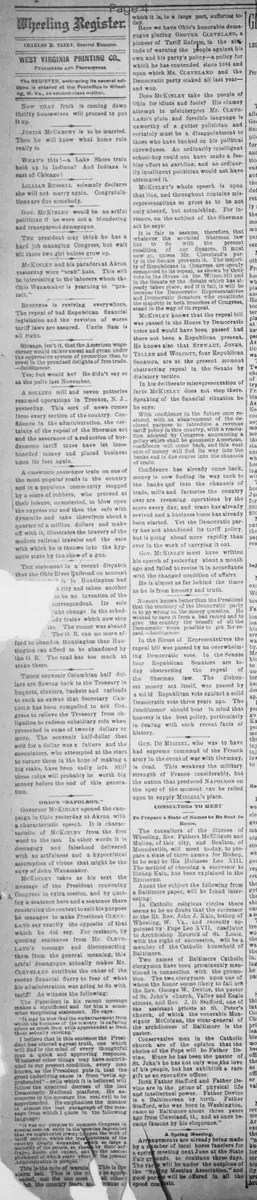
OHIO'S "NAPOLEON."
Governor McKinley opened the campaign in Ohio yesterday at Akron with characteristic speech. It is characteristic of McKinley from the first word to the last. In other words it is demagogy and falsehood delivered with an artfulness and a hypocritical assumption of virtue that might be the envy of John Wanamaker.
McKinley takes as his text the message of the President convening Congress in extra session, and by quoting a sentence here and a sentence there construing the context to suit his purpose he manages to make President Cleveland say exactly the opposite of that which he did say. For instance, by quoting sentences from Mr. Cleveland's message and disconnecting them from the general meaning, this artful demagogue actually makes Mr. Cleveland attribute the cause of the recent financial flurry to fear of what his administration was going to do with tariff! As witness the following:
The President in his recent message makes a significant and for him a somewhat surprising statement. He says:
"It may be true that the embarrassment from which the business of the country is suffering arises as much from evils apprehended as from those actually existing."
I believe that in this sentence the President has uttered a great truth, one which will find in the mind of every thoughtful man a quick and approving response.
Whatever other things may have contributed to our present condition, every man knows, as the President puts it, that the great underlying cause is from "evils apprehended"—evils which it is believed will follow the executed decrees of the last Democratic National platform. He announces in his message the real evil to be apprehended. He emphasizes the menace in almost the last paragraph of the message from which I quote in the following language:
"It was my purpose to summon Congress in special session early in the coming September that we might enter promptly upon the work of tariff reform, which the true interests of the country clearly demanded, and which so large a majority of the people, as shown by their suffrages, desire and expect, and the accomplishment of which every effort of the present Administration is pledged."
This is the note of warning. This is the alarm bell. This is the evil to be apprehended, and the one most feared by the country because all other evils apprehended.
Here we have Ohio's honorable demagogue placing Grover Cleveland, a pioneer of Tariff Reform, in the attitude of warning the people against his own and his party's policy—a policy for which he has contended since 1884 and upon which Mr. Cleveland and the Democratic party staked all last year—and won.
Does McKinley take the people of Ohio for idiots and fools? His clumsy attempt to misinterpret Mr. Cleveland's plain and forcible language is unworthy of a gutter politician and certainly must be a disappointment to those who have banked on his political shrewdness. An ordinarily intelligent school-boy could not have made a feebler effort at garbling, and an ordinarily intelligent politician would not have attempted it.
McKinley's whole speech is upon that line, and throughout contains misrepresentations so gross as to be not only absurd, but astonishing. For instance, on the subject of the Sherman act he says:
It is fair to assume, therefore, that whatever the so-called Sherman law has to do with the present condition of our finances, it must now go, unless Mr. Cleveland's party in the Senate prevents it. The majority of Republicans in Congress are openly committed to its repeal, as shown by their vote in the House on the Wilson bill and in the Senate by the debate which has already taken place; and if it fail, it will be because the Democratic Representatives and Democratic Senators who constitute the majority in both branches of Congress stand in the way of its repeal.
McKinley knows that the repeal bill was passed in the House by Democratic votes and would have been passed had there not been a Republican present. He knows also that Stewart, Jones, Teller and Wolcott, four Republican Senators, are at the present moment obstructing repeal in the Senate by dilatory tactics.
In his deliberate misrepresentation of facts McKinley does not stop there. Speaking of the financial situation he says:
With confidence in the future once restored, with an abandonment of the declared purpose to introduce a revenue tariff policy in this country, with a resolution adopted by Congress announcing a policy which shall be genuinely American, confidence will come back, and this vast sum of money will find its way into the banks and in due course into the channels of trade.
Confidence has already come back, money is now finding its way back to the banks and into the channels of trade, mills and factories the country over are resuming operations by the score every day, and trade has already revived and a business boom has already been started. Yet the Democratic party has not abandoned its tariff policy but is going ahead more rapidly than ever in the work of carrying it out.
Gov. McKinley must have written his speech of yesterday about a month ago and failed to revise it in accordance with the changed condition of affairs. He is almost as far behind the times as he is from honesty and truth.
Nobody knows better than the President that the tendency of the Democratic party is to go wrong on the money question. He wished to save it from a bad record and to give the country the benefit of all the Democratic votes possible to get for repeal. —Intelligencer.
In the House of Representatives the repeal bill was passed by an overwhelming Democratic vote. In the Senate four Republican Senators are to-day obstructing the repeal of the Sherman law. The dishonest money act itself, was passed by a solid Republican vote against a solid Democratic vote three years ago. The Intelligencer should bear in mind that honesty is the best policy, particularly in dealing with such recent facts of history.
Governor McKinley opened the campaign in Ohio yesterday at Akron with characteristic speech. It is characteristic of McKinley from the first word to the last. In other words it is demagogy and falsehood delivered with an artfulness and a hypocritical assumption of virtue that might be the envy of John Wanamaker.
McKinley takes as his text the message of the President convening Congress in extra session, and by quoting a sentence here and a sentence there construing the context to suit his purpose he manages to make President Cleveland say exactly the opposite of that which he did say. For instance, by quoting sentences from Mr. Cleveland's message and disconnecting them from the general meaning, this artful demagogue actually makes Mr. Cleveland attribute the cause of the recent financial flurry to fear of what his administration was going to do with tariff! As witness the following:
The President in his recent message makes a significant and for him a somewhat surprising statement. He says:
"It may be true that the embarrassment from which the business of the country is suffering arises as much from evils apprehended as from those actually existing."
I believe that in this sentence the President has uttered a great truth, one which will find in the mind of every thoughtful man a quick and approving response.
Whatever other things may have contributed to our present condition, every man knows, as the President puts it, that the great underlying cause is from "evils apprehended"—evils which it is believed will follow the executed decrees of the last Democratic National platform. He announces in his message the real evil to be apprehended. He emphasizes the menace in almost the last paragraph of the message from which I quote in the following language:
"It was my purpose to summon Congress in special session early in the coming September that we might enter promptly upon the work of tariff reform, which the true interests of the country clearly demanded, and which so large a majority of the people, as shown by their suffrages, desire and expect, and the accomplishment of which every effort of the present Administration is pledged."
This is the note of warning. This is the alarm bell. This is the evil to be apprehended, and the one most feared by the country because all other evils apprehended.
Here we have Ohio's honorable demagogue placing Grover Cleveland, a pioneer of Tariff Reform, in the attitude of warning the people against his own and his party's policy—a policy for which he has contended since 1884 and upon which Mr. Cleveland and the Democratic party staked all last year—and won.
Does McKinley take the people of Ohio for idiots and fools? His clumsy attempt to misinterpret Mr. Cleveland's plain and forcible language is unworthy of a gutter politician and certainly must be a disappointment to those who have banked on his political shrewdness. An ordinarily intelligent school-boy could not have made a feebler effort at garbling, and an ordinarily intelligent politician would not have attempted it.
McKinley's whole speech is upon that line, and throughout contains misrepresentations so gross as to be not only absurd, but astonishing. For instance, on the subject of the Sherman act he says:
It is fair to assume, therefore, that whatever the so-called Sherman law has to do with the present condition of our finances, it must now go, unless Mr. Cleveland's party in the Senate prevents it. The majority of Republicans in Congress are openly committed to its repeal, as shown by their vote in the House on the Wilson bill and in the Senate by the debate which has already taken place; and if it fail, it will be because the Democratic Representatives and Democratic Senators who constitute the majority in both branches of Congress stand in the way of its repeal.
McKinley knows that the repeal bill was passed in the House by Democratic votes and would have been passed had there not been a Republican present. He knows also that Stewart, Jones, Teller and Wolcott, four Republican Senators, are at the present moment obstructing repeal in the Senate by dilatory tactics.
In his deliberate misrepresentation of facts McKinley does not stop there. Speaking of the financial situation he says:
With confidence in the future once restored, with an abandonment of the declared purpose to introduce a revenue tariff policy in this country, with a resolution adopted by Congress announcing a policy which shall be genuinely American, confidence will come back, and this vast sum of money will find its way into the banks and in due course into the channels of trade.
Confidence has already come back, money is now finding its way back to the banks and into the channels of trade, mills and factories the country over are resuming operations by the score every day, and trade has already revived and a business boom has already been started. Yet the Democratic party has not abandoned its tariff policy but is going ahead more rapidly than ever in the work of carrying it out.
Gov. McKinley must have written his speech of yesterday about a month ago and failed to revise it in accordance with the changed condition of affairs. He is almost as far behind the times as he is from honesty and truth.
Nobody knows better than the President that the tendency of the Democratic party is to go wrong on the money question. He wished to save it from a bad record and to give the country the benefit of all the Democratic votes possible to get for repeal. —Intelligencer.
In the House of Representatives the repeal bill was passed by an overwhelming Democratic vote. In the Senate four Republican Senators are to-day obstructing the repeal of the Sherman law. The dishonest money act itself, was passed by a solid Republican vote against a solid Democratic vote three years ago. The Intelligencer should bear in mind that honesty is the best policy, particularly in dealing with such recent facts of history.
What sub-type of article is it?
Partisan Politics
Economic Policy
Trade Or Commerce
What keywords are associated?
Mckinley Criticism
Tariff Reform
Sherman Act Repeal
Financial Panic
Democratic Policy
Republican Obstruction
Cleveland Message
What entities or persons were involved?
Governor Mckinley
President Cleveland
Democratic Party
Republican Senators (Stewart, Jones, Teller, Wolcott)
Sherman Act
Editorial Details
Primary Topic
Criticism Of Mckinley's Misrepresentation Of Cleveland's Tariff Reform Message And Financial Policies
Stance / Tone
Strongly Anti Mckinley And Pro Democratic Tariff Reform
Key Figures
Governor Mckinley
President Cleveland
Democratic Party
Republican Senators (Stewart, Jones, Teller, Wolcott)
Sherman Act
Key Arguments
Mckinley Misinterprets Cleveland's Message To Blame Democratic Tariff Policies For Financial Fears
Cleveland Supports Tariff Reform, Not Warns Against It
Repeal Of Sherman Act Passed House By Democratic Votes, Obstructed By Republicans In Senate
Financial Confidence Is Returning Despite Ongoing Democratic Tariff Policy
Mckinley's Speech Contains Gross Misrepresentations And Outdated Claims