Thank you for visiting SNEWPapers!
Sign up free
The Virginia Gazette
Williamsburg, Virginia
What is this article about?
The Ottoman Empire's manifesto, delivered to foreign ministers in Constantinople, accuses Russia of violating peace treaties through interference in Poland's election of King Poniatowski, troop deployments, and the massacre of over 1,000 Muslims at Balta, justifying the arrest of the Russian resident and a declaration of war.
Merged-components note: Continuation of the Grand Signior's Manifesto across pages, same topic and text flows directly.
Clippings
1 of 2
OCR Quality
Full Text
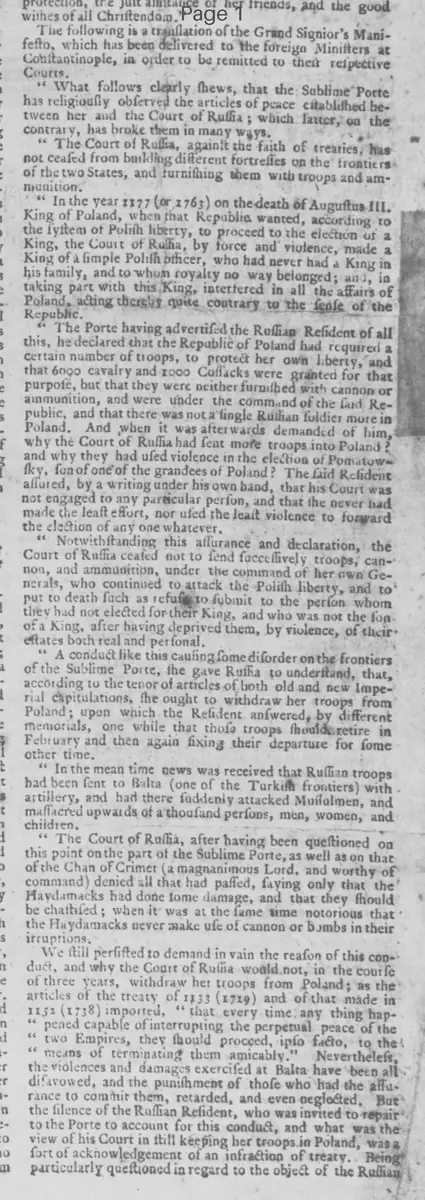
"What follows clearly shews, that the Sublime Porte has religiously observed the articles of peace established between her and the Court of Russia; which latter, on the contrary, has broke them in many ways.
"The Court of Russia, against the faith of treaties, has not ceased from building different fortresses on the frontiers of the two States, and furnishing them with troops and ammunition.
"In the year 1177 (or 1763) on the death of Augustus III. King of Poland, when that Republic wanted, according to the system of Polish liberty, to proceed to the election of a King, the Court of Russia, by force and violence, made a King of a simple Polish officer, who had never had a King in his family, and to whom royalty no way belonged; and, in taking part with this King, interfered in all the affairs of Poland, acting thereby quite contrary to the end of the Republic.
The Porte having advertised the Russian Resident of all this, he declared that the Republic of Poland had required a certain number of troops, to protect her own liberty, and that 6000 cavalry and 1000 Cossacks were granted for that purpose, but that they were neither furnished with cannon or ammunition, and were under the command of the said Republic, and that there was not a single Russian soldier more in Poland. And when it was afterwards demanded of him, why the Court of Russia had sent more troops into Poland? and why they had used violence in the election of Poniatowski, one of the grandees of Poland? The said Resident assured, by a writing under his own hand, that his Court was not engaged to any particular person, and that they never had made the least effort, nor used the least violence to forward the election of any one whatever.
"Notwithstanding this assurance and declaration, the Court of Russia ceased not to send successively troops, cannon, and ammunition, under the command of her own Generals, who continued to attack the Polish liberty, and to put to death such as refused to submit to the person whom they had not elected for their King, and who was not the son of a King, after having deprived them, by violence, of their estates both real and personal.
"A conduct like this causing some disorder on the frontiers of the Sublime Porte, she gave Russia to understand, that, according to the tenor of articles of both old and new Imperial capitulations, she ought to withdraw her troops from Poland; upon which the Resident answered, by different memorials, one while that those troops should retire in February and then again fixing their departure for some other time.
"In the mean time news was received that Russian troops had been sent to Balta (one of the Turkish frontiers) with artillery, and had there suddenly attacked Mussulmen, and massacred upwards of a thousand persons, men, women, and children.
"The Court of Russia, after having been questioned on this point on the part of the Sublime Porte, as well as on that of the Chan of Crimea (a magnanimous Lord, and worthy of command) denied all that had passed, saying only that the Haydamacks had done some damage, and that they should be chastised: when it was at the same time notorious that the Haydamacks never make use of cannon or bombs in their irruptions.
We still persisted to demand in vain the reason of this conduct, and why the Court of Russia would not, in the course of three years, withdraw her troops from Poland; as the articles of the treaty of 1133 (1719) and of that made in 1152 (1739) imported, "that every time any thing happened capable of interrupting the perpetual peace of the two Empires, they should proceed, ipso facto, to the means of terminating them amicably." Nevertheless, the violences and damages exercised at Balta have been all disavowed, and the punishment of those who had the assurance to commit them, retarded, and even neglected. But the silence of the Russian Resident, who was invited to repair to the Porte to account for this conduct, and what was the view of his Court in still keeping her troops in Poland, was a sort of acknowledgement of an infraction of treaty. Being particularly questioned in regard to the object of the Russian
troops who remained in Poland, he could only answer that they would not depart till all the Poles had submitted to the King.
At length, it was finally demanded of the Russian Resident, whether, according to the old and new treaties between the two Empires, the Court of Russia would desist from meddling with the affairs of Poland, under the pretence of guaranty and promise? and he replied, that his powers were limited, and that he could give no answer upon this head, which was only known to his Court.
This manner of proceeding clearly demonstrating that the said power had thought proper to break the treaties, the illustrious Doctors of the Law have given by fetwas (or legal sentences) their opinion, importing, that the exigencies of rigorous justice made it necessary to declare war against the Muscovite; an opinion which has been unanimously confirmed: insomuch that the arrest of the Russian Resident became expedient.
By the present Manifesto, all the powers of Europe are informed, that, according to the ancient etiquette of the Sublime Porte, the said Resident must remain in the Castle of the Seven Towers; and that, during the whole time this affair has been in hand, the Sublime Porte has done nothing to break the good friendship with Russia, but, on the contrary, disguised her griefs and deferred her resentment for three years, out of regard for that Court, which alone has been guilty of the infraction of treaties, by the facts, herein before-mentioned."
What sub-type of article is it?
What keywords are associated?
What entities or persons were involved?
Where did it happen?
Foreign News Details
Primary Location
Poland
Key Persons
Outcome
massacre of upwards of a thousand mussulmen at balta; arrest of the russian resident and confinement in the castle of the seven towers; ottoman declaration of war against russia justified by treaty violations.
Event Details
The Ottoman manifesto details Russia's violations of peace treaties, including building fortresses on borders, forceful imposition of Poniatowski as King of Poland in 1763 against Polish liberty, continued troop deployments and violence in Poland, and the unprovoked massacre at Balta. Despite Ottoman protests and demands for troop withdrawal per treaties of 1719 and 1739, Russia denied involvement and delayed action, leading Ottoman legal scholars to endorse war and the arrest of the Russian resident.