Thank you for visiting SNEWPapers!
Sign up free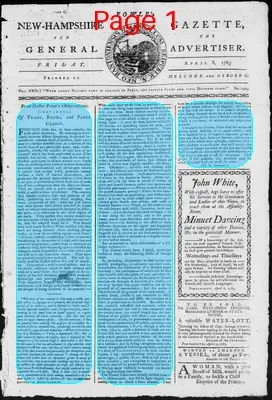
Literary
April 8, 1785
Fowle's New Hampshire Gazette And General Advertiser
Portsmouth, Rockingham County, New Hampshire
What is this article about?
Excerpt from Dr. Price's essay critiquing foreign trade's risks for American States, advocating internal focus, agriculture over commerce, and cautioning against paper credit and banks leading to economic bubbles and corruption. Contrasts with Britain's situation and promotes universal benevolence over narrow patriotism.
Clipping
OCR Quality
95%
Excellent
Full Text
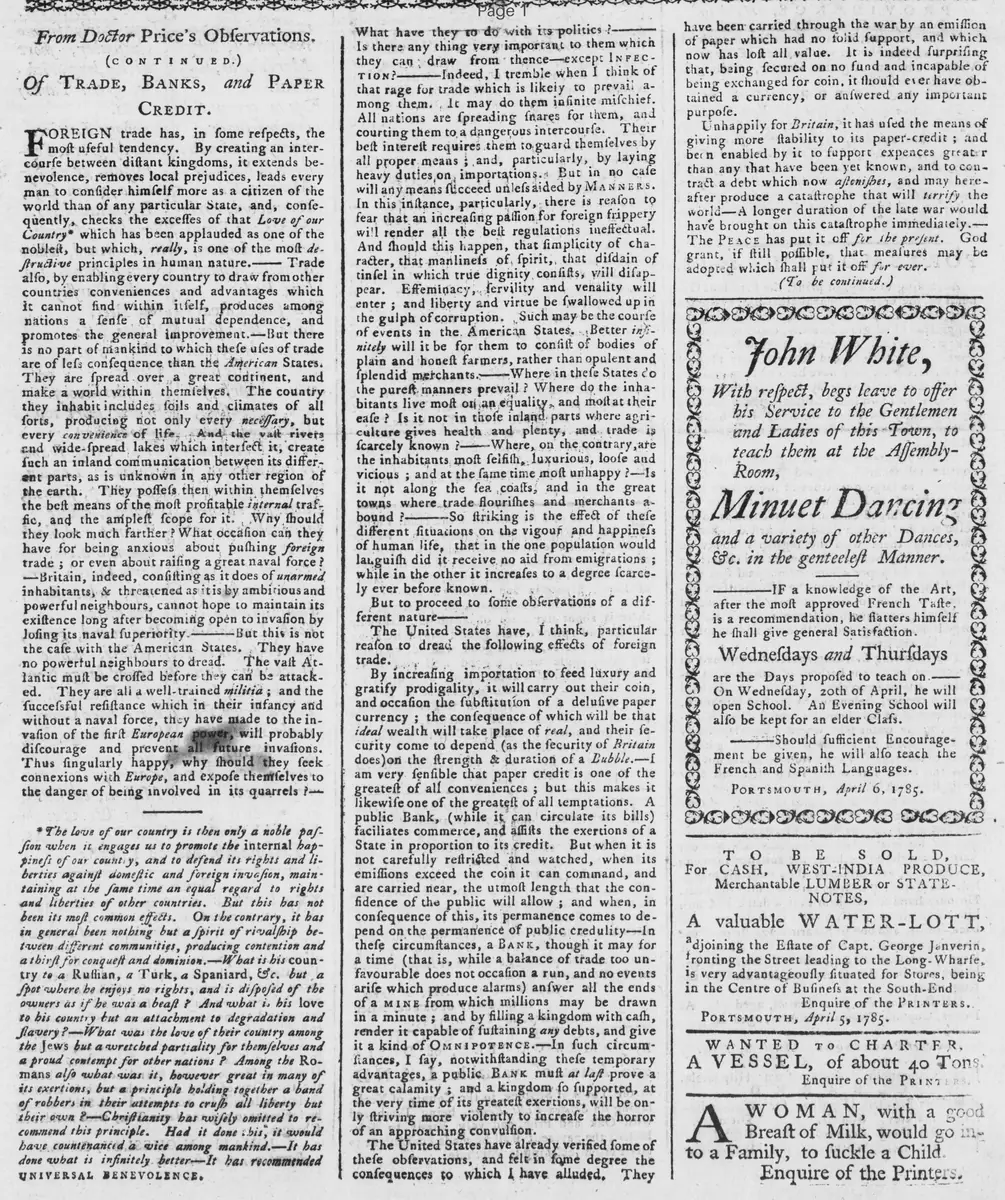
From Doctor Price's Observations.
(CONTINUED.)
Of TRADE, BANKS, and PAPER CREDIT.
FOREIGN trade has, in some respects, the most useful tendency. By creating an intercourse between distant kingdoms, it extends benevolence, removes local prejudices, leads every man to consider himself more as a citizen of the world than of any particular State, and, consequently, checks the excess of that Love of our Country* which has been applauded as one of the noblest, but which, really, is one of the most destructive principles in human nature.--- Trade also, by enabling every country to draw from other countries conveniences and advantages which it cannot find within itself, produces among nations a sense of mutual dependence, and promotes the general improvement.--But there is no part of mankind to which these uses of trade are of less consequence than the American States. They are spread over a great continent, and make a world within themselves. The country they inhabit includes soils and climates of all sorts, producing not only every necessary, but every convenience of life; And the vast rivers and wide-spread lakes which intersect it, create such an inland communication between its different parts, as is unknown in any other region of the earth. They possess then within themselves the best means of the most profitable internal traffic, and the amplest scope for it. Why should they look much farther? What occasion can they have for being anxious about pushing foreign trade; or even about raising a great naval force? -Britain, indeed, consisting as it does of unarmed inhabitants, & threatened as it is by ambitious and powerful neighbours, cannot hope to maintain its existence long after becoming open to invasion by losing its naval superiority.--But this is not the case with the American States. They have no powerful neighbours to dread. The vast Atlantic must be crossed before they can be attacked. They are all a well-trained militia: and the successful resistance which in their infancy and without a naval force, they have made to the invasion of the first European power, will probably discourage and prevent all future invasions. Thus singularly happy, why should they seek connexions with Europe, and expose themselves to the danger of being involved in its quarrels?-
* The love of our country is then only a noble passion when it engages us to promote the internal happiness of our country, and to defend its rights and liberties against domestic and foreign invasion, maintaining at the same time an equal regard to rights and liberties of other countries. But this has not been its most common effects. On the contrary, it has in general been nothing but a spirit of rivalry between different communities, producing contention and a thirst for conquest and dominion.- What is his country to a Russian, a Turk, a Spaniard, &c. but a spot where he enjoys no rights, and is disposed of by the owners as if he was a beast? And what is his love to his country but an attachment to degradation and slavery?- What was the love of their country among the Jews but a wretched partiality for themselves and a proud contempt for other nations? Among the Romans also what was it, however great in many of its exertions, but a principle holding together a band of robbers in their attempts to crush all liberty but their own?--Christianity has wisely omitted to recommend this principle. Had it done this, it would have countenanced a vice among mankind.--It has done what is infinitely better--It has recommended UNIVERSAL BENEVOLENCE.
What have they to do with its politics - Is there any thing very important to them which they can draw from thence-except Infection?-Indeed. I tremble when I think of that rage for trade which is likely to prevail among them. It may do them infinite mischief. All nations are spreading snares for them, and courting them to a dangerous intercourse. Their best interest requires them to guard themselves by all proper means; and, particularly, by laying heavy duties on importations. But in no case will any means succeed unless aided by MANNERS. In this instance, particularly, there is reason to fear that an increasing passion for foreign frippery will render all the best regulations ineffectual. And should this happen, that simplicity of character, that manliness of spirit, that disdain of tinsel in which true dignity consists, will disappear. Effeminacy, servility and venality will enter; and liberty and virtue be swallowed up in the gulph of corruption. Such may be the course of events in the American States. Better infinitely will it be for them to consist of bodies of plain and honest farmers, rather than opulent and splendid merchants. -Where in these States do the pure manners prevail? Where do the inhabitants live most on an equality, and most at their ease? Is it not in those inland parts where agriculture gives health and plenty, and trade is scarcely known?-Where, on the contrary, are the inhabitants most effeminate, luxurious, loose and vicious; and at the same time most unhappy?--Is it not along the sea coasts, and in the great towns where trade flourishes and merchants abound?--So striking is the effect of these different situations on the vigour and happiness of human life. that in the one population would languish did it receive no aid from emigrations: while in the other it increases to a degree scarcely ever before known.
But to proceed to some observations of a different nature-
The United States have, I think, particular reason to dread the following effects of foreign trade. By increasing importation to feed luxury and gratify prodigality, it will carry out their coin, and occasion the substitution of a delusive paper currency; the consequence of which will be that ideal wealth will take place of real, and their security come to depend (as the security of Britain does) on the strength & duration of a Bubble.--I am very sensible that paper credit is one of the greatest of all conveniences; but this makes it likewise one of the greatest of all temptations. A public Bank, (while it can circulate its bills) facilitates commerce, and assists the exertions of a State in proportion to its credit. But when it is not carefully restricted and watched, when its emissions exceed the coin it can command, and are carried near the utmost length that the confidence of the public will allow: and when, in consequence of this, its permanence comes to depend on the permanence of public credulity--In these circumstances, a BANK, though it may for a time (that is, while a balance of trade too unfavourable does not occasion a run, and no events arise which produce alarms) answer all the ends of a Mine from which millions may be drawn in a minute; and by filling a kingdom with cash, render it capable of sustaining any debts, and give it a kind of OMNIPOTENCE.--In such circumstances, I say, notwithstanding these temporary advantages, a public Bank must at last prove a great calamity; and a kingdom so supported, at the very time of its greatest exertions, will be only striving more violently to increase the horror of an approaching convulsion.
The United States have already verified some of these observations, and felt in some degree the consequences to which I have alluded. They have been carried through the war by an emission of paper which had no solid support, and which now has lost all value. It is indeed surprising that, being secured on no fund and incapable of being exchanged for coin. it should ever have obtained a currency, or answered any important purpose.
Unhappily for Britain, it has used the means of giving more stability to its paper-credit; and been enabled by it to support expences greater than any that have been yet known, and to contract a debt which now astonishes, and may hereafter produce a catastrophe that will terrify the world--A longer duration of the late war would have brought on this catastrophe immediately.-- The Peace has put it off for the present. God grant, if still possible, that measures may be adopted which shall put it off for ever.
(To be continued.)
(CONTINUED.)
Of TRADE, BANKS, and PAPER CREDIT.
FOREIGN trade has, in some respects, the most useful tendency. By creating an intercourse between distant kingdoms, it extends benevolence, removes local prejudices, leads every man to consider himself more as a citizen of the world than of any particular State, and, consequently, checks the excess of that Love of our Country* which has been applauded as one of the noblest, but which, really, is one of the most destructive principles in human nature.--- Trade also, by enabling every country to draw from other countries conveniences and advantages which it cannot find within itself, produces among nations a sense of mutual dependence, and promotes the general improvement.--But there is no part of mankind to which these uses of trade are of less consequence than the American States. They are spread over a great continent, and make a world within themselves. The country they inhabit includes soils and climates of all sorts, producing not only every necessary, but every convenience of life; And the vast rivers and wide-spread lakes which intersect it, create such an inland communication between its different parts, as is unknown in any other region of the earth. They possess then within themselves the best means of the most profitable internal traffic, and the amplest scope for it. Why should they look much farther? What occasion can they have for being anxious about pushing foreign trade; or even about raising a great naval force? -Britain, indeed, consisting as it does of unarmed inhabitants, & threatened as it is by ambitious and powerful neighbours, cannot hope to maintain its existence long after becoming open to invasion by losing its naval superiority.--But this is not the case with the American States. They have no powerful neighbours to dread. The vast Atlantic must be crossed before they can be attacked. They are all a well-trained militia: and the successful resistance which in their infancy and without a naval force, they have made to the invasion of the first European power, will probably discourage and prevent all future invasions. Thus singularly happy, why should they seek connexions with Europe, and expose themselves to the danger of being involved in its quarrels?-
* The love of our country is then only a noble passion when it engages us to promote the internal happiness of our country, and to defend its rights and liberties against domestic and foreign invasion, maintaining at the same time an equal regard to rights and liberties of other countries. But this has not been its most common effects. On the contrary, it has in general been nothing but a spirit of rivalry between different communities, producing contention and a thirst for conquest and dominion.- What is his country to a Russian, a Turk, a Spaniard, &c. but a spot where he enjoys no rights, and is disposed of by the owners as if he was a beast? And what is his love to his country but an attachment to degradation and slavery?- What was the love of their country among the Jews but a wretched partiality for themselves and a proud contempt for other nations? Among the Romans also what was it, however great in many of its exertions, but a principle holding together a band of robbers in their attempts to crush all liberty but their own?--Christianity has wisely omitted to recommend this principle. Had it done this, it would have countenanced a vice among mankind.--It has done what is infinitely better--It has recommended UNIVERSAL BENEVOLENCE.
What have they to do with its politics - Is there any thing very important to them which they can draw from thence-except Infection?-Indeed. I tremble when I think of that rage for trade which is likely to prevail among them. It may do them infinite mischief. All nations are spreading snares for them, and courting them to a dangerous intercourse. Their best interest requires them to guard themselves by all proper means; and, particularly, by laying heavy duties on importations. But in no case will any means succeed unless aided by MANNERS. In this instance, particularly, there is reason to fear that an increasing passion for foreign frippery will render all the best regulations ineffectual. And should this happen, that simplicity of character, that manliness of spirit, that disdain of tinsel in which true dignity consists, will disappear. Effeminacy, servility and venality will enter; and liberty and virtue be swallowed up in the gulph of corruption. Such may be the course of events in the American States. Better infinitely will it be for them to consist of bodies of plain and honest farmers, rather than opulent and splendid merchants. -Where in these States do the pure manners prevail? Where do the inhabitants live most on an equality, and most at their ease? Is it not in those inland parts where agriculture gives health and plenty, and trade is scarcely known?-Where, on the contrary, are the inhabitants most effeminate, luxurious, loose and vicious; and at the same time most unhappy?--Is it not along the sea coasts, and in the great towns where trade flourishes and merchants abound?--So striking is the effect of these different situations on the vigour and happiness of human life. that in the one population would languish did it receive no aid from emigrations: while in the other it increases to a degree scarcely ever before known.
But to proceed to some observations of a different nature-
The United States have, I think, particular reason to dread the following effects of foreign trade. By increasing importation to feed luxury and gratify prodigality, it will carry out their coin, and occasion the substitution of a delusive paper currency; the consequence of which will be that ideal wealth will take place of real, and their security come to depend (as the security of Britain does) on the strength & duration of a Bubble.--I am very sensible that paper credit is one of the greatest of all conveniences; but this makes it likewise one of the greatest of all temptations. A public Bank, (while it can circulate its bills) facilitates commerce, and assists the exertions of a State in proportion to its credit. But when it is not carefully restricted and watched, when its emissions exceed the coin it can command, and are carried near the utmost length that the confidence of the public will allow: and when, in consequence of this, its permanence comes to depend on the permanence of public credulity--In these circumstances, a BANK, though it may for a time (that is, while a balance of trade too unfavourable does not occasion a run, and no events arise which produce alarms) answer all the ends of a Mine from which millions may be drawn in a minute; and by filling a kingdom with cash, render it capable of sustaining any debts, and give it a kind of OMNIPOTENCE.--In such circumstances, I say, notwithstanding these temporary advantages, a public Bank must at last prove a great calamity; and a kingdom so supported, at the very time of its greatest exertions, will be only striving more violently to increase the horror of an approaching convulsion.
The United States have already verified some of these observations, and felt in some degree the consequences to which I have alluded. They have been carried through the war by an emission of paper which had no solid support, and which now has lost all value. It is indeed surprising that, being secured on no fund and incapable of being exchanged for coin. it should ever have obtained a currency, or answered any important purpose.
Unhappily for Britain, it has used the means of giving more stability to its paper-credit; and been enabled by it to support expences greater than any that have been yet known, and to contract a debt which now astonishes, and may hereafter produce a catastrophe that will terrify the world--A longer duration of the late war would have brought on this catastrophe immediately.-- The Peace has put it off for the present. God grant, if still possible, that measures may be adopted which shall put it off for ever.
(To be continued.)
What sub-type of article is it?
Essay
What themes does it cover?
Political
Commerce Trade
Liberty Freedom
What keywords are associated?
Foreign Trade
American States
Paper Credit
Universal Benevolence
Patriotism Critique
Banks Dangers
Agriculture Virtue
Economic Bubble
What entities or persons were involved?
From Doctor Price's Observations.
Literary Details
Title
Of Trade, Banks, And Paper Credit.
Author
From Doctor Price's Observations.
Key Lines
The Love Of Our Country Is Then Only A Noble Passion When It Engages Us To Promote The Internal Happiness Of Our Country, And To Defend Its Rights And Liberties Against Domestic And Foreign Invasion, Maintaining At The Same Time An Equal Regard To Rights And Liberties Of Other Countries.
Christianity Has Wisely Omitted To Recommend This Principle. Had It Done This, It Would Have Countenanced A Vice Among Mankind. It Has Done What Is Infinitely Better It Has Recommended Universal Benevolence.
Better Infinitely Will It Be For Them To Consist Of Bodies Of Plain And Honest Farmers, Rather Than Opulent And Splendid Merchants.
A Public Bank Must At Last Prove A Great Calamity; And A Kingdom So Supported, At The Very Time Of Its Greatest Exertions, Will Be Only Striving More Violently To Increase The Horror Of An Approaching Convulsion.
God Grant, If Still Possible, That Measures May Be Adopted Which Shall Put It Off For Ever.