Thank you for visiting SNEWPapers!
Sign up free
Editorial
May 7, 1862
Democrat And Sentinel
Ebensburg, Cambria County, Pennsylvania
What is this article about?
The Democrat and Sentinel editorial defends its criticism of the Pennsylvania Railroad Company for corruptly securing the repeal of the tonnage tax, arguing the company should pay its fair share amid wartime taxation burdens on the people. It refutes charges of hostility and calls for restoring the tax.
Clipping
OCR Quality
72%
Good
Full Text
Democrat and Sentinel.
J. D. Murragh, Editor.
James S. Todd, Publisher.
TUESDAY MAY 7, 1862.
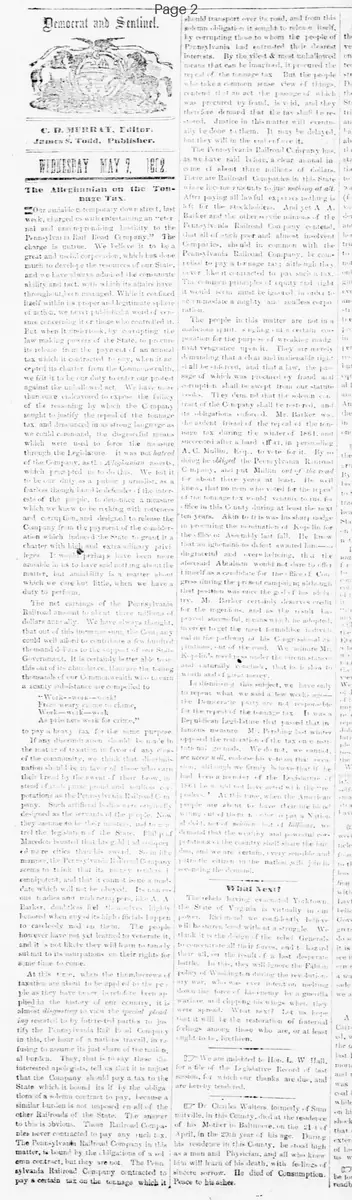
The Alleganian on the Tonnage Tax.
Our amiable contemporary down street, last week, charged us with entertaining 'utter and unprovoking hostility to the Pennsylvania Rail Road Company.' The charge is untrue. We believe it to be a great and useful corporation, which has done much to develop the resources of our State, and we have always admired the consummate ability and tact, with which its affairs have through fifteen years managed. While it confined itself within its proper and legitimate sphere of action, whenever published word of censure concerning it those who controlled it. But when it undertook by corrupting the lawmaking power of the State, to place its release from the payment of an annual tax which it contracted to pay, when it accepted its charter from the Commonwealth, we felt it to be our duty to enter our protest against the unallowed act. We have more than once endeavored to expose the fallacy of the reasoning by which the Company sought to justify the repeal of the tonnage tax and denounced it as strong language as we could command, the disgraceful means which were used to force the measure through the Legislature. It was not hatred of the Company, as the Alleganian asserts, which prompted us to do this. We felt it to be our duty as a public journalist, as a fearless though humble defender of the interests of the people, to denounce a measure which we knew to be reeking with rottenness and corruption, and designed to release the Company from the payment of the consideration which induced the State to grant it a charter with high and extraordinary privileges. It would perhaps have been more amiable to us to have said nothing about the matter, but amiability is a matter about which we care but little, when we have a duty to perform.
The net earnings of the Pennsylvania Railroad amount to about three millions of dollars annually. We have always thought, that out of this immense sum, the Company could well afford to contribute a few hundred thousand dollars to the support of our State Government. It is certainly by far better able to do this out of its abundance, than are the thousands of our Commonwealth who to gain a scanty subsistence are compelled to 'Work--Work--work! From weary chime to chime, Work-mad-work As prize lets work for crime.' to pay a heavy tax for the same purpose. If any discrimination in the matter of taxation in favor of any class of the community, we think that discrimination should be in favor of those who earn their bread by the sweat of their brow, in stead of such purse proud and soulless corporations as the Pennsylvania Railroad Company. Such artificial idols were never designed as the servants of the people. Now they assume to be their masters, and to lord it over the legislation of the State. Phil Macken boasted that his gold had conquered more cities than his sword. In somewhat similar manner, the Pennsylvania Railroad Company seems to think that its money renders it omnipotent, and that it cannot issue a mandate which will not be obeyed. Numerous ladies and gentlemen of the A. A. Barker, doubtless felt themselves highly honored when any of its high officials deigned to call on them. The people however have not yet learned to venerate it, and it is not likely they will learn to tamely submit to its usurpations on their rights for some time to come.
At this time, when the thumbscrews of taxation are about to be applied to the people as they have never before been in the history of our country, it is almost disgusting to view the special pleading resorted to by interested parties to justify the Pennsylvania Rail Road Company in this, the hour of a national travail, in refusing to assume its just share of the national burden. They, that is to say these dis interested apologists, tell us that it is unjust that the Company should pay a tax to the State which it bound itself by the obligations of a solemn contract to pay, because a similar burden is not imposed on all of the other Railroads of the State. The answer to this is obvious. Those Railroad Companies never contracted to pay any such tax. The Pennsylvania Railroad Company in this matter, is bound by the obligations of a solemn contract, but they are not. The Pennsylvania Railroad Company contracted to pay a certain tax on the tonnage which it should transport over its road, and from this solemn obligation it sought to release itself, by corrupting those to whom the people of Pennsylvania had entrusted their dearest interests. By the vilest and most unallowed means that can be imagined, it procured the repeal of the tonnage tax. But the people will take a common sense view of things, contend that an act procured by fraud, is void, and they therefore demand that the tax shall be restored. Justice in this matter will eventually be done to them. It may be delayed, but they will in the end enforce it.
The Pennsylvania Railroad Company has, as we have said before, a clear annual income of about three millions of dollars. There are Railroad Companies in this State whose income amounts to less than nothing at all. After paying all lawful expenses nothing is left for the stockholders, and set A. A. Barker and the other servile minions of the Pennsylvania Railroad Company contend, that all of such poor and almost insolvent Companies, should in common with the Pennsylvania Railroad Company, be contracted to pay a tonnage tax; although these never their contracted to pay such a tax. The common principles of equity and right it would seem must be ignored under to emulate a mighty and soulless corporation.
The people in this matter are not in a factious spirit, seeking uncertain conjuration for the purpose of wreaking malignant vengeance upon it. They are merely demanding that a dear inalienable right shall be enforced, and that a law, the passage of which was procured by fraud and corruption shall be swept from our statute books. They demand that the solemn contract of the Company shall be restored, and its obligations enforced. Mr. Barker was the ardent friend of the repeal of the tonnage tax during the winter of last, and succeeded after a hard fight, in prevailing A. C. Mullin, Esq. to vote for it. By doing he obliged the Pennsylvania Railroad Company, and put Mullin out at the road for about three years at least. He well knew, that no man who voted for the repeal of the tonnage tax would venture to run for office in this County during at least the next ten years. Akin to this was his shabby doing in pressing the nomination of Koge for the office of Assembly last fall. He knew that an ignominious and defeat awaited him disgraceful and overwhelming, that the aforesaid Abraham would not dare to offer himself as a candidate for the office of Congress during the next campaign; although that position was once the glittering prize. M. Barker certainly deserves credit for the ingenious, and as the result last, successful, means with he adopted to get the too formidable rival in the pathway of his Congressional aspirations, out of the road. We admire Mr. Koge's meekness much the more it he stoat that his slate to wrath and fight! never.
In dismissing this subject, we have only to repeat what we said a few weeks ago—the Democratic party are not responsible for the repeal of the tonnage tax. It was Republican Legislature that passed that infamous measure. Mr. Pershing last winter opposed the repeal of the tax on real estate. Without, we candidly, ever heard to our knowledge, so strong although we firmly in favor that it be re-enacted the next session of the Legislature. In these times, when the people are about to have their ue bio wanguftinIqr 'lataNitd aldeit.wtd mill httbillias. we demand that the wealthy and the actual corporations of the country shall share the ih den, and we are certain, very sensible and patriotic citizens in the nation will join in sending the demand.
J. D. Murragh, Editor.
James S. Todd, Publisher.
TUESDAY MAY 7, 1862.
The Alleganian on the Tonnage Tax.
Our amiable contemporary down street, last week, charged us with entertaining 'utter and unprovoking hostility to the Pennsylvania Rail Road Company.' The charge is untrue. We believe it to be a great and useful corporation, which has done much to develop the resources of our State, and we have always admired the consummate ability and tact, with which its affairs have through fifteen years managed. While it confined itself within its proper and legitimate sphere of action, whenever published word of censure concerning it those who controlled it. But when it undertook by corrupting the lawmaking power of the State, to place its release from the payment of an annual tax which it contracted to pay, when it accepted its charter from the Commonwealth, we felt it to be our duty to enter our protest against the unallowed act. We have more than once endeavored to expose the fallacy of the reasoning by which the Company sought to justify the repeal of the tonnage tax and denounced it as strong language as we could command, the disgraceful means which were used to force the measure through the Legislature. It was not hatred of the Company, as the Alleganian asserts, which prompted us to do this. We felt it to be our duty as a public journalist, as a fearless though humble defender of the interests of the people, to denounce a measure which we knew to be reeking with rottenness and corruption, and designed to release the Company from the payment of the consideration which induced the State to grant it a charter with high and extraordinary privileges. It would perhaps have been more amiable to us to have said nothing about the matter, but amiability is a matter about which we care but little, when we have a duty to perform.
The net earnings of the Pennsylvania Railroad amount to about three millions of dollars annually. We have always thought, that out of this immense sum, the Company could well afford to contribute a few hundred thousand dollars to the support of our State Government. It is certainly by far better able to do this out of its abundance, than are the thousands of our Commonwealth who to gain a scanty subsistence are compelled to 'Work--Work--work! From weary chime to chime, Work-mad-work As prize lets work for crime.' to pay a heavy tax for the same purpose. If any discrimination in the matter of taxation in favor of any class of the community, we think that discrimination should be in favor of those who earn their bread by the sweat of their brow, in stead of such purse proud and soulless corporations as the Pennsylvania Railroad Company. Such artificial idols were never designed as the servants of the people. Now they assume to be their masters, and to lord it over the legislation of the State. Phil Macken boasted that his gold had conquered more cities than his sword. In somewhat similar manner, the Pennsylvania Railroad Company seems to think that its money renders it omnipotent, and that it cannot issue a mandate which will not be obeyed. Numerous ladies and gentlemen of the A. A. Barker, doubtless felt themselves highly honored when any of its high officials deigned to call on them. The people however have not yet learned to venerate it, and it is not likely they will learn to tamely submit to its usurpations on their rights for some time to come.
At this time, when the thumbscrews of taxation are about to be applied to the people as they have never before been in the history of our country, it is almost disgusting to view the special pleading resorted to by interested parties to justify the Pennsylvania Rail Road Company in this, the hour of a national travail, in refusing to assume its just share of the national burden. They, that is to say these dis interested apologists, tell us that it is unjust that the Company should pay a tax to the State which it bound itself by the obligations of a solemn contract to pay, because a similar burden is not imposed on all of the other Railroads of the State. The answer to this is obvious. Those Railroad Companies never contracted to pay any such tax. The Pennsylvania Railroad Company in this matter, is bound by the obligations of a solemn contract, but they are not. The Pennsylvania Railroad Company contracted to pay a certain tax on the tonnage which it should transport over its road, and from this solemn obligation it sought to release itself, by corrupting those to whom the people of Pennsylvania had entrusted their dearest interests. By the vilest and most unallowed means that can be imagined, it procured the repeal of the tonnage tax. But the people will take a common sense view of things, contend that an act procured by fraud, is void, and they therefore demand that the tax shall be restored. Justice in this matter will eventually be done to them. It may be delayed, but they will in the end enforce it.
The Pennsylvania Railroad Company has, as we have said before, a clear annual income of about three millions of dollars. There are Railroad Companies in this State whose income amounts to less than nothing at all. After paying all lawful expenses nothing is left for the stockholders, and set A. A. Barker and the other servile minions of the Pennsylvania Railroad Company contend, that all of such poor and almost insolvent Companies, should in common with the Pennsylvania Railroad Company, be contracted to pay a tonnage tax; although these never their contracted to pay such a tax. The common principles of equity and right it would seem must be ignored under to emulate a mighty and soulless corporation.
The people in this matter are not in a factious spirit, seeking uncertain conjuration for the purpose of wreaking malignant vengeance upon it. They are merely demanding that a dear inalienable right shall be enforced, and that a law, the passage of which was procured by fraud and corruption shall be swept from our statute books. They demand that the solemn contract of the Company shall be restored, and its obligations enforced. Mr. Barker was the ardent friend of the repeal of the tonnage tax during the winter of last, and succeeded after a hard fight, in prevailing A. C. Mullin, Esq. to vote for it. By doing he obliged the Pennsylvania Railroad Company, and put Mullin out at the road for about three years at least. He well knew, that no man who voted for the repeal of the tonnage tax would venture to run for office in this County during at least the next ten years. Akin to this was his shabby doing in pressing the nomination of Koge for the office of Assembly last fall. He knew that an ignominious and defeat awaited him disgraceful and overwhelming, that the aforesaid Abraham would not dare to offer himself as a candidate for the office of Congress during the next campaign; although that position was once the glittering prize. M. Barker certainly deserves credit for the ingenious, and as the result last, successful, means with he adopted to get the too formidable rival in the pathway of his Congressional aspirations, out of the road. We admire Mr. Koge's meekness much the more it he stoat that his slate to wrath and fight! never.
In dismissing this subject, we have only to repeat what we said a few weeks ago—the Democratic party are not responsible for the repeal of the tonnage tax. It was Republican Legislature that passed that infamous measure. Mr. Pershing last winter opposed the repeal of the tax on real estate. Without, we candidly, ever heard to our knowledge, so strong although we firmly in favor that it be re-enacted the next session of the Legislature. In these times, when the people are about to have their ue bio wanguftinIqr 'lataNitd aldeit.wtd mill httbillias. we demand that the wealthy and the actual corporations of the country shall share the ih den, and we are certain, very sensible and patriotic citizens in the nation will join in sending the demand.
What sub-type of article is it?
Taxation
Economic Policy
Partisan Politics
What keywords are associated?
Tonnage Tax
Pennsylvania Railroad
Tax Repeal
Corruption
Legislature
War Taxation
Democratic Party
What entities or persons were involved?
Pennsylvania Railroad Company
Alleganian
A. A. Barker
A. C. Mullin
Koge
M. Barker
Mr. Pershing
Editorial Details
Primary Topic
Opposition To Repeal Of Pennsylvania Railroad Tonnage Tax
Stance / Tone
Strongly Critical Of Corruption And Supportive Of Tax Restoration
Key Figures
Pennsylvania Railroad Company
Alleganian
A. A. Barker
A. C. Mullin
Koge
M. Barker
Mr. Pershing
Key Arguments
The Company Corruptly Influenced The Legislature To Repeal The Tonnage Tax It Contracted To Pay.
The Railroad's Annual Earnings Of Three Million Dollars Allow It To Afford The Tax Unlike Struggling Citizens.
Tax Discrimination Should Favor Working People Over Wealthy Corporations.
Acts Procured By Fraud Are Void; The Tax Must Be Restored.
Democratic Party Not Responsible; Republican Legislature Passed The Repeal.
People Demand Enforcement Of The Original Contract Amid Wartime Burdens.