Thank you for visiting SNEWPapers!
Sign up free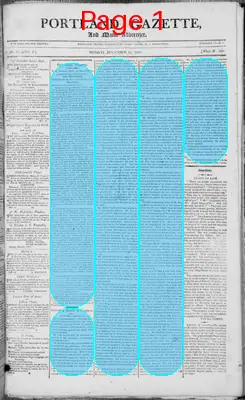
Portland Gazette, And Maine Advertiser
Portland, Cumberland County, Maine
What is this article about?
Merchants and traders from Philadelphia submitted a memorial to Congress urging repeal of the April 1806 non-importation act against Britain, citing commercial concerns amid negotiations and the Chesapeake incident. In a heated House debate on November 27, the petition was presented by Mr. J. Clay but ordered to lie on the table after motions to refer it failed.
Merged-components note: These components together form a complete report on the Philadelphia merchants' memorial and the congressional debate regarding the non-importation act.
Clipping
OCR Quality
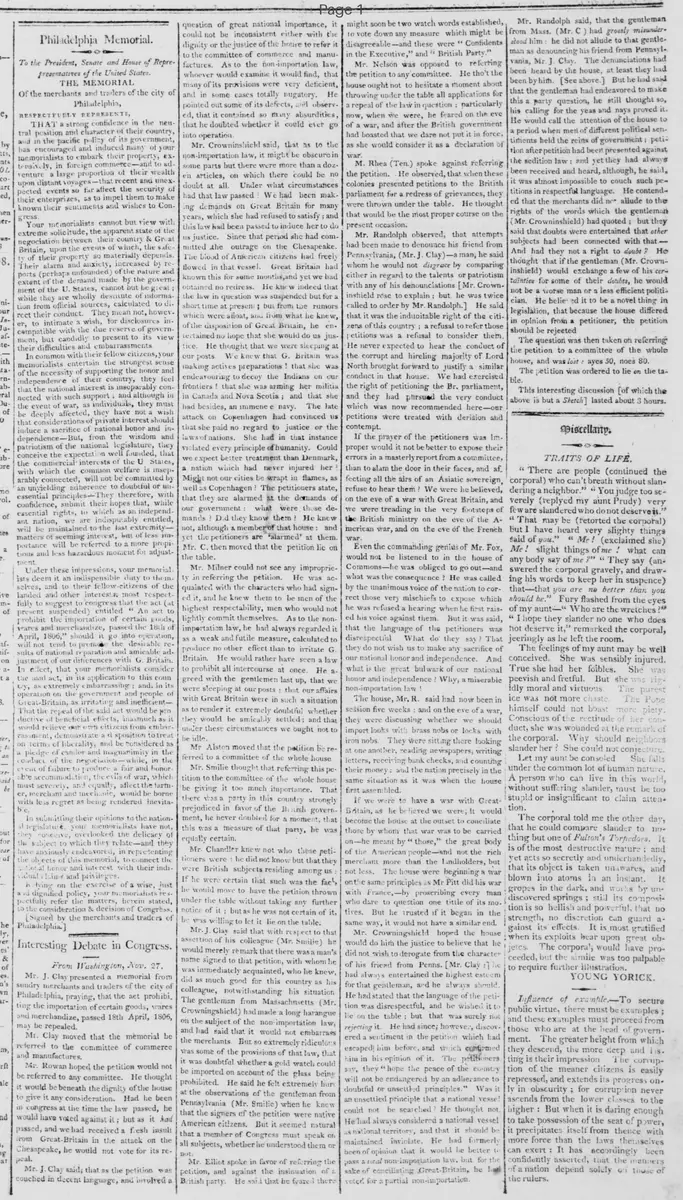
Full Text
To the President, Senate and House of Representatives of the United States.
THE MEMORIAL
Of the merchants and traders of the city of Philadelphia,
RESPECTFULLY REPRESENTS,
THAT a strong confidence in the neutral position and character of their country, and in the pacific policy of its government, has encouraged and induced many of your memorialists to embark their property, extensively, in foreign commerce—and to adventure a large proportion of their wealth upon distant voyages—that recent and unexpected events so far affect the security of their enterprizes, as to impel them to make known their sentiments and wishes to Congress.
Your memorialists cannot but view with extreme solicitude, the apparent state of the negociation between their country & Great Britain. upon the events of which, the safety of their property so materially depends.
Their alarm and anxiety, increased by reports (perhaps unfounded) of the nature and extent of the demand made by the government of the U. States, cannot but be great; while they are wholly destitute of information from official sources, calculated to direct their conduct. They mean not, however, to intimate a wish, for disclosures incompatible with the due reserve of government, but candidly to present to its view their difficulties and embarrassments
In common with their fellow citizens, your memorialists entertain the strongest sense of the necessity of supporting the honor and independence of their country, they feel that the national interest is inseparably connected with such support; and although in the event of war, as individuals, they must be deeply affected, they have not a wish that considerations of private interest should induce a sacrifice of national honor and independence—But, from the wisdom and patriotism of the national legislature, they conceive the expectation well founded, that the commercial interests of the U States, with which the common welfare is inseparably connected, will not be committed by an unyielding adherence to doubtful or unessential principles—They therefore, with confidence, submit their hopes that, while essential rights, to which as an independent nation, we are indisputably entitled, will be maintained to the last extremity—matters of seeming interest, but of less importance will be referred to a more propitious and less hazardous moment for adjustment
Under these impressions, your memorialists deem it an indispensible duty to themselves, and to their fellow-citizens of the landed and other interests. most respectfully to suggest to congress that the act (at present suspended) entitled "An act to prohibit the importation of certain goods, wares and merchandize, passed the 18th of April, 1806," should it go into operation, will not tend to promote the desirable results of national reparation and amicable adjustment of our differences with G. Britain.
In effect, that your memorialists consider the said act, in its application to this country, as extremely embarrassing; and, in its operation on the government and people of Great-Britain, as irritating and inefficient—That the repeal of the said act would be productive of beneficial effects, inasmuch as it would relieve our own citizens from embarrassment, demonstrate a disposition to treat on terms of liberality, and be considered as a pledge of candor and magnanimity in the conduct of the negociation—while, in the event of failure to produce a fair and honorable accommodation, the evils of war, which must severely, and equally, affect the farmer, merchant and mechanic, would be borne with less regret as being rendered inevitable.
In submitting their opinions to the national legislature, your memorialists have not, they observe, overlooked the delicacy of the subject to which they relate—and they have anxiously endeavored, in representing the objects of this memorial, to connect the total honor and interest with their individual claims and privileges.
Relying on the exercise of a wise, just and dignified policy, your memorialists respectfully refer the matters, herein stated, to the consideration & decision of Congress.
(signed by the merchants and traders of Philadelphia
Interesting Debate in Congress.
From Washington, Nov. 27.
Mr. J. Clay presented a memorial from sundry merchants and traders of the city of Philadelphia, praying, that the act prohibiting the importation of certain goods, wares and merchandize, passed 18th April, 1806, may be repealed.
Mr. Clay moved that the memorial be referred to the committee of commerce and manufactures.
Mr. Rowan hoped the petition would not be referred to any committee. He thought it would be beneath the dignity of the house to give it any consideration. Had he been in congress at the time the law passed, he would have voted against it; but as it had passed, and we had received a fresh insult from Great-Britain in the attack on the Chesapeake, he would not vote for its repeal.
Mr. J. Clay said; that as the petition was couched in decent language, and involved a question of great national importance, it could not be inconsistent either with the dignity or the justice of the house to refer it to the committee of commerce and manufactures. As to the non-importation law, whoever would examine it would find, that many of its provisions were very deficient, and in some cases totally nugatory. He pointed out some of its defects, and observed, that it contained so many absurdities. that he doubted whether it could ever go into operation
Mr. Crowninshield said, that as to the non-importation law, it might be obscure in some parts but there were more than a dozen articles, on which there could be no doubt at all. Under what circumstances had that law passed? We had been making demands on Great Britain for many years, which she had refused to satisfy; and this law had been passed to induce her to do us justice. Since that period she had committed the outrage on the Chesapeake.
The blood of American citizens had freely flowed in that vessel. Great Britain had known this for some months, and yet we had obtained no redress. He knew indeed that the law in question was suspended but for a short time at present; but from the rumors which were afloat, and from what he knew, of the disposition of Great Britain, he entertained no hope that she would do us justice. He thought that we were sleeping at our posts. We knew that G. Britain was making active preparations! that she was endeavouring to decoy the Indians on our frontiers! that she was arming her militia in Canada and Nova Scotia; and that she had besides, an immense navy. The late attack on Copenhagen had convinced us that she paid no regard to justice or the laws of nations. She had in that instance violated every principle of humanity. Could we expect better treatment than Denmark, a nation which had never injured her
Might not our cities be wrapt in flames, as well as Copenhagen? The petitioners state, that they are alarmed at the demands of our government: what were those demands? Did they know them? He knew not, although a member of that house: and yet the petitioners are alarmed at them.
Mr. C. then moved that the petition lie on the table.
Mr. Milner could not see any impropriety in referring the petition. He was acquainted with the characters who had signed it, and he knew them to be men of the highest respectability, men who would not lightly commit themselves. As to the non-importation law, he had always regarded it as a weak and futile measure, calculated to produce no other effect than to irritate G. Britain. He would rather have seen a law to prohibit all intercourse at once. He agreed with the gentlemen last up, that we were sleeping at our posts; that our affairs with Great Britain were in such a situation as to render it extremely doubtful whether they would be amicably settled; and that under these circumstances we ought not to be idle.
Mr Aiston moved that the petition be referred to a committee of the whole house
Mr. Smilie thought that referring this petition to the committee of the whole house be giving it too much importance. That there was a party in this country strongly prejudiced in favor of the British government, he never doubted for a moment, that this was a measure of that party, he was equally certain.
Mr. Chandler knew not who these petitioners were: he did not know but that they were British subjects residing among us:
If he were certain that such was the fact he would move to have the petition thrown under the table without taking any further notice of it; but as he was not certain of it, he was willing to let it lie on the table.
Mr. J. Clay said that with respect to that assertion of his colleague (Mr. Smilie) he would merely remark that there was a man's name signed to that petition, with whom he was immediately acquainted, who he knew, did as much good for this country as his colleague, notwithstanding his situation
The gentleman from Massachusetts (Mr. Crowninshield) had made a long harangue on the subject of the non-importation law and had said that it would not embarrass the merchants. But so extremely ridiculous was some of the provisions of that law, that it was doubtful whether a gold watch could be imported on account of the glass being prohibited. He said he felt extremely hurt at the observations of the gentleman from Pennsylvania (Mr. Smilie) when he knew that the signers of the petition were native American citizens. But it seemed natural that a member of Congress must speak on all subjects, whether he understood them or not.
Mr. Elliot spoke in favor of referring the petition, and against the insinuation of : British party. He said that he feared there might soon be two watch words established, to vote down any measure which might be disagreeable—and these were "Confidants in the Executive," and "British Party."
Mr. Nelson was opposed to referring the petition to any committee. He tho't the house ought not to hesitate a moment about throwing under the table all applications for a repeal of the law in question; particularly now, when we were, he feared on the eve of a war, and after the British government had boasted that we dare not put it in force, as she would consider it as a declaration of war.
Mr. Rhea (Ten.) spoke against referring the petition. He observed, that when these colonies presented petitions to the British parliament for a redress of grievances, they were thrown under the table. He thought that would be the most proper course on the present occasion.
Mr. Randolph observed, that attempts had been made to denounce his friend from Penn sylvania, (Mr. J. Clay)—a man, he said whom he would not disgrace by comparing either in regard to the talents or patriotism with any of his denouncers [Mr. Crowninshield rose to explain: but he was twice called to order by Mr. Randolph.] He said that it was the indubitable right of the citizens of this country; a refusal to refer those petitions was a refusal to consider them.
He never expected to hear the conduct of the corrupt and hireling majority of Lord North brought forward to justify a similar conduct in that house. We had exercised the right of petitioning the Br. parliament, and they had pursued the very conduct which was now recommended here—our petitions were treated with derision and contempt.
If the prayer of the petitioners was improper would it not be better to expose their errors in a masterly report from a committee, than to slam the door in their faces, and affecting all the airs of an Asiatic sovereign refuse to hear them? We were he believed, on the eve of a war with Great Britain, and we were treading in the very footsteps of the British ministry on the eve of the A-merican war, and on the eve of the French war.
Even the commanding genius of Mr. Fox, would not be listened to in the house of Commons—he was obliged to go out—and what was the consequence? He was called by the unanimous voice of the nation to cor-rect those very mischiefs to expose which he was refused a hearing when he first rais-ed his voice against them. But it was said. that the language of the petitioners was disrespectful What do they say? That they do not wish us to make any sacrifice of our national honor and independence. And what is the greatest bulwark of our national honor and independence? Why, a miserable non-importation law!
The house, Mr. R. said had now been in session five weeks; and on the eve of a war. they were discussing whether we should import locks with brass knobs or locks with iron knobs They were sitting there looking at one another, reading newspapers, writing letters, receiving bank checks, and counting their money: and the nation precisely in the same situation as it was when the house first assembled.
If we were to have a war with Great-Britain, as he believed we were, it would become the house at the outset to conciliate those by whom that war was to be carried on—he meant by "those," the great body of the American people—and not the rich merchant more than the landholders, but not less, The house were beginning a war on the same principles as Mr Pitt did his war with France, by proscribing every man who dare to question one tittle of its mo-tives. But he trusted if it began in the same way, it would not have a similar end.
Mr. Crowninshield hoped the house would do him the justice to believe that he did not wish to derogate from the character of his friend from Penns. [Mr. Clay:] he had always entertained the highest esteem for that gentleman, and he always should.
He had stated that the language of the peti-tion was disrespectful, and he wished it to lie on the table; but that was surely not rejecting it. He had since, however, discov-ered a sentiment in the petition which had escaped him before, and which confirmed him in his opinion of it. The petitioners say, they "hope the peace of the country will not be endangered by an adherence to doubtful or unsettled principles." Was it an unsettled principle that a national vessel could not be searched He thought not He had always considered a national vessel as national territory, and that it should be maintained inviolate, He had formerly been of opinion that it would be better to pass a total non-importation law, but for the sake of conciliating Great-Britain, he had voted for a partial non-importation.
Mr. Randolph said, that the gentleman from Mass. (Mr. C ) had grossly misunder-stood him: he did not allude to that gentle-man as denouncing his friend from Pennsyl-vania, Mr J. Clay. The denunciations had been heard by the house, at least they had been by him. [See above.] But he had said that the gentleman had endeavored to make this a party question, he still thought so, his calling for the yeas and nays proved it.
He would call the attention of the house to a period when men of different political sen-timents held the reins of government; peti-tion after petition had been presented against the sedition law; and yet they had always been received and heard, although, he said, it was almost impossible to couch such pe-titions in respectful language. He contend-ed that the merchants did not allude to the rights of the words which the gentleman (Mr. Crowninshield) had quoted; but they said that doubts were entertained that other subjects had been connected with that.—And had they not a right to doubt? He thought that if the gentleman (Mr. Crowninshield) would exchange a few of his cer-tainties for some of their doubts, he would not be a worse man or a less efficient politi-cian. He believed it to be a novel thing in legislation, that because the house differed in opinion from a petitioner, the petition should be rejected
The question was then taken on referring the petition to a committee of the whole house, and was lost: ayes 50. noes 80.
The petition was ordered to lie on the ta-ble.
This interesting discussion [of which the above is but a Sketch] lasted about 3 hours.
What sub-type of article is it?
What keywords are associated?
What entities or persons were involved?
Where did it happen?
Domestic News Details
Primary Location
Washington
Event Date
Nov. 27
Key Persons
Outcome
the petition was ordered to lie on the table after motions to refer it to committees failed (ayes 50, noes 80 on committee of the whole).
Event Details
Merchants from Philadelphia presented a memorial urging repeal of the 1806 non-importation act, arguing it embarrasses U.S. commerce and irritates Britain without aiding negotiations, especially after the Chesapeake attack. In House debate, supporters like Clay and Randolph advocated referral for consideration of commercial interests and national honor; opponents like Crowninshield and Smilie viewed it as undignified, pro-British, and untimely amid war threats, leading to tabling.