Thank you for visiting SNEWPapers!
Sign up free
The New Hampshire Gazette And Historical Chronicle
Portsmouth, Greenland, Rockingham County, New Hampshire
What is this article about?
Philalethes defends Mr. Sandiman's doctrines in 'Theron and Aspasio' against misrepresentations, quoting passages to demonstrate emphasis on faith producing love and good works, affirmation of sacraments, Sabbath, and Holy Spirit operations, countering claims of antinomianism.
Merged-components note: The Latin poem from Horace serves as an epigraph introducing and thematically related to the following letter to the editor defending Mr. Sandiman against misrepresentations and false accusations, as the poem warns against backbiters and slanderers.
Clipping
OCR Quality
Full Text
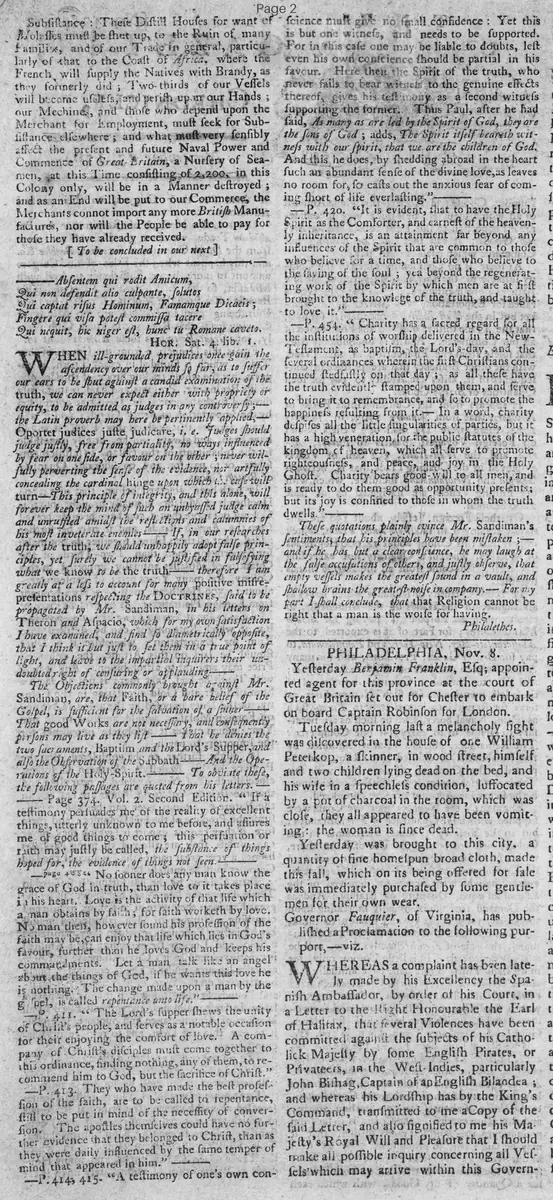
Qui non defendit alio culpante, solutos
Qui captat risus hominum, famamque dicacis;
Fingere qui non vult commissa tacere noceus.
Qui nequit, hic niger est, hunc tu Romane caveto.
Hor: Sat. 4. lib. 1.
When ill-grounded prejudices once gain the ascendency over our minds so far as to suffer our ears to be shut against a candid examination of the truth, we can never expect either with propriety or equity, to be admitted as judges in any controversy;-- the Latin proverb may here be pertinently applied, as Oportet judices jure judicare, i. e. Judges should judge justly, free from partiality, no ways influenced by fear on one side, or favour on the other; never wilfully perverting the sense of the evidence, nor artfully concealing the cardinal hinge upon which the case will turn--This principle of integrity, and this alone, will forever keep the mind of such an unbiased judge calm and unruffled amidst the reflections and calumnies of his most inveterate enemies. If, in our researches after the truth, we should unhappily adopt false principles, yet surely we cannot be justified in falsifying what we know to be the truth-- therefore I am greatly at a loss to account for many positive misrepresentations respecting the Doctrines, said to be propagated by Mr. Sandiman, in his Letters On Theron and Aspasio, which for my own satisfaction I have examined, and find so diametrically opposite, that I think it but just to set them in a true point of light, and leave to the impartial inquirers their undoubted right of censuring or applauding.
The Objections commonly brought against Mr. Sandiman, are, that Faith, or a bare belief of the Gospel, is sufficient for the salvation of a sinner-- That good Works are not necessary, and consequently persons may live as they list-- That he denies the two sacraments, Baptism and the Lord's-Supper, and also the Observation of the Sabbath-- And the Operations of the Holy-Spirit.-- To obviate these, the following passages are quoted from his letters.
-- Page 374. Vol. 2. Second Edition.-- If a testimony persuades me of the reality of excellent things, utterly unknown to me before, and assures me of good things to come; this persuasion or hope is, the evidence of things not seen, which may justly be called, the substance of things hoped for.
--Page 405.-- No sooner does any man know the grace of God in truth, than love to it takes place in his heart. Love is the activity of that life which a man obtains by faith; for faith worketh by love. No man then, however sound his profession of the faith may be, can enjoy that life which lies in God's favour, further than he loves God and keeps his commandments. Let a man talk like an angel about the things of God, if he wants this love he is nothing: The change made upon a man by the gospel, is called repentance unto life."
--P. 411.-- "The Lord's supper shews the unity of Christ's people, and serves as a notable occasion for their enjoying the comfort of love.) A company of Christ's disciples must come together to this ordinance, finding nothing, any of them, to recommend him to God, but the sacrifice of Christ."
Still to be put in mind of the necessity of conversion of the faith, are to be called to repentance,
:P. 413. They who have made the best profession. The apostles themselves could have no further evidence that they belonged to Christ, than as they were daily influenced by the same temper of mind that appeared in him." --rea.
--P.414, 415. "A testimony of one's own conscience must give no small confidence: Yet this is but one witness, and needs to be supported. For in this case one may be liable to doubts, lest even his own conscience should be partial in his favour. Here then the Spirit of the truth, who never fails to bear witness to the genuine effects thereof, gives his testimony as a second witness supporting the former. Thus Paul, after he had said, As many as are led by the Spirit of God, they are the sons of God; adds, The Spirit itself beareth witness with our spirit, that we are the children of God. And this he does, by shedding abroad in the heart such an abundant sense of the divine love, as leaves no room for, or casts out the anxious fear of coming short of life everlasting."
--P. 420. "It is evident, that to have the Holy Spirit as the Comforter, and earnest of the heavenly inheritance, is an attainment far beyond any influences of the Spirit that are common to those who believe for a time, and those who believe to the saving of the soul; yea beyond the regenerating work of the Spirit by which men are at first brought to the knowledge of the truth, and taught to love it."
--P. 454. "Charity has a sacred regard for all the institutions of worship delivered in the New-Testament, as baptism, the Lord's-day, and the several ordinances wherein the first Christians continued steadfastly only: that day in as all these have the truth evidently stamped upon them, and serve to bring it to remembrance, and so to promote the happiness resulting from it.-- In a word, charity despises all the little singularities of parties, but it has a high veneration for the public statutes of the kingdom of heaven, which all serve to promote righteousness, and peace, and joy in the Holy Ghost. Charity bears good-will to all men, and is ready to do them good as opportunity presents: but its joy is confined to those in whom the truth dwells."
These quotations plainly evince Mr. Sandiman's sentiments; that his principles have been mistaken;-- and if he has but a clear conscience, he may laugh at the false accusations of others, and justly observe, that empty vessels make the greatest sound in a vault, and shallow brains the greatest noise in company.-- For my part I shall conclude, that that Religion cannot be right that a man is the worse for having.
Philalethes.
What sub-type of article is it?
What themes does it cover?
What keywords are associated?
What entities or persons were involved?
Letter to Editor Details
Author
Philalethes
Main Argument
mr. sandiman's doctrines in 'theron and aspasio' have been misrepresented; quotations show they affirm faith working through love and good works, the necessity of sacraments like baptism and lord's supper, sabbath observance, and operations of the holy spirit, countering claims of denying these essentials.
Notable Details