Thank you for visiting SNEWPapers!
Sign up free
The New York Herald
New York, New York County, New York
What is this article about?
Paris report on socialist victory in electing author Eugene Sue to National Assembly, causing Bourse decline; government fails to provoke unrest; Orleanists and Legitimists plot successions amid political intrigue (May 2, 1850).
Clipping
OCR Quality
Full Text
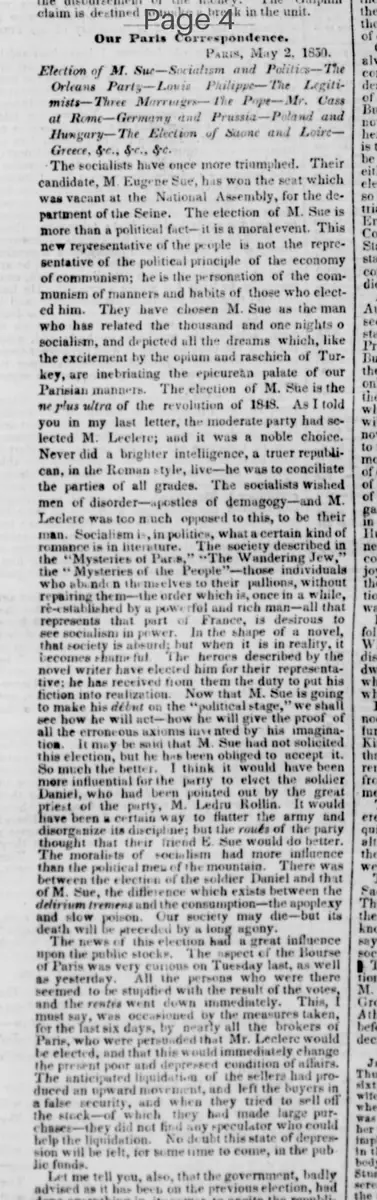
Paris, May 2, 1850.
Election of M. Sue—Socialism and Politics—The Orleans Party—Louis Philippe—The Legitimists—Three Marriages—The Pope—Mr. Cass at Rome—Germany and Prussia—Poland and Hungary—The Election of Saone and Loire— Greece, &c., &c.
The socialists have once more triumphed. Their candidate, M. Eugene Sue, has won the seat which was vacant at the National Assembly, for the department of the Seine. The election of M. Sue is more than a political fact—it is a moral event. This new representative of the people is not the representative of the political principle of the economy of communism; he is the personation of the communism of manners and habits of those who elected him. They have chosen M. Sue as the man who has related the thousand and one nights of socialism, and depicted all the dreams which, like the excitement by the opium and rasschich of Turkey, are inebriating the epicurean palate of our Parisian manners. The election of M. Sue is the ne plus ultra of the revolution of 1848. As I told you in my last letter, the moderate party had selected M. Leclerc; and it was a noble choice. Never did a brighter intelligence, a truer republican, in the Roman style, live—he was to conciliate the parties of all grades. The socialists wished men of disorder—apostles of demagogy—and M. Leclerc was too much opposed to this, to be their man. Socialism is, in politics, what a certain kind of romance is in literature. The society described in the "Mysteries of Paris," "The Wandering Jew," the "Mysteries of the People"—those individuals who abandon themselves to their passions, without repairing them—the order which is, once in a while, re-established by a powerful and rich man—all that represents that part of France, is desirous to see socialism in power. In the shape of a novel, that society is absurd; but when it is in reality, it becomes shameful. The heroes described by the novel writer have elected him for their representative: he has received from them the duty to put his fiction into realization. Now that M. Sue is going to make his début on the "political stage," we shall see how he will act—how he will give the proof of all the erroneous actions invented by his imagination. It may be said that M. Sue had not solicited this election, but he has been obliged to accept it. So much the better. I think it would have been more influential for the party to elect the soldier Daniel, who had been pointed out by the great priest of the party, M. Ledru Rollin. It would have been a certain way to flatter the army and disorganize its discipline; but the roues of the party thought that their friend E. Sue would do better. The moralists of socialism had more influence than the political men of the mountain. There was between the election of the soldier Daniel and that of M. Sue, the difference which exists between the delirium tremens and the consumption—the apoplexy and slow poison. Our society may die—but its death will be preceded by a long agony. The news of this election had a great influence upon the public stocks. The aspect of the Bourse of Paris was very curious on Tuesday last, as well as yesterday. All the persons who were there seemed to be stupified with the result of the votes, and the rentes went down immediately. This, I must say, was occasioned by the measures taken, for the last six days, by nearly all the brokers of Paris, who were persuaded that Mr. Leclerc would be elected, and that this would immediately change the present poor and depressed condition of affairs. The anticipated liquidation of the sellers had produced an upward movement, and left the buyers in a false security, and when they tried to sell off the stock—of which they had made large purchases—they did not find any speculator who could help the liquidation. No doubt this state of depression will be felt, for some time to come, in the public funds. Let me tell you, also, that the government, badly advised as it has been on the previous election, had done everything in its power to excite the republican socialists, in order to force them to an attack, and thus have an occasion to repress them in a very strong manner. Eight days ago, the Prefect of Police, M. Carlier, had issued an order to disarm all the National Guards of the faubourgs. A revision of the people who have a right to vote, had also taken place, and all those who had not a real domicile in Paris, had been excluded. The sale of all the republican newspapers had been prohibited in the streets, and a Rezzia operated against the Événement, and other journals. Well, none of these means of rendering the socialists savage had succeeded, and having seen the snare, they had obeyed their chiefs, and remained quiet. Another attempt will be made by M. Carlier, at the proclamation of the newly elected representative, M. Sue: but it will have no effect—the peace will be kept. One may see, from this moment, by reading the socialist journals with attention, that they know the plot, and that they will avoid the abyss around them. It has been rumored to-day that the ministry would be changed. A great meeting of the statesmen devoted to the President, took place on Tuesday evening, at the Elysee, in order to take measures against the propagation of socialism. Messrs. De Broglie, Thiers, Guizot, Mole, St. Priest, and de Grammont were present. A list of new ministers, among whom I was told there were Messrs. Greuv, Gustave de Beaumont, Bixio, Lamartine, Dufaure and Lamoriciere, had been prepared, at all events. Another question was also balloted at that meeting—it was to remove the seat of government from Paris. It would be a safe plan; but I do not believe it will be followed. The undertaking is too great for the present moment. While all these debates are taking place in France, the Orleanist party is intriguing outside. The Duchess of Orleans, it appears, has been called to Claremont by the old king, Louis Philippe, to settle the question of the inheritance of the Count of Paris. Whilst the Orleanists are taking steps, with regard to future events, the legitimists are also at work, but without the authorization of the Count of Chambord, who, retired at Frohsdorf, seems to be decided to live in a quiet way, without the embarrassment of a throne. But I have been told, by some leaders of the party, who know well the intention of Henry V., that if he ever returns to France, it will be with the Count of Paris, in his hand and this second pretender would be his successor in case of his dying without children. Perhaps the assembly de famille of Claremont has no other purpose but to lick at the proposal and decide upon it, whether it will be good and safe to accept it. We shall see.
What sub-type of article is it?
What keywords are associated?
What entities or persons were involved?
Where did it happen?
Foreign News Details
Primary Location
Paris
Event Date
May 2, 1850
Key Persons
Outcome
election of m. eugene sue to the national assembly for the seine department; socialists triumph; public stocks and rentes decline at the bourse; no violent incidents despite government provocations; rumors of ministry change and government relocation unconfirmed; orleanists and legitimists intrigue regarding succession.
Event Details
Socialists elect M. Eugene Sue, author of socialist novels, to the vacant National Assembly seat for the Seine, seen as a moral victory representing communist manners. Moderate candidate M. Leclerc loses. Election impacts Paris Bourse, causing stock depression. Government attempts to provoke socialists fail, maintaining peace. Meeting at Elysee discusses anti-socialism measures, potential new ministry, and relocating government. Orleanists meet at Claremont on Count of Paris inheritance; Legitimists plan without Count of Chambord's involvement, considering him as successor to Henry V.