Thank you for visiting SNEWPapers!
Sign up free
The Enquirer
Richmond, Henrico County, Virginia
What is this article about?
The Earl of Liverpool affirmed in the House of Peers on April 28 that the principle of retaliation underlying the British Orders in Council remains, to counter French decrees. However, the ministry has rescinded orders regarding the US amid diplomatic shifts, possibly to ease commerce pressures and maintain credibility, without awaiting French revocation.
Clipping
OCR Quality
Full Text
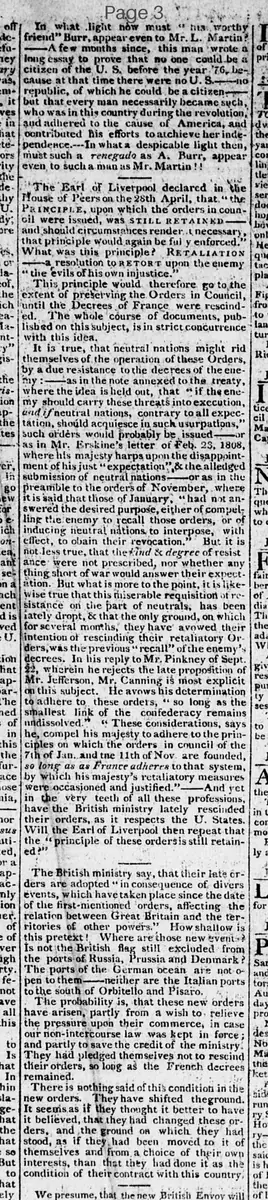
What was this principle? RETALIATION— a resolution to RETORT upon the enemy the evils of his own injustice."
This principle would therefore go to the extent of preserving the Orders in Council, until the Decrees of France were rescinded... The whole course of documents, published on this subject, is in strict concurrence with this idea.
It is true, that neutral nations might rid themselves of the operation of these Orders, by a due resistance to the decrees of the enemy: —as in the note annexed to the treaty, where the idea is held out, that "if the enemy should carry these threats into execution, and if neutral nations, contrary to all expectation, should acquiesce in such usurpations," such orders would probably be issued—or as in Mr. Erskine's letter of Feb. 23. 1808. where his majesty harps upon the disappointment of his just "expectation" & the alledged submission of neutral nations—or as in the preamble to the orders of November, where it is said that those of January "had not answered the desired purpose, either of compelling the enemy to recall those orders, or of inducing neutral nations to interpose, with effect, to obtain their revocation." But it is not less true, that the kind & degree of resistance were not prescribed, nor whether any thing short of war would answer their expectation. But what is more to the point, it is likewise true that this miserable requisition of resistance on the part of neutrals, has been lately dropt, & that the only ground, on which for several months, they have avowed their intention of rescinding their retaliatory Orders, was the previous "recall" of the enemy's decrees. In his reply to Mr. Pinkney of Sept. 22, wherein he rejects the late proposition of Mr. Jefferson, Mr. Canning is most explicit on this subject. He avows his determination to adhere to these orders, "so long as the smallest link of the confederacy remains undissolved." These considerations, says he, compel his majesty to adhere to the principles on which the orders in council of the 7th of Jan. and the 11th of Nov. are founded, so long as France adheres to that system, by which his majesty's retaliatory measures were occasioned and justified." —And yet in the very teeth of all these professions, have the British ministry lately rescinded their orders, as it respects the U. States.
Will the Earl of Liverpool then repeat that the "principle of these orders is still retained?"
The British ministry say, that their late orders are adopted "in consequence of, divers events, which have taken place since the date of the first-mentioned orders, affecting the relation between Great Britain and the territories of other powers." How shallow is this pretext! Where are those new events? Is not the British flag still excluded from the ports of Russia, Prussia and Denmark? The ports of the German ocean are not open to them—neither are the Italian ports to the south of Orbitello and Pisaro.
The probability is, that these new orders have arisen, partly from a wish to relieve the pressure upon their commerce, in case our non-intercourse law was kept in force; and partly to save the credit of the ministry. They had pledged themselves not to rescind their orders, so long as the French decrees remained.
There is nothing said of this condition in the new orders. They have shifted the ground. It seems as if they thought it better to have it believed, that they had changed these orders, and the ground on which they had stood, as if they had been moved to it of themselves and from a choice of their own interests, than that they had done it as the condition of their contract with this country.
We presume, that the new British Envoy will not leave Great Britain, for the U. States, until she has heard of the adjustment at Washington. We may of course expect him in a few weeks. The terms of the treaty, which he will be instructed to form, will depend upon the tone of Great Britain. That tone will depend to a certain degree only upon the success or defeat of the Austrians.
What sub-type of article is it?
What keywords are associated?
What entities or persons were involved?
Where did it happen?
Foreign News Details
Primary Location
Great Britain
Event Date
28th April
Key Persons
Outcome
british ministry rescinded orders in council as respects the united states, despite prior commitments to retain them until french decrees were revoked; new envoy expected soon to negotiate treaty terms influenced by austrian outcomes.
Event Details
Earl of Liverpool declared in House of Peers that the retaliatory principle of Orders in Council against French decrees is retained and would be enforced if necessary. Analysis shows ministry has dropped neutral resistance requirement and rescinded orders for US amid commerce pressures and credibility concerns, shifting grounds without French recall. New orders cite changed relations with other powers, but exclusions persist in Russia, Prussia, Denmark, and Italian ports. Upcoming British envoy to US awaits Washington adjustment; treaty terms to reflect Britain's tone based on Austrian war progress.