Thank you for visiting SNEWPapers!
Sign up free
Herald Of The United States
Warren, Bristol County, Rhode Island
What is this article about?
General Wilkinson arrives in Richmond for the Burr conspiracy trial proceedings in federal court, accompanied by witnesses; reports detail court arguments over evidence, witnesses, and indictments for treason and misdemeanor against Burr and Blennerhassett.
Merged-components note: Continuation of domestic news article on Gen. Wilkinson and the Burr trial across pages 2 and 3; relabeling the second part from 'editorial' to 'domestic_news' as it reports on domestic legal proceedings rather than pure opinion.
Clippings
1 of 2
OCR Quality
Full Text
RICHMOND, JUNE 15.
Gen. Wilkinson And Suite.—
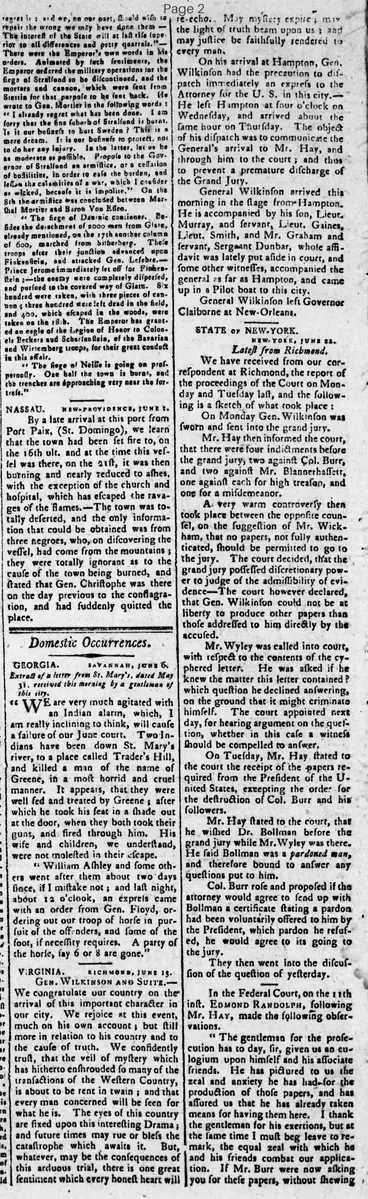
We congratulate our country on the arrival of this important character in our city. We rejoice at this event, much on his own account; but still more in relation to his country and to the cause of truth. We confidently trust, that the veil of mystery which has hitherto enshrouded so many of the transactions of the Western Country, is about to be rent in twain; and that every man concerned will be seen for what he is. The eyes of this country are fixed upon this interesting Drama; and future times may rue or bless the catastrophe which awaits it. But, whatever may be the consequences of this arduous trial, there is one great sentiment which every honest heart will re-echo: May mysteries expire: may the light of truth beam upon us; and may justice be faithfully rendered to every man.
On his arrival at Hampton, Gen. Wilkinson had the precaution to dispatch immediately an express to the Attorney for the U. S. in this city. He left Hampton at four o'clock on Wednesday, and arrived about the same hour on Thursday. The object of his dispatch was to communicate the General's arrival to Mr. Hay, and through him to the court; and thus to prevent a premature discharge of the Grand Jury.
General Wilkinson arrived this morning in the stage from Hampton. He is accompanied by his son, Lieut. Murray, and servant, Lieut. Gaines, Lieut. Smith, and Mr. Graham and servant, Sergeant Dunbar, whose affidavit was lately put aside in court, and some other witnesses, accompanied the general as far as Hampton, and came up in a Pilot boat to this city.
General Wilkinson left Governor Claiborne at New-Orleans.
STATE of NEW-YORK.
NEW-YORK, JUNE 21.
Latest from Richmond.
We have received from our correspondent at Richmond, the report of the proceedings of the Court on Monday and Tuesday last, and the following is a sketch of what took place:
On Monday Gen. Wilkinson was sworn and sent into the grand jury. Mr. Hay then informed the court, that there were four indictments before the grand jury, two against Col. Burr, and two against Mr. Blannerhassett, one against each for high treason, and one for a misdemeanor.
A very warm controversy then took place between the opposite counsel, on the suggestion of Mr. Wickham, that no papers, not fully authenticated, should be permitted to go to the jury. The court decided, that the grand jury possessed discretionary power to judge of the admissibility of evidence. The court however declared that Gen. Wilkinson could not be at liberty to produce other papers than those addressed to him directly by the accused.
Mr. Wyley was called into court, with respect to the contents of the ciphered letter. He was asked if he knew the matter this letter contained? which question he declined answering, on the ground that it might criminate himself. The court appointed next day, for hearing argument on the question, whether in this case a witness should be compelled to answer.
On Tuesday, Mr. Hay stated to the court the receipt of the papers required from the President of the United States, excepting the order for the destruction of Col. Burr and his followers.
Mr. Hay stated to the court that he wished Dr. Bollman before the grand jury while Mr. Wyley was there. He said Bollman was a pardoned man, and therefore bound to answer any questions put to him.
Col. Burr rose and proposed if the attorney would agree to send up with Bollman a certificate stating a pardon had been voluntarily offered to him by the President, which pardon he refused, he would agree to its going to the jury.
They then went into the discussion of the question of yesterday.
In the Federal Court, on the 17th inst. Edmond Randolph, following Mr. Hay, made the following observations.
"The gentleman for the prosecution has to day, sir, given us an eulogium upon himself and his associate friends. He has pictured to us the zeal and anxiety he has had for the production of those papers, and has assured us that he has already taken means for having them here. I thank the gentleman for his exertions, but at the same time I must beg leave to remark, the equal zeal with which he and his friends combat our application. If Mr. Burr were now asking you for these papers, without shewing"
has probable cause that they were material, this indeed would be a wanton, womanish, feverish curiosity ; but it is no such curiosity ; we have shewn in the fullest manner, that they are material and of the first importance. It is said by the production, that Gen. Wilkinson, that huge Atlas, on whose mighty shoulders the American world is sustained, is wished to be represented as a man in whom confidence ought to be placed. But I say, if the production of these papers were to effect the annihilation of Gen. Wilkinson, that I hope and believe no other visible chasm in the creation would be produced; but in that portion of space at present, occupied by his material body. How can the rank and safety of Gen. Wilkinson be concerned in the production of these papers. Gen. Wilkinson is only an organ in the hands of government. As to his glory I believe, its meridian splendor is set, and that he will be no longer worshipped as the political Messiah of America; but even if he were crucified, I trust it would make no chasm in our time. Suspicion, at all events belongs to him. He stands in that character which is always regarded as odious, that of an approver. He has confessed himself guilty of the most heinous of crimes, for the purpose of trapping others, of rendering other equally infamous as himself,
MASSACHUSETTS.
What sub-type of article is it?
What keywords are associated?
What entities or persons were involved?
Where did it happen?
Domestic News Details
Primary Location
Richmond, Virginia
Event Date
June 15
Key Persons
Outcome
ongoing grand jury proceedings with indictments for high treason and misdemeanor; court debates on evidence admissibility and witness testimony; no final resolution reported.
Event Details
Gen. Wilkinson arrives in Richmond with witnesses for the federal court trial related to the Western Country transactions and Burr conspiracy. He dispatches notice to prevent premature grand jury discharge. Court proceedings involve swearing in Wilkinson, discussions on four indictments against Burr and Blennerhassett, controversies over evidence authentication, ciphered letter contents, and witness compulsion. Papers from the President received except one. Debate on Dr. Bollman's testimony given his pardon. Edmond Randolph argues for production of material papers, criticizing Wilkinson's role.