Thank you for visiting SNEWPapers!
Sign up free
Phenix Gazette
Alexandria, Virginia
What is this article about?
Historical correction on the signing of the Declaration of Independence, debunking myths about the July 4, 1776, signing date and Charles Carroll's absence, using Congressional Journals to clarify timelines and signer participation, tying to Adams and Jefferson's deaths.
Merged-components note: Continuation of the same article on the Declaration of Independence; changed label to story as it is a full narrative historical piece.
Clippings
1 of 2
OCR Quality
Full Text
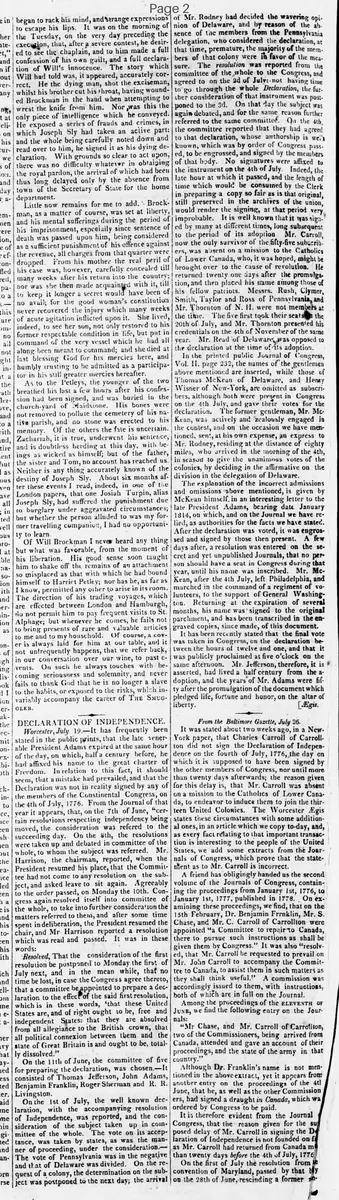
Worcester, July 19.-It has frequently been stated in the public prints, that the late venerable President Adams expired at the same hour of the day, on which, half a century before, he had affixed his name to the great charter of Freedom. In relation to this fact, it should seem, that a mistake had prevailed, and that the Declaration was not in reality signed by any of the members of the Continental Congress, on the 4th of July, 1776. From the Journal of that year it appears, that, on the 7th of June, "certain resolutions respecting independency being moved, the consideration was referred to the succeeding day. On the 8th, the resolutions were taken up and debated in committee of the whole, to whom the subject was referred. Mr. Harrison, the chairman, reported, when the President resumed his place, that the Committee had not come to any resolution on the subject, and asked leave to sit again. Agreeably to the order passed, on Monday the 10th. Congress again resolved itself into committee of the whole, to take into further consideration the matters referred to them, and after some time spent in deliberation, the President resumed the chair, and Mr Harrison reported a resolution which was read and passed. It was in these words:
Resolved, That the consideration of the first resolution be postponed to Monday the first of July next, and in the mean while, that no time be lost, in case the Congress agree thereto, that a committee be appointed to prepare a declaration to the effect of the said first resolution, which is in these words, that these United States are, and of right ought to be, free and independent States: that they are absolved from all allegiance to the British crown, that all political connexion between them and the state of Great Britain is and ought to be, totally dissolved."
On the 11th of June, the committee of five for preparing the declaration, was chosen.-It consisted of Thomas Jefferson, John Adams, Benjamin Franklin, Roger Sherman and R. R. Livingston.
On the 1st of July, the well known declaration, with the accompanying resolution of Independence, was reported, and the consideration of the subject taken up in committee of the whole. The vote on its acceptance, was taken by states, as was the manner of proceeding, under the consideration.- The vote of Pennsylvania was in the negative and that of Delaware was divided. On the request of a colony, the determination on the subject was postponed to the next day; the arrival of Mr. Rodney had decided the wavering opinion of Delaware, and by reason of the absence of the members from the Pennsylvania delegation, who considered the declaration, at that time, premature, the majority of the members of that colony were in favor of the measure. The resolution was reported from the committee of the whole to the Congress, and agreed to on the 2d of July:-not having time to go through the whole Declaration, the further consideration of that instrument was postponed to the 3d. On that day the subject was again debated, and for the same reason further referred to the same committee. On the 4th, the committee reported that they had agreed to that declaration, whose authorship is well known, which was by order of Congress passed, to be engrossed, and signed by the members of that body. No signatures were affixed to the instrument on the 4th of July. Indeed, the late hour at which it passed, and the length of time which would be consumed by the Clerk in preparing a copy so fair as is that original, still preserved in the archives of the union, would render the signing, at that period very improbable. It is well known that it was signed by many at different times, long subsequent to the period of its adoption Mr. Carroll now the only survivor of the fifty-five subscribers, was absent on a mission to the Catholics of Lower Canada, who, it was hoped, might be brought over to the cause of revolution. He returned twenty one days after the promulgation, and then placed his name among those of his fellow patriots. Messrs. Rush, Clymer Smith, Taylor and Ross of Pennsylvania, and Mr. Thornton of N. H. were not members at the time. The five first took their seats on the 20th of July, and Mr. Thornton presented his credentials on the 4th of November of the same year. Mr. Read 'of Delaware, was opposed to the declaration at the time of its adoption. In the printed public Journal of Congress, Vol. II. page 232, the names of the gentlemen above mentioned are inserted, while those of Thomas McKean of Delaware, and Henry Wisner of New-York, are omitted as subscribers, although both were present in Congress on the 4th July, and gave their votes for the declaration. The former gentleman, Mr. McKean, was actively and zealously engaged in the contest, and on the occasion we have mentioned, sent, at his own expense, an express to Mr. Rodney, residing at the distance of eighty miles, who arrived in the morning of the 4th, in season to give the unanimous votes of the colonies, by deciding in the affirmative on the division in the delegation of Delaware.
The explanation of the incorrect admissions and omissions above mentioned, is given by McKean himself, in an interesting letter to the late President Adams, bearing date January 1814, on which, and on the Journal we have relied, as authorities or the facts we have stated.
After the declaration was voted, it was engrossed and signed by those then present. A few days after, a resolution was entered on the secret and yet unpublished Journals, that no person should have a seat in Congress during that year, until his name was inscribed. Mr. McKean, after the 4th July, left Philadelphia, and marched in the command of a regiment of volunteers, to the support of General Washington. Returning at the expiration of several months, his name was signed to the original parchment, and has been transcribed in the engraved copies, since made, of this document.
It has been recently stated that the final vote was taken in Congress, on the declaration between the hours of twelve and one, and that it was publicly proclaimed at five o'clock on the same afternoon. Mr. Jefferson, therefore, it is asserted, had lived a half century from the adoption, and the years of Mr. Adams were fifty after the promulgation of the document which pledged life, fortune and honor, on the altar of liberty.
[Egis.
From the Baltimore Gazette, July 26.
It was stated about two weeks ago, in a New-York paper, that Charles Carroll of Carrollton did not sign the Declaration of Independence on the fourth of July, 1776, the day on which it is supposed to have been signed by the other members of Congress, nor until more than twenty days afterwards; the reason given for this delay is, that Mr. Carroll was absent on a mission to the Catholics of Lower Canada, to endeavor to induce them to join the thirteen United Colonies. The Worcester Egis states these circumstances with some additional ones, in an article which we copy to-day, and, as every fact relating to that important transaction is interesting to the people of the United States, we add some extracts from the Journals of Congress, which prove that the statement as to Mr. Carroll is incorrect.
A friend has obligingly handed us the second volume of the Journals of Congress, containing the proceedings from January 1st, 1776, to January 1st, 1777, published in 1778. On examining these proceedings, we find, that on the 15th February, Dr. Benjamin Franklin, Mr. S. Chase, and Mr. C. Carroll of Carrollton were appointed "a Committee to repair to Canada, there to pursue such instructions as shall be given them by Congress." It was also "resolved, that Mr. Carroll be requested to prevail on Mr. John Carroll to accompany the Committee to Canada, to assist them in such matters as they shall think useful." A commission was accordingly issued to them, with instructions, both of which are in full on the Journal.
Among the proceedings of the Eleventh of June, we find the following entry on the Journals:
"Mr Chase, and Mr. Carroll of Carrollton, two of the Commissioners, being arrived from Canada, attended and gave an account of their proceedings, and the state of the army in that country
Although Dr. Franklin's name is not mentioned in the above extract, yet it appears from another entry on the proceedings of the 4th June, that he, as well as the other Commissioners, had signed a draught in Canada, which was ordered by Congress to be paid.
It is therefore evident from the Journal Congress, that the reason given for the supposed delay of Mr. Carroll in signing the Declaration of Independence is not founded on fact as Mr. Carroll had returned from Canada more than twenty days before the 4th of July, 1776
On the first of July the resolution from convention of Maryland, passed by that H on the 28th of June, rescinding a former
Resolution and authorising the deputies of said colony, or any three or more of them to concur with the other United Colonies or a majority of them in declaring the United Colonies free and independent, &c." was read in Congress— on the second of July the committee of the whole reported the resolution of Independence, and on the fourth the declaration was adopted. After the declaration are the following words in the Journal "The foregoing declaration was by order of Congress engrossed and signed by the following members, &c." The names of Samuel Chase, William Paca, Thomas Stone and Charles Carroll of Carrollton, appeared among those which are signed. It will be noticed that "three or more of the deputies" of Maryland only, were authorized to concur, &c. Had two of the commissioners, Chase and Carroll, been absent, the remaining two could not have assented and of course could not have affixed their names on the 4th. The conclusion is that both Carroll and Chase were present one of them must have been, and as the Canada Mission alone is stated to have detained them, as we have shewn that they returned from that mission on the 11th of June, the inference to be drawn from the whole is that both were present. But it is urged that the declaration was not signed at all on the Fourth—In the Journal of Congress, however, and as a part of the proceedings of that day the signatures of the members are stated to have been affixed—Had this not been the case the signing would have been mentioned in the proceedings of the day on which it actually took place. Besides we find that the names of the members who really did not sign are not upon the list contained in the Journal of the fourth, as that of Robert R. Livingston and Thomas McKean, and some others as may be seen by comparing the fac simile of the declaration with the last above mentioned. I hope that this comparison of dates will forever set the matter at rest. We can readily account for the Orator in New-York having made the assertion, in order to render the death of Adams and Jefferson more striking than it was, (if such could have been done:) and the assertion once made, of course it had to be supported. We repeat our hopes that the above explanation will be satisfactory, and that no further attempt will be made to prove that a younger or a later wreath adorns the brow of Mr. Carroll than those which hang above the tombs of Adams and Jefferson.
What sub-type of article is it?
What themes does it cover?
What keywords are associated?
What entities or persons were involved?
Where did it happen?
Story Details
Key Persons
Location
Philadelphia
Event Date
July 4, 1776
Story Details
Correction of myths surrounding the signing of the Declaration of Independence, clarifying that it was adopted but not signed on July 4, 1776; Charles Carroll returned from Canada mission by June 11 and was present; ties to coincidental deaths of Adams and Jefferson fifty years later.