Thank you for visiting SNEWPapers!
Sign up free
Constitutional Whig
Richmond, Virginia
What is this article about?
Critical analysis of US diplomat Louis McLane's 1830 negotiations with Britain on West India trade, accusing him and Secretary Van Buren of compromising US interests by issuing a proclamation without full British compliance, restricting American vessels while favoring British ones, amid political motivations.
Merged-components note: These sequential components are parts of a serial article (Nos. X and XI with continuation) criticizing Louis McLane's diplomatic negotiation on the British West India trade.
Clippings
1 of 3
OCR Quality
Full Text
THE HON. LOUIS McLANE AND THE BRITISH WEST INDIA TRADE—No. X.
We have seen that Mr. McLane promised the British government, that a material provision of an act of congress should be totally frustrated and annulled by an executive construction. Upon these terms, Aberdeen yielded his slow consent. Our ports were first to be opened, without waiting for the 'satisfactory evidence' which the act required; and then he engaged the direct trade should be opened—but on what conditions?
The act of congress required that American vessels may import into those colonial ports, from the United States, any article or articles that can be imported in a British vessel.' But Lord Aberdeen and Mr. McLane agreed, that American vessels should not be allowed to do any such thing; but that this should be construed to mean, that British vessels might carry any article at all, but American vessels should be restricted to carry only American produce.
Lord Aberdeen also apprised Mr. McLane, as parts of the arrangement, that there would be modifications in the schedule of duties attached to the act of parliament of 1825, with a view more effectually to support the interests of the British North American colonies.'
When the news of this extraordinary 'arrangement' reached this country, in September, 1830, a demur took place, which it may be hoped was owing to the reluctance of the President to sanction such a proceeding. But the elections were pending in some of the debatable states; the newspapers had raised a shout of the 'successful' issue of the negotiation; the most clamorous joy was affected by interested partisans, for the restoration of the West-India trade,' the humbug was extensive, and serviceable. To mar all this chorus of triumph, to repudiate the miserable arrangement, and adhere to the requisitions of the act of Congress, would have been most mortifying; and upon the elections, most disastrous.
It was determined to maintain the delusion at any cost, and on the 6th of October, the President's proclamation was issued. The official paper of the administration has, within a few days, spoken of this arrangement as having met the unanimous approbation of the senate. The editor probably believed that Mr. McLane actually negotiated a treaty, which was regularly ratified by the senate! The blunder is not surprising for so many bold untruths were published respecting the whole affair, that the nation generally have had but a confused knowledge of the transaction.
Unhappily the senate had no control over the proceeding. There was neither treaty, nor convention, nor indeed any thing that deserved to be called a negotiation.
Mr. McLane then, very needlessly solicited the British government to comply with the proposed conditions. The British Secretary told him that if performing half of the conditions would answer the purpose, his government was disposed to do so. Mr. McLane undertook to promise that such half compliance would be considered sufficient and satisfactory; although the condition not complied with was one upon which the United States had always insisted.
Such is the simple summary of the whole 'negotiation;' and thus it came to the president, for his decision, whether he would redeem the officious pledge of Mr. McLane, and issue the proclamation without the fulfilment of a material part of the condition on which alone he was authorized to issue it.
There can be no doubt that he was bound in duty, and propriety, to wait for the full performance of the conditions which congress had chosen to require.
But nevertheless, the proclamation was sent forth, bearing upon its face a palpable and wilful FALSEHOOD.
It recites and declares that he had received satisfactory evidence, that whenever he shall give effect to the provisions of act of congress, Great Britain will open the colonial ports to the vessels of the United States and her cargoes, upon the terms, and according to the requisition of the aforesaid act.
Now the President must have known, as did every one else that had seen Lord Aberdeen's letter, which constituted the "satisfactory evidence," of the intentions of the British government: that Great Britain was not going to open the colonial ports upon the terms, or according to the requisitions of the act of congress, at all. The terms and requisitions of the act of congress, contemplated the opening of those ports to American vessels, with the same cargoes which British vessels could bring from the United States.
But lord Aberdeen expressly refused to agree to such a condition, and those ports were to be closed against American vessels with assorted or mixed cargoes, but were to be opened for British vessels with such cargoes.
Nevertheless, President Jackson undertook to open our ports by his proclamation; so since that time—in spite of the act of Congress—a British vessel may be laden with a mixed cargo, in our ports, alongside of an American vessel which is restricted to carry only American produce,—and, both sailing together to the opened ports,—the American is liable to be turned off, or confiscated. for carrying such goods as the British vessels may import with safety and with manifest advantage.
Thus have the consistency of our commercial policy, and the dignity of our national character, been trifled with and disregarded for the sake of promoting the private views of two individuals, seeking higher office and a factitious reputation.
Such is the disgraceful issue of this miscalled "negotiation"—which began in slander—was prosecuted through servility and humiliation—and has ended in a bold violation of truth—and a gross insult to the American people in an executive nullification of the solemn act of their national legislature.
But what has been gained to the interests of trade by all these sacrifices?
A few considerations on that subject remain to be presented.
X. Y.
From the United States' Gazette.
THE HON. LOUIS M'LANE, AND THE BRITISH WEST INDIA TRADE.
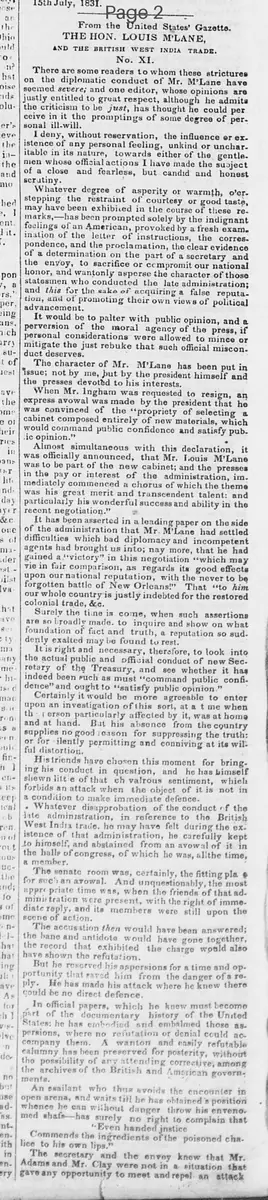
No. XI.
There are some readers to whom these strictures on the diplomatic conduct of Mr. M'Lane have seemed severe; and one editor, whose opinions are justly entitled to great respect, although he admits the criticism to be just, has thought he could perceive in it the promptings of some degree of personal ill-will.
I deny, without reservation, the influence or existence of any personal feeling, unkind or uncharitable in its nature, towards either of the gentlemen whose official actions I have made the subject of a close and fearless, but candid and honest scrutiny.
Whatever degree of asperity or warmth, overstepping the restraint of courtesy or good taste, may have been exhibited in the course of these remarks,--has been prompted solely by the indignant feelings of an American, provoked by a fresh examination of the letter of instructions, the correspondence, and the proclamation, the clear evidence of a determination on the part of a secretary and the envoy, to sacrifice or compromise our national honor, and wantonly asperse the character of those statesmen who conducted the late administration; and this for the sake of acquiring a false reputation, and of promoting their own views of political advancement.
It would be to palter with public opinion, and a perversion of the moral agency of the press, if personal considerations were allowed to mince or mitigate the just rebuke that such official misconduct deserves.
The character of Mr. M'Lane has been put in issue; not by me, but by the president himself and the presses devoted to his interests.
When Mr. Ingham was requested to resign, an express avowal was made by the president that he was convinced of the "propriety of selecting a cabinet composed entirely of new materials, which would command public confidence and satisfy public opinion."
Almost simultaneous with this declaration, it was officially announced, that Mr. Louis M'Lane was to be part of the new cabinet; and the presses in the pay or interest of the administration, immediately commenced a chorus of which the theme was his great merit and transcendent talent: and particularly his wonderful success and ability in the recent negotiation."
It has been asserted in a leading paper on the side of the administration that Mr. M'Lane had settled difficulties which bad diplomacy and incompetent agents had brought us into; nay more, that he had gained a "victory" in this negotiation "which may vie in fair comparison, as regards its good effects upon our national reputation, with the never to be forgotten battle of New Orleans!" That "to him our whole country is justly indebted for the restored colonial trade, &c.
Surely the time is come, when such assertions are so broadly made. to inquire and show on what foundation of fact and truth, a reputation so suddenly exalted may be found to rest.
It is right and necessary, therefore, to look into the actual public and official conduct of new Secretary of the Treasury, and see whether it has indeed been such as must "command public confidence" and ought to "satisfy public opinion"
Certainly it would be more agreeable to enter upon an investigation of this sort, at a time when the person particularly affected by it, was at home and at hand. But his absence from the country supplies no good reason for suppressing the truth: or for silently permitting and conniving at its wilful distortion.
His friends have chosen this moment for bringing his conduct in question, and he has himself shown little of that chivalrous sentiment, which forbids an attack when the object of it is not in a condition to make immediate defence.
Whatever disapprobation of the conduct of the late administration. in reference to the British West India trade, he may have felt during the existence of that administration, he carefully kept to himself. and abstained from an avowal of it in the halls of congress, of which he was, all the time, a member.
The senate room was, certainly, the fitting place for such an avowal. And unquestionably, the most appropriate time was, when the friends of that administration were present, with the right of immediate reply, and its members were still upon the scene of action.
The accusation then would have been answered; the bane and antidote would have gone together, the record that exhibited the charge would also have shown the refutation.
But he reserved his aspersions for a time and opportunity that saved him from the danger of a reply. He has made his attack where he knew there could be no direct defence.
In official papers, which he knew must become part of the documentary history of the United States: he has embodied and embalmed those aspersions, where no refutation or denial could accompany them. A wanton and easily refutable calumny has been preserved for posterity, without the possibility of any attending corrective, among the archives of the British and American governments.
An assailant who thus avoids the encounter in open arena, and waits till he has obtained a position whence he can without danger throw his envenomed shafts--has surely no right to complain that "Even handed justice Commends the ingredients of the poisoned chalice to his own lips."
The secretary and the envoy know that Mr. Adams and Mr. Clay were not in a situation that gave any opportunity to meet and repel an attack
made, in this insidious mode, upon their character.
Mr. McLane and Mr. Van Buren cannot, under such circumstances, be surprised that a warm and honest indignation is roused by their conduct.
But, further, when Mr. Van Buren instructed Mr. McLane to lay before the British government all MITIGATING circumstances to palliate the conduct of our country towards England; and when he chose to enumerate, the misconduct of the late administration; the sentiments of unbounded respect cherished by our new president, towards Great Britain: his own part in opposition to Mr. Adams; the loss of Mr. Adams's election, and much more of the same pattern; as among the circumstances to be pleaded in mitigation of British disfavor, he could not have expected that the lesson he had himself recited, in the senate, could be so soon forgotten.
That it is "our duty" to present towards foreign governments an unbroken front—that the cause of our government must be considered (in respect to this very controversy) as the cause of our country—that the pretensions of the British government were, "indefensible and unjust"—such were the sentiments so recently declared by himself;—and could he expect, because he found a motive for disregarding all this, that therefore free born Americans, sincerely and consistently anxious for the honor of their country, could witness the unpatriotic, and abject spirit of his whole letter of instructions, without the blush of generous shame, and the throb of indignant scorn?
If, judging others by himself—he could think so meanly of his countrymen as to suppose it would be patiently borne—that our nation should thus be brought, by its official organs, into the attitude of a supplicant at the footstool of the British king, asking for a mitigation such as his disgraceful word of royal or ministerial displeasure—and urging the abject plea by the use of considerations belonging solely to our internal party differences—if such be indeed his opinion of us, it is full time that he should be undeceived—and that he should be made to know—and the world should perceive, that he has miserably undervalued the spirit, the pride, and the just sensibility of the American people.
Let the words of truth, then, be spoken without reserve, or coldness, or fear of being attributed to personal dislike. As an American, I cannot inquire what language can be too strong; or too severe, what rebuke too sharp, or the statesman that wilfully degrades the honor of my country.
But Mr. Van Buren is now in retirement. He will probably remain there, for his own preposterous nominations of himself as a candidate for the Presidency at an election to be held six years hence, is not apparently well calculated to further its own object.
If he should be at any time, brought forward for official trust again it will be proper to review his first course, much more extensively than I have done.
If his name should ever be presented to the senate for the confirmation of an appointment, that august and patriotic body, as guardians of the nation's honor, will surely investigate, with suitable gravity and care, the whole of his performances as secretary of state, and will not be withheld by factious compact, or silly considerations of personal indulgence, from fixing the ineffaceable stamp of their disapprobation upon the man, who, faithless to a sacred trust, has been willing, for selfish ends, to abuse the dignity of national character.
But he will scarcely venture to brave the ordeal. Mr. McLane is not retiring, like Mr. Van Buren. He is advancing to a higher employment;—his merits therefore are an object of more present interest, and his conduct has, on that account, been chiefly the theme of these remarks.
If harshness and asperity have entered into the criticism, it has been perhaps, because my readers have not read as I have, the whole of the correspondence.
Surely when McLane, at the secretary's bidding, undertook the task of putting in the plea of "guilty" for the country, and adducing evidence in mitigation of the sentence of the British pride—he must have counted and anticipated the consequences to his own fame.
He may have foreseen a reward, and perhaps now thinks he has received it but he never could have looked for the approbation of his country.
When in pursuance of the abject purpose of his instructions, he told the British minister that American pretensions had embarrassed the negotiation—that he would not decide, whether the conduct of the past administration towards England, was more a subject of regret or censure, when he volunteered an avowal that the conduct of the United States, would not be justified, (in rejecting terms that Mr. Van Buren had said were wholly inadmissible—and in refusing to meet the British government on grounds, that Mr. Van Buren had declared to be indefensible and unjust)—when, besides all this, he conducted himself as I have shown, and made so discreditable a finish of the business—surely he could not but expect, to excite the distrust of every intelligent and independent mind.
Whether his conduct be more a subject of regret or censure—whether he is to be pitied for a subjection to influence malign and blighting to his reputation—or blamed for submitting to such influences; in either event he ought not to expect, and his friends cannot hope for him, that he will escape the unreserved expression of decided, contemptuous, scornful condemnation.
The length to which I have allowed these general observations to extend, obliges me to defer to another number my proposed examination of the gains of trade by the late arrangement. X. Y.
What sub-type of article is it?
What keywords are associated?
What entities or persons were involved?
Where did it happen?
Foreign News Details
Primary Location
British West Indies
Event Date
September 1830; 6th Of October
Key Persons
Outcome
us ports opened via proclamation despite incomplete british compliance; american vessels restricted to us produce while british can carry mixed cargoes; criticized as violation of congressional act and national dignity for political gain.
Event Details
Critique of McLane's negotiation with Aberdeen, where US agreed to open ports without full evidence required by Congress; British modified duties but restricted American vessels; President issued proclamation in October 1830 amid elections, seen as false and compromising US trade interests.