Thank you for visiting SNEWPapers!
Sign up free
Editorial
December 15, 1859
The Home Journal
Winchester, Franklin County, Tennessee
What is this article about?
Editorial strongly supports a Tennessee bill allowing incorporated towns to vote on banning spirituous liquor sales, arguing it empowers majority rule, protects families and community from alcohol's harms, and promotes public good in Winchester.
Clipping
OCR Quality
95%
Excellent
Full Text
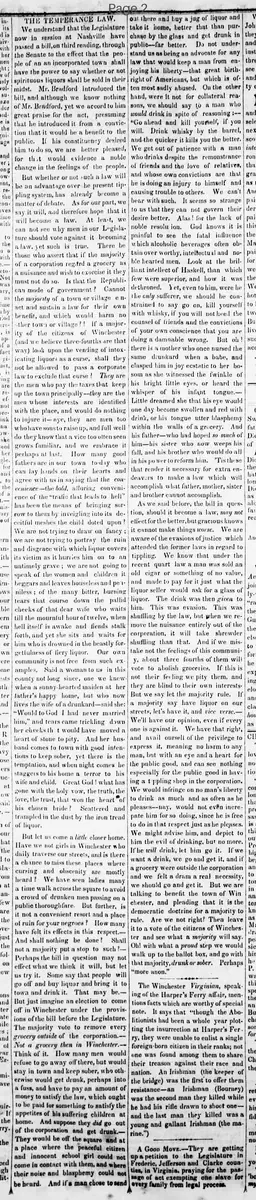
THE TEMPERANCE LAW.
We understand that the Legislature now in session at Nashville have passed a bill, on third reading, through the Senate to the effect that the people of an incorporated town shall have the power to say whether or not spirituous liquors shall be sold in their midst. Mr. Bradford introduced the bill, and although we know nothing of Mr. Bradford, yet we accord to him great praise for the act, presuming that he introduced it from a conviction that it would be a benefit to the public. If his constituency desired him to do so, we are better pleased, for that would evidence a noble change in the feelings of the people.
But whether or not such a law will be an advantage over the present tippling system, has already become a matter of debate. As for our part, we say it will, and therefore hope that it will become a law. At least, we can not see why men in our Legislature should vote against it becoming a law, yet such is true. There be those who assert that if the majority of a corporation regard a grocery as a nuisance and wish to exorcise it they must not do so. Is that the Republican mode of government? Cannot the majority of a town or village enact and sustain a law for their own benefit, and which would harm no other town or village?! If a majority of the citizens of Winchester (and we believe three-fourths are that way) look upon the vending of intoxicating liquors as a curse, shall they not be allowed to pass a corporate law to exclude that curse? They are the men who pay the taxes that keep up the town principally—they are the men whose interests are identified with the place, and would do nothing to injure it—aye, they are men too who have sons to raise up, and full well do they know that a vice too often seen grows familiar, and we embrace it perhaps at last. How many good fathers are in our town to-day who can lay hands on their hearts and agree with us in saying that the convenience—the bold, alluring convenience of the "traffic that leads to hell" has been the means of bringing sorrow to them by inveigling into its deceitful meshes the child doted upon? We are not trying to draw on fancy: we are not trying to portray the ruin and disgrace with which liquor covers its victim as it hurries him on to an untimely grave; we are not going to speak of the women and children it beggars and leaves houseless and penniless; of the many bitter, burning tears that course down the pallid cheeks of that dear wife who waits till the mournful hour of twelve, when hell itself is awake and fiends stalk forth, and yet she sits and waits for him who is drowned in the beastly forgetfulness of fiery liquor. Our own community is not free from such examples. Said a woman to us in this county not long since, one we knew when a sunny-hearted maiden at her father's happy home, but who now lives the wife of a drunkard—said she: "Would to God I had never married him," and tears came trickling down her cheeks that would have moved a heart of stone to pity. And her husband comes to town with good intentions to keep sober, yet there is the temptation, and when night comes he staggers to his home a terror to his wife and child. Great God! what has gone with the holy vow, the truth, the love, the trust, that won the heart of his chosen bride? Scattered and trampled in the dust by the iron tread of liquor.
But let us come a little closer home. Have we not girls in Winchester who daily traverse our streets, and is there a chance to miss these places where cursing and obscenity are mostly heard? We have seen ladies many a time walk across the square to avoid a crowd of drunken men passing on a public thoroughfare. But further, is it not a convenient resort and a place of ruin for your negroes? How many have felt its effects in this respect.—And shall nothing be done? Shall not a majority put a stop to such?—Perhaps the bill in question may not effect what we think it will, but let us try it. Some say that people will go off and buy liquor and bring it to town and drink it. That may be.—But just imagine an election to come off in Winchester under the provisions of the bill before the Legislature. The majority vote to remove every grocery outside of the corporation.—Not a grocery then in Winchester.—Think of it. How many men would refuse to go away off there, but would stay in town and keep sober, who otherwise would get drunk, perhaps into a fuss, and have to pay an amount of money to satisfy the law, which ought to be paid for something to satisfy the appetites of his suffering children at home. And suppose they did go out of the corporation and get drunk.—They would be off the square and at a place where the peaceful citizen and innocent school girl could not come in contact with them, and where their noise and blasphemy could not be heard. And if a man chose to send out there and buy a jug of liquor and take it home, better that than purchase by the glass and get drunk in public—far better. Do not understand us as being an advocate for any law that would keep a man from enjoying his liberty—that great birth-right of Americans, but which is often most sadly abused. On the other hand, were it not for collateral reasons, we should say to a man who would drink in spite of reasoning:—"Go ahead and kill yourself, if you will. Drink whisky by the barrel, and the quicker it kills you the better." We get out of patience with a man who drinks despite the remonstrance of friends and the love of relatives, and whose own convictions are that he is doing an injury to himself and causing trouble to others. We can't bear with such. It seems so strange to us that they can not govern their desire better. Alas! for the lack of noble resolution. God knows it is painful to see the fatal influence which alcoholic beverages often obtain over worthy, intellectual and noble hearted men. Look at the brilliant intellect of Haskell, than which few were superior, and how it was dethroned. Yet, even to him, were he the only sufferer, we should be constrained to say go on, kill yourself with whisky, if you will not heed the counsel of friends and the convictions of your own conscience that you are doing a damnable wrong. But oh! there is a mother who once nursed the same drunkard when a babe, and clasped him in joy ecstatic to her bosom as she witnessed the twinkle of his bright little eyes, or heard the whisper of his infant tongue.—Little dreamed she that his eye would one day become swollen and red with drink, or his tongue utter blasphemy within the walls of a grocery. And his father—who had hoped so much of him—his sister who now weeps his fall, and his brother who would do all in his power to reform him. 'Tis these that render it necessary for extra endeavors to make a law which will accomplish what father, mother, sister and brother cannot accomplish.
As we said before, the bill in question, should it become a law, may not effect for the better, but gracious knows it cannot make things worse. We are aware of the evasions of justice which attended the former laws in regard to tippling. We know that under the recent quart law a man was sold an old cigar or something of no value and made to pay for it just what the liquor seller would ask for a glass of liquor. The drink was then given to him. This was evasion. This was shuffling by the law, but when we remove the nuisance entirely out of the corporation, it will take shrewder shuffling than that. And if we mistake not the feelings of this community, about three fourths of them will vote to abolish groceries. If this is not their feeling we pity them, and they are blind to their own interests. But we say let the majority rule. If a majority say have liquor on our streets, let's have it, and vice versa.—We'll have our opinion, even if every one is against it. We have that right, and avail ourselves of the privilege to express it, meaning no harm to any man, but with an eye and a heart for the public good, and can see nothing especially for the public good in having a tippling shop in the corporation. We would infringe on no man's liberty to drink as much and as often as he pleases—nay, would not even incarcerate him for so doing, since he is free to do in that respect just as he pleases. We might advise him, and depict to him the evil of drinking, but no more. If he will drink, let him go it. If we want a drink, we go and get it, and if a grocery were outside the corporation and we felt a dram a real necessity, we should go and get it. But we are talking to benefit the town of Winchester, and pleading that it is the democratic doctrine for a majority to rule. Are we not right? Then leave it to a vote of the citizens of Winchester and see what a majority will say. Oh! with what a proud step we would walk up to the ballot box, and go with that majority, drunk or sober. Perhaps "more anon."
We understand that the Legislature now in session at Nashville have passed a bill, on third reading, through the Senate to the effect that the people of an incorporated town shall have the power to say whether or not spirituous liquors shall be sold in their midst. Mr. Bradford introduced the bill, and although we know nothing of Mr. Bradford, yet we accord to him great praise for the act, presuming that he introduced it from a conviction that it would be a benefit to the public. If his constituency desired him to do so, we are better pleased, for that would evidence a noble change in the feelings of the people.
But whether or not such a law will be an advantage over the present tippling system, has already become a matter of debate. As for our part, we say it will, and therefore hope that it will become a law. At least, we can not see why men in our Legislature should vote against it becoming a law, yet such is true. There be those who assert that if the majority of a corporation regard a grocery as a nuisance and wish to exorcise it they must not do so. Is that the Republican mode of government? Cannot the majority of a town or village enact and sustain a law for their own benefit, and which would harm no other town or village?! If a majority of the citizens of Winchester (and we believe three-fourths are that way) look upon the vending of intoxicating liquors as a curse, shall they not be allowed to pass a corporate law to exclude that curse? They are the men who pay the taxes that keep up the town principally—they are the men whose interests are identified with the place, and would do nothing to injure it—aye, they are men too who have sons to raise up, and full well do they know that a vice too often seen grows familiar, and we embrace it perhaps at last. How many good fathers are in our town to-day who can lay hands on their hearts and agree with us in saying that the convenience—the bold, alluring convenience of the "traffic that leads to hell" has been the means of bringing sorrow to them by inveigling into its deceitful meshes the child doted upon? We are not trying to draw on fancy: we are not trying to portray the ruin and disgrace with which liquor covers its victim as it hurries him on to an untimely grave; we are not going to speak of the women and children it beggars and leaves houseless and penniless; of the many bitter, burning tears that course down the pallid cheeks of that dear wife who waits till the mournful hour of twelve, when hell itself is awake and fiends stalk forth, and yet she sits and waits for him who is drowned in the beastly forgetfulness of fiery liquor. Our own community is not free from such examples. Said a woman to us in this county not long since, one we knew when a sunny-hearted maiden at her father's happy home, but who now lives the wife of a drunkard—said she: "Would to God I had never married him," and tears came trickling down her cheeks that would have moved a heart of stone to pity. And her husband comes to town with good intentions to keep sober, yet there is the temptation, and when night comes he staggers to his home a terror to his wife and child. Great God! what has gone with the holy vow, the truth, the love, the trust, that won the heart of his chosen bride? Scattered and trampled in the dust by the iron tread of liquor.
But let us come a little closer home. Have we not girls in Winchester who daily traverse our streets, and is there a chance to miss these places where cursing and obscenity are mostly heard? We have seen ladies many a time walk across the square to avoid a crowd of drunken men passing on a public thoroughfare. But further, is it not a convenient resort and a place of ruin for your negroes? How many have felt its effects in this respect.—And shall nothing be done? Shall not a majority put a stop to such?—Perhaps the bill in question may not effect what we think it will, but let us try it. Some say that people will go off and buy liquor and bring it to town and drink it. That may be.—But just imagine an election to come off in Winchester under the provisions of the bill before the Legislature. The majority vote to remove every grocery outside of the corporation.—Not a grocery then in Winchester.—Think of it. How many men would refuse to go away off there, but would stay in town and keep sober, who otherwise would get drunk, perhaps into a fuss, and have to pay an amount of money to satisfy the law, which ought to be paid for something to satisfy the appetites of his suffering children at home. And suppose they did go out of the corporation and get drunk.—They would be off the square and at a place where the peaceful citizen and innocent school girl could not come in contact with them, and where their noise and blasphemy could not be heard. And if a man chose to send out there and buy a jug of liquor and take it home, better that than purchase by the glass and get drunk in public—far better. Do not understand us as being an advocate for any law that would keep a man from enjoying his liberty—that great birth-right of Americans, but which is often most sadly abused. On the other hand, were it not for collateral reasons, we should say to a man who would drink in spite of reasoning:—"Go ahead and kill yourself, if you will. Drink whisky by the barrel, and the quicker it kills you the better." We get out of patience with a man who drinks despite the remonstrance of friends and the love of relatives, and whose own convictions are that he is doing an injury to himself and causing trouble to others. We can't bear with such. It seems so strange to us that they can not govern their desire better. Alas! for the lack of noble resolution. God knows it is painful to see the fatal influence which alcoholic beverages often obtain over worthy, intellectual and noble hearted men. Look at the brilliant intellect of Haskell, than which few were superior, and how it was dethroned. Yet, even to him, were he the only sufferer, we should be constrained to say go on, kill yourself with whisky, if you will not heed the counsel of friends and the convictions of your own conscience that you are doing a damnable wrong. But oh! there is a mother who once nursed the same drunkard when a babe, and clasped him in joy ecstatic to her bosom as she witnessed the twinkle of his bright little eyes, or heard the whisper of his infant tongue.—Little dreamed she that his eye would one day become swollen and red with drink, or his tongue utter blasphemy within the walls of a grocery. And his father—who had hoped so much of him—his sister who now weeps his fall, and his brother who would do all in his power to reform him. 'Tis these that render it necessary for extra endeavors to make a law which will accomplish what father, mother, sister and brother cannot accomplish.
As we said before, the bill in question, should it become a law, may not effect for the better, but gracious knows it cannot make things worse. We are aware of the evasions of justice which attended the former laws in regard to tippling. We know that under the recent quart law a man was sold an old cigar or something of no value and made to pay for it just what the liquor seller would ask for a glass of liquor. The drink was then given to him. This was evasion. This was shuffling by the law, but when we remove the nuisance entirely out of the corporation, it will take shrewder shuffling than that. And if we mistake not the feelings of this community, about three fourths of them will vote to abolish groceries. If this is not their feeling we pity them, and they are blind to their own interests. But we say let the majority rule. If a majority say have liquor on our streets, let's have it, and vice versa.—We'll have our opinion, even if every one is against it. We have that right, and avail ourselves of the privilege to express it, meaning no harm to any man, but with an eye and a heart for the public good, and can see nothing especially for the public good in having a tippling shop in the corporation. We would infringe on no man's liberty to drink as much and as often as he pleases—nay, would not even incarcerate him for so doing, since he is free to do in that respect just as he pleases. We might advise him, and depict to him the evil of drinking, but no more. If he will drink, let him go it. If we want a drink, we go and get it, and if a grocery were outside the corporation and we felt a dram a real necessity, we should go and get it. But we are talking to benefit the town of Winchester, and pleading that it is the democratic doctrine for a majority to rule. Are we not right? Then leave it to a vote of the citizens of Winchester and see what a majority will say. Oh! with what a proud step we would walk up to the ballot box, and go with that majority, drunk or sober. Perhaps "more anon."
What sub-type of article is it?
Temperance
Moral Or Religious
Social Reform
What keywords are associated?
Temperance Law
Liquor Ban
Majority Rule
Winchester
Alcohol Harms
Family Protection
Local Option
What entities or persons were involved?
Mr. Bradford
Tennessee Legislature
Winchester Citizens
Haskell
Editorial Details
Primary Topic
Support For Local Option Law Banning Liquor Sales In Tennessee Towns
Stance / Tone
Strongly Pro Temperance, Moral Exhortation Advocating Majority Rule
Key Figures
Mr. Bradford
Tennessee Legislature
Winchester Citizens
Haskell
Key Arguments
Majority In Incorporated Towns Should Vote To Ban Liquor Sales
Liquor Vending Is A Curse Harming Families, Women, Children, And Community
Protects Youth And Innocents From Exposure To Vice And Drunkenness
Better Than Current Evasion Prone Laws, Even If Some Buy Liquor Outside
Democratic Principle Of Majority Rule For Local Benefit
Does Not Infringe Personal Liberty To Drink Privately