Thank you for visiting SNEWPapers!
Sign up free
Literary
March 2, 1921
The Lamar Register
Lamar, Prowers County, Colorado
What is this article about?
Excerpt from 'A Princess of Mars' by Edgar Rice Burroughs. John Carter, transported to Mars, is captured by green Martians, meets princess Dejah Thoris, plans escape, fights a duel against betrayal, and learns Sola's tragic family story amid a caravan journey to Thark.
Merged-components note: Merging continuation of serialized story 'A Princess of Mars' across pages 2 and 5, including overlapping illustrations.
Clippings
1 of 2
OCR Quality
85%
Good
Full Text
Synopsis.
FOREWORD.—The author tells of his acquaintance with the hero of one of the most remarkable adventures ever recorded. From a manuscript left by his friend he has vividly set out the strange happenings which brought together a brave Virginia gentleman and a Princess of Mars.
CHAPTER I.—In the Arizona hills. John Carter, mining prospector and ex-Confederate soldier, fleeing from a war party of Apaches, takes refuge in a cave the atmosphere of which has a remarkable effect on him. Yielding to its influence, he sinks into unconsciousness, his last thoughts centered on the glow from the planet Mars.
CHAPTER II.—Awaking, Carter realizes that he has, in some incomprehensible manner, been transported to Mars. He is surprised by a party of armed Martian warriors, who seek his life. He convinces their leader, Tars Tarkas, of his harmlessness and is conveyed, a prisoner, to the Martian city.
CHAPTER III.—A creature holding much the position of a dog on earth set to guard him.
CHAPTER IV.—Three days later a fleet of warships from the neighboring state of Helium, passing over the city, is attacked by Carter's captors, the green Martians. The fleet is scattered and one of the airships captured. Among the prisoners is a young woman of a race different from the green Martians and more closely resembling the women of the earth.
CHAPTER V.—Carter ascertains that the fair prisoner's name is Dejah Thoris, granddaughter of the Jeddak, or ruler, of Helium. He also ascertains that according to custom he is doomed to die by torture. In the council chamber he talks with her and assures her of his sympathy.
CHAPTER VI.—The prisoner is confined to the guardianship of Carter's friend, Sola, and the two prisoners plan to escape before Dejah Thoris is taken before the supreme ruler of the green Martians, Tal Hajus.
My first impulse was to tell her of my love, and then I thought of the helplessness of her position wherein I alone could lighten the burdens of her captivity, and protect her in my poor way against the thousands of hereditary enemies she must face upon our arrival at Thark. I could not chance causing her additional pain or sorrow by declaring a love which, in all probability she did not return.
"Why are you so quiet, Dejah Thoris?" I asked.
"Possibly you would rather return to Sola and your quarters."
"No," she murmured, "I am happy here. I do not know why it is that I should always be happy and contented when you, John Carter, a stranger, are with me; yet at such times it seems that I am safe and that, with you, I shall soon return to my father's court and feel his strong arms about me and my mother's tears and kisses on my cheek."
"Do people kiss, then, upon Barsoom?" I asked, when she had explained the word she used, in answer to my inquiry as to its meaning.
"Parents, brothers, and sisters, yes; and," she added in a low, thoughtful tone, "lovers."
"And you, Dejah Thoris, have parents and brothers and sisters?"
"Yes."
"And a—lover?"
She was silent, nor could I venture to repeat the question.
"The man of Barsoom," she finally ventured, "does not ask personal questions of women, except his mother, and the woman he has fought for and won."
"But I have fought—" I started, and then I wished my tongue had been cut from my mouth: for she turned even as I caught myself and ceased, and drawing my silks from her shoulder she held them out to me, and without a word, and with head held high, she moved with the carriage of the queen she was toward the plaza and the doorway of her quarters.
I did not attempt to follow her, other than to see that she reached the building in safety, but directing Woola to accompany her, I turned disconsolately and entered my own house.
I sat for hours cross-legged, and cross-tempered, upon my silks meditating upon the queer freaks chance plays upon us poor devils of mortals.
I was a fool, but I was in love, and though I was suffering the greatest misery I had ever known I would not have had it otherwise for all the riches of Barsoom. Such is love, and such are lovers wherever love is known.
To me Dejah Thoris was all that was perfect; all that was virtuous and beautiful and noble and good. I believed that from the bottom of my heart, from the depth of my soul on that night in Korad as I sat cross-legged upon my silks, and I believe it today as I sit at my desk in the little study overlooking the Hudson.
Twenty years have intervened; for ten of them I lived and fought for Dejah Thoris and her people, and for ten I have lived upon her memory.
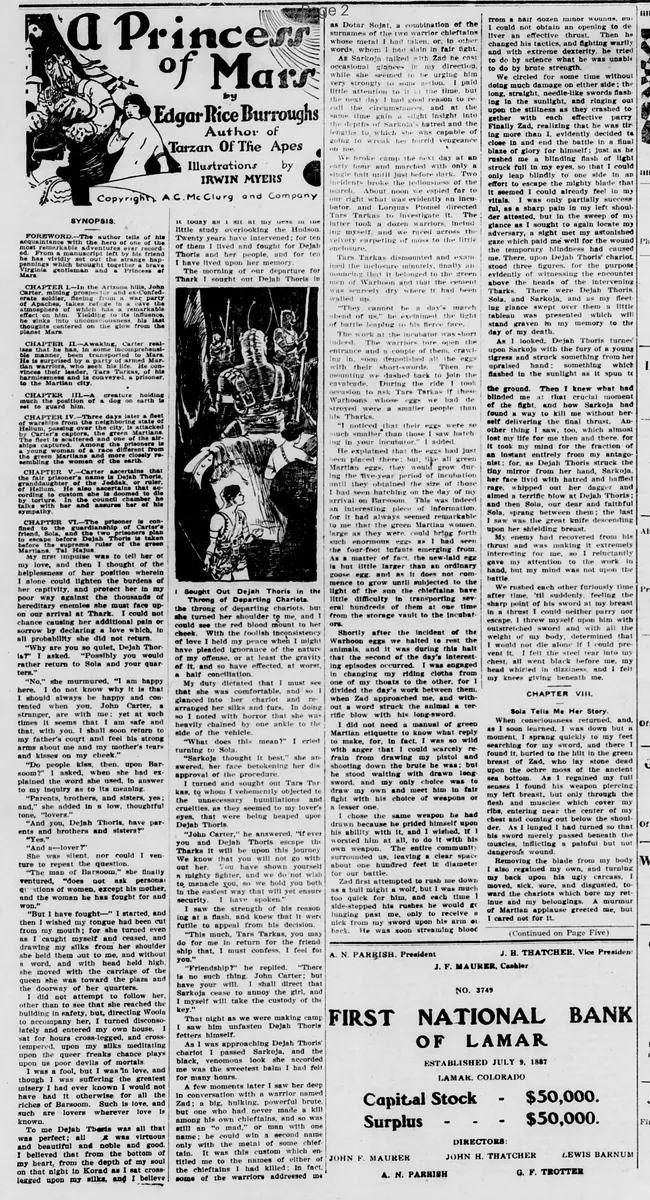
The morning of our departure for Thark I sought out Dejah Thoris in the throng of departing chariots.
Sought Out Dejah Thoris in the Throng of Departing Chariots, but she turned her shoulder to me, and I could see the red blood mount to her cheek.
With the foolish inconsistency of love I held my peace when I might have pleaded ignorance of the nature of my offense, or at least the gravity of it, and so have effected, at worst, a half conciliation.
My duty dictated that I must see that she was comfortable, and so I glanced into her chariot and re-arranged her silks and furs. In doing so I noted with horror that she was heavily chained by one ankle to the side of the vehicle.
"What does this mean?" I cried turning to Sola.
"Sarkoja thought it best," she answered, her face betokening her disapproval of the procedure.
I turned and sought out Tars Tarkas, to whom I vehemently objected to the unnecessary humiliations and cruelties, as they seemed to my lover's eyes, that were being heaped upon Dejah Thoris.
"John Carter," he answered, "If ever you and Dejah Thoris escape the Tharks it will be upon this journey. We know that you will not go without her. You have shown yourself a mighty fighter, and we do not wish to manacle you, so we hold you both in the easiest way that will yet ensure security. I have spoken."
I saw the strength of his reasoning at a flash, and knew that it were futile to appeal from his decision.
"This much, Tars Tarkas, you may do for me in return for the friendship that, I must confess, I feel for you."
"Friendship?" he replied. "There is no such thing, John Carter; but have your will. I shall direct that Sarkoja cease to annoy the girl, and I myself will take the custody of the key."
That night as we were making camp I saw him unfasten Dejah Thoris' fetters himself.
As I was approaching Dejah Thoris' chariot I passed Sarkoja, and the black, venomous look she accorded me was the sweetest balm I had felt for many hours.
A few moments later I saw her deep in conversation with a warrior named Zad; a big, hulking, powerful brute, but one who had never made a kill among his own chieftains, and so was still an "o mad," or man with one name; he could win a second name only with the metal of some chief.
It was this custom which entitled me to the names of either of the chieftains I had killed; in fact, some of the warriors addressed me as Dotar Sojat, a combination of the surnames of the two warrior chieftains whose metal I had taken, or, in other words, whom I had slain in fair fight.
As Sarkoja talked with Zad he cast occasional glances in my direction, while she seemed to be urging him very strongly to some action. I paid little attention to it at the time, but the next day I had good reason to recall the circumstances, and at the same time gain a slight insight into the depths of Sarkoja's hatred and the lengths to which she was capable of going to wreak her horrid vengeance on me.
We broke camp the next day at an early hour and marched with only a single halt until just before dark. Two incidents broke the monotony of the march. About noon we espied far to our right what was evidently an incubator, and Lorquas Ptomel directed Tars Tarkas to investigate it. The latter took a dozen warriors, including myself, and we raced across the velvety carpeting of moss to the little enclosure.
Tars Tarkas dismounted and examined the inclosure minutely, finally announcing that it belonged to the green men of Warhoon and that the cement was scarcely dry where it had been walled up.
"They cannot be a day's march ahead of us," he exclaimed the light of battle leaping to his fierce face.
The work at the incubator was short indeed. The warriors tore open the entrance and a couple of them, crawling in, soon demolished all the eggs with their short-swords. Then remounting we dashed back to join the cavalcade. During the ride I took occasion to ask Tars Tarkas if these Warhoons whose eggs we had destroyed were a smaller people than his Tharks.
"I noticed that their eggs were so much smaller than those I saw hatching in your incubator," I added.
He explained that the eggs had just been placed there: but, like all green Martian eggs, they would grow during the five-year period of incubation until they obtained the size of those I had seen hatching on the day of my arrival on Barsoom. This was indeed an interesting piece of information, for it had always seemed remarkable to me that the green Martian women, large as they were, could bring forth such enormous eggs as I had seen the four-foot infants emerging from.
As a matter of fact, the new-laid egg is but little larger than an ordinary goose egg, and as it does not commence to grow until subjected to the light of the sun the chieftains have little difficulty in transporting several hundreds of them at one time from the storage vault to the incubators.
Shortly after the incident of the Warhoon eggs we halted to rest the animals, and it was during this halt that the second of the day's interesting episodes occurred. I was engaged in changing my riding cloths from one of my thoats to the other, for I divided the day's work between them, when Zad approached me, and without a word struck the animal a terrific blow with his long-sword.
I did not need a manual of green Martian etiquette to know what reply to make, for, in fact, I was so wild with anger that I could scarcely refrain from drawing my pistol and shooting down the brute he was; but he stood waiting with drawn long-sword, and my only choice was to draw my own and meet him in fair fight with his choice of weapons or a lesser one.
I chose the same weapon he had drawn because he prided himself upon his ability with it, and I wished, if I worsted him at all, to do it with his own weapon. The entire community surrounded us, leaving a clear space about one hundred feet in diameter for our battle.
Zad first attempted to rush me down as a bull might a wolf, but I was much too quick for him, and each time side-stepped his rushes he would go lunging past me, only to receive a nick from my sword upon his arm or back.
He was soon streaming blood from a half dozen minor wounds, but I could not obtain an opening to deliver an effective thrust. Then he changed his tactics, and fighting warily and with extreme dexterity, he tried to do by science what he was unable to do by brute strength.
We circled for some time without doing much damage on either side; the long, straight, needle-like swords flashing in the sunlight, and ringing out upon the stillness as they crashed together with each effective parry.
Finally Zad, realizing that he was tiring more than I, evidently decided to close in and end the battle in a final blaze of glory for himself; just as he rushed me a blinding flash of light struck full in my eyes, so that I could only leap blindly to one side in an effort to escape the mighty blade that it seemed I could already feel in my vitals. I was only partially successful, as a sharp pain in my left shoulder attested, but in the sweep of my glance as I sought to again locate my adversary, a sight met my astonished gaze which paid me well for the wound the temporary blindness had caused me.
There, upon Dejah Thoris' chariot, stood three figures, for the purpose evidently of witnessing the encounter above the heads of the intervening Tharks.
There were Dejah Thoris, Sola, and Sarkoja, and as my fleeting glance swept over them a little tableau was presented which will stand graven in my memory to the day of my death.
As I looked, Dejah Thoris turned upon Sarkoja with the fury of a young tigress and struck something from her upraised hand: something which flashed in the sunlight as it spun to the ground.
Then I knew what had blinded me at that crucial moment of the fight, and how Sarkoja had found a way to kill me without herself delivering the final thrust. Another thing I saw, too, which almost lost my life for me then and there, for it took my mind for the fraction of an instant entirely from my antagonist; for, as Dejah Thoris struck the tiny mirror from her hand, Sarkoja, her face livid with hatred and baffled rage, whipped out her dagger and aimed a terrific blow at Dejah Thoris; and then Sola, our dear and faithful Sola, sprang between them: the last I saw was the great knife descending upon her shielding breast.
My enemy had recovered from his thrust and was making it extremely interesting for me, so I reluctantly gave my attention to the work in hand, but my mind was not upon the battle.
We rushed each other furiously time after time, 'til suddenly, feeling the sharp point of his sword at my breast in a thrust I could neither parry nor escape, I threw myself upon him with outstretched sword and with all the weight of my body, determined that I would not die alone if I could prevent it. I felt the steel tear into my chest, all went black before me, my head whirled in dizziness, and I felt my knees giving beneath me.
CHAPTER VIII.
Sola Tells Me Her Story.
When consciousness returned, and, as I soon learned, I was down but a moment, I sprang quickly to my feet searching for my sword, and there I found it, buried to the hilt in the green breast of Zad, who lay stone dead upon the ochre moss of the ancient sea bottom.
As I regained my full senses I found his weapon piercing my left breast, but only through the flesh and the muscles which cover my ribs, entering near the center of my chest and coming out below the shoulder. As I lunged I had turned so that his sword merely passed beneath the muscles, inflicting a painful but not dangerous wound.
Removing the blade from my body I also regained my own, and turning my back upon his ugly carcass, I moved, sick, sore, and disgusted, toward the chariots which bore my retainue and my belongings.
A murmur of Martian applause greeted me, but I cared not for it.
(Continued on Page Five)
A Princess of Mars
By Edgar Rice Burroughs,
Author of
Tarzan of the Apes
Illustrations by Irwin Myers
(Copyright, 1912, by A. C. McClurg & Co.)
(Continued from Page Two)
Bleeding and weak I reached my women, who, accustomed to such happenings, dressed my wounds, applying the wonderful healing and remedial agents which make only the most instantaneous of death blows fatal.
As soon as they were through with me I hastened to the chariot of Dejah Thoris, where I found my poor Sola with her chest swathed in bandages, but apparently little the worse for her encounter with Sarkoja, whose dagger it seemed had struck the edge of one of Sola's metal breast ornaments and, thus deflected, had inflicted but a slight flesh wound.
As I approached I found Dejah Thoris lying prone upon her silks and furs, her lithe form racked with sobs. She did not notice my presence, nor did she hear me speaking with Sola, who was standing a short distance from the vehicle.
"Is she injured?" I asked of Sola, indicating Dejah Thoris by an inclination of my head.
"No," she answered. "She thinks that you are dead. I do not understand either her ways or yours, but I am sure the granddaughter of ten thousand jeddaks would never grieve like this over the death of one she considered beneath her, or indeed over any one who held but the highest claim upon her affections.
"Tears are a strange sight upon Barsoom," she continued, "and so it is difficult for me to interpret them. I have seen but two people weep in all my life, other than Dejah Thoris: one wept from sorrow, the other from baffled rage. The first was my mother, years ago, before they killed her; the other was Sarkoja, when they dragged her from me today."
"Your mother!" I exclaimed. "But, Sola, you could not have known your mother, child."
"But I did. And my father, also," she added. "If you would like to hear the strange and un-Barsoomian stories come to the chariot tonight, John Carter, and I will tell you that of which I have never spoken in all my life before."
"I will come tonight, Sola," I promised. "Be sure to tell Dejah Thoris I am alive and well. If she would speak with me I but await her command."
Sola mounted the chariot, which was swinging into its place in line, and I hastened to my waiting thoat and galloped to my station beside Tars Tarkas at the rear of the column.
We made a most imposing and awe-inspiring spectacle as we strung out across the yellow landscape: the two hundred and fifty ornate and brightly colored chariots, preceded by an advance guard of some two hundred mounted warriors and chieftains riding five abreast and one hundred yards apart, and followed by a like number in the same formation, with a score or more of flankers on either side; the fifty extra mastodons, or heavy draught animals, known as zitidars, and the five or six hundred extra thoats of the warriors running loose within the hollow square formed by the surrounding warriors. The gleaming metal and jewels of the gorgeous ornaments of the men and women, duplicated in the trappings of the zitidars and thoats, and interspersed with the flashing colors of magnificent silks and furs and feathers, lent a barbaric splendor to the caravan which would have turned an East Indian potentate green with envy.
The enormous broad tires of the chariots and the padded feet of the animals brought forth no sound from the moss-covered sea bottom; and so we moved in utter silence, like some huge phantasmagoria, except when the stillness was broken by the guttural growling of a goaded zitidar, or the squealing of fighting thoats. The green Martians converse but little, and then usually in monosyllables, low and like the faint rumbling of distant thunder.
We traversed a trackless waste of moss which, bending to the pressure of broad tire or padded foot, rose up again behind us, leaving no sign that we had passed. We might indeed have been the wraiths of the departed dead upon the dead sea of that dying planet for all the sound or sign we made in passing. It was the first march of a large body of men and animals I had ever witnessed which raised no dust and left no spoor; for there is no dust upon Mars except in the cultivated districts during the winter months, and even then the absence of high winds renders it almost unnoticeable.
We camped that night at the foot of the hills we had been approaching for two days and which marked the southern boundary of this particular sea. Our animals had been two days without drink, nor had they had water for nearly two months, not since shortly after leaving Thark; but, as Tars Tarkas explained to me, they require but little and can live almost indefinitely upon the moss which covers Barsoom, and which, he told me, holds in its tiny stems sufficient moisture to meet the limited demands of the animals.
After partaking of my evening meal of cheese-like food and vegetable milk I sought out Sola, whom I found working by the light of a torch upon some of Tars Tarkas' trappings. She looked up at my approach, her face lighting with pleasure and with welcome.
"I am glad you came," she said; "Dejah Thoris sleeps and I am lonely. I promised to tell you my story, or rather the story of my parents. From what I have learned of you and the ways of your people I am sure that the tale will not seem strange to you. But among green Martians it has no parallel within the memory of the oldest living Thark, nor do our legends hold many similar tales.
"My mother was rather small, in fact too small to be allowed the responsibilities of maternity, as our chieftains breed principally for size. She was also less cold and cruel than most green Martian women, and caring little for their society, she often roamed the deserted avenues of Thark alone, or went and sat among the wild flowers that deck the nearby hills, thinking thoughts and wishing wishes which I believe I alone among Tharkian women today may understand, for am I not the child of my mother?
"And there among the hills she met a young warrior, whose duty it was to guard the feeding zitidars and thoats and see that they roamed not beyond the hills. She trusted him and told of the awful repugnance she felt for the cruelties of their kind, for the hideous, loveless lives they must ever lead. And then she waited for the storm of denunciation to break from his cold, hard lips; but instead he took her in his arms and kissed her.
"They kept their love a secret for six long years. She, my mother, was of the retinue of the great Tal Hajus, while her lover was a simple warrior, wearing only his own metal. Had their defection from the traditions of the Tharks been discovered both would have paid the penalty in the great arena before Tal Hajus and the assembled hordes.
The egg from which I came was hidden beneath a great glass vessel upon the highest and most inaccessible of the partially ruined towers of ancient Thark. Once each year my mother visited it for the five long years it lay there in the process of incubation. She dared not come oftener, for in the mighty guilt of her conscience she feared that her every move was watched. During this period my father gained great distinction as a warrior and had taken the metal from several chieftains. His advance was rapid and he soon stood high in the councils of Thark. But one day he was ordered away upon a long expedition to the ice-clad south, to make war upon the natives there and despoil them of their furs, for which we had developed a taste during our incursions into the land of the yellow men.
"He was gone for four years, and when he returned all had been over for three; for about a year after his departure, and shortly before the time for the return of an expedition which had gone forth to fetch the fruits of a community incubator, the egg had hatched.
Thereafter my mother continued to keep me in the old tower, visiting me nightly and lavishing upon me the love the community life would have robbed us both of.
(To Be Continued).
FOREWORD.—The author tells of his acquaintance with the hero of one of the most remarkable adventures ever recorded. From a manuscript left by his friend he has vividly set out the strange happenings which brought together a brave Virginia gentleman and a Princess of Mars.
CHAPTER I.—In the Arizona hills. John Carter, mining prospector and ex-Confederate soldier, fleeing from a war party of Apaches, takes refuge in a cave the atmosphere of which has a remarkable effect on him. Yielding to its influence, he sinks into unconsciousness, his last thoughts centered on the glow from the planet Mars.
CHAPTER II.—Awaking, Carter realizes that he has, in some incomprehensible manner, been transported to Mars. He is surprised by a party of armed Martian warriors, who seek his life. He convinces their leader, Tars Tarkas, of his harmlessness and is conveyed, a prisoner, to the Martian city.
CHAPTER III.—A creature holding much the position of a dog on earth set to guard him.
CHAPTER IV.—Three days later a fleet of warships from the neighboring state of Helium, passing over the city, is attacked by Carter's captors, the green Martians. The fleet is scattered and one of the airships captured. Among the prisoners is a young woman of a race different from the green Martians and more closely resembling the women of the earth.
CHAPTER V.—Carter ascertains that the fair prisoner's name is Dejah Thoris, granddaughter of the Jeddak, or ruler, of Helium. He also ascertains that according to custom he is doomed to die by torture. In the council chamber he talks with her and assures her of his sympathy.
CHAPTER VI.—The prisoner is confined to the guardianship of Carter's friend, Sola, and the two prisoners plan to escape before Dejah Thoris is taken before the supreme ruler of the green Martians, Tal Hajus.
My first impulse was to tell her of my love, and then I thought of the helplessness of her position wherein I alone could lighten the burdens of her captivity, and protect her in my poor way against the thousands of hereditary enemies she must face upon our arrival at Thark. I could not chance causing her additional pain or sorrow by declaring a love which, in all probability she did not return.
"Why are you so quiet, Dejah Thoris?" I asked.
"Possibly you would rather return to Sola and your quarters."
"No," she murmured, "I am happy here. I do not know why it is that I should always be happy and contented when you, John Carter, a stranger, are with me; yet at such times it seems that I am safe and that, with you, I shall soon return to my father's court and feel his strong arms about me and my mother's tears and kisses on my cheek."
"Do people kiss, then, upon Barsoom?" I asked, when she had explained the word she used, in answer to my inquiry as to its meaning.
"Parents, brothers, and sisters, yes; and," she added in a low, thoughtful tone, "lovers."
"And you, Dejah Thoris, have parents and brothers and sisters?"
"Yes."
"And a—lover?"
She was silent, nor could I venture to repeat the question.
"The man of Barsoom," she finally ventured, "does not ask personal questions of women, except his mother, and the woman he has fought for and won."
"But I have fought—" I started, and then I wished my tongue had been cut from my mouth: for she turned even as I caught myself and ceased, and drawing my silks from her shoulder she held them out to me, and without a word, and with head held high, she moved with the carriage of the queen she was toward the plaza and the doorway of her quarters.
I did not attempt to follow her, other than to see that she reached the building in safety, but directing Woola to accompany her, I turned disconsolately and entered my own house.
I sat for hours cross-legged, and cross-tempered, upon my silks meditating upon the queer freaks chance plays upon us poor devils of mortals.
I was a fool, but I was in love, and though I was suffering the greatest misery I had ever known I would not have had it otherwise for all the riches of Barsoom. Such is love, and such are lovers wherever love is known.
To me Dejah Thoris was all that was perfect; all that was virtuous and beautiful and noble and good. I believed that from the bottom of my heart, from the depth of my soul on that night in Korad as I sat cross-legged upon my silks, and I believe it today as I sit at my desk in the little study overlooking the Hudson.
Twenty years have intervened; for ten of them I lived and fought for Dejah Thoris and her people, and for ten I have lived upon her memory.
The morning of our departure for Thark I sought out Dejah Thoris in the throng of departing chariots.
Sought Out Dejah Thoris in the Throng of Departing Chariots, but she turned her shoulder to me, and I could see the red blood mount to her cheek.
With the foolish inconsistency of love I held my peace when I might have pleaded ignorance of the nature of my offense, or at least the gravity of it, and so have effected, at worst, a half conciliation.
My duty dictated that I must see that she was comfortable, and so I glanced into her chariot and re-arranged her silks and furs. In doing so I noted with horror that she was heavily chained by one ankle to the side of the vehicle.
"What does this mean?" I cried turning to Sola.
"Sarkoja thought it best," she answered, her face betokening her disapproval of the procedure.
I turned and sought out Tars Tarkas, to whom I vehemently objected to the unnecessary humiliations and cruelties, as they seemed to my lover's eyes, that were being heaped upon Dejah Thoris.
"John Carter," he answered, "If ever you and Dejah Thoris escape the Tharks it will be upon this journey. We know that you will not go without her. You have shown yourself a mighty fighter, and we do not wish to manacle you, so we hold you both in the easiest way that will yet ensure security. I have spoken."
I saw the strength of his reasoning at a flash, and knew that it were futile to appeal from his decision.
"This much, Tars Tarkas, you may do for me in return for the friendship that, I must confess, I feel for you."
"Friendship?" he replied. "There is no such thing, John Carter; but have your will. I shall direct that Sarkoja cease to annoy the girl, and I myself will take the custody of the key."
That night as we were making camp I saw him unfasten Dejah Thoris' fetters himself.
As I was approaching Dejah Thoris' chariot I passed Sarkoja, and the black, venomous look she accorded me was the sweetest balm I had felt for many hours.
A few moments later I saw her deep in conversation with a warrior named Zad; a big, hulking, powerful brute, but one who had never made a kill among his own chieftains, and so was still an "o mad," or man with one name; he could win a second name only with the metal of some chief.
It was this custom which entitled me to the names of either of the chieftains I had killed; in fact, some of the warriors addressed me as Dotar Sojat, a combination of the surnames of the two warrior chieftains whose metal I had taken, or, in other words, whom I had slain in fair fight.
As Sarkoja talked with Zad he cast occasional glances in my direction, while she seemed to be urging him very strongly to some action. I paid little attention to it at the time, but the next day I had good reason to recall the circumstances, and at the same time gain a slight insight into the depths of Sarkoja's hatred and the lengths to which she was capable of going to wreak her horrid vengeance on me.
We broke camp the next day at an early hour and marched with only a single halt until just before dark. Two incidents broke the monotony of the march. About noon we espied far to our right what was evidently an incubator, and Lorquas Ptomel directed Tars Tarkas to investigate it. The latter took a dozen warriors, including myself, and we raced across the velvety carpeting of moss to the little enclosure.
Tars Tarkas dismounted and examined the inclosure minutely, finally announcing that it belonged to the green men of Warhoon and that the cement was scarcely dry where it had been walled up.
"They cannot be a day's march ahead of us," he exclaimed the light of battle leaping to his fierce face.
The work at the incubator was short indeed. The warriors tore open the entrance and a couple of them, crawling in, soon demolished all the eggs with their short-swords. Then remounting we dashed back to join the cavalcade. During the ride I took occasion to ask Tars Tarkas if these Warhoons whose eggs we had destroyed were a smaller people than his Tharks.
"I noticed that their eggs were so much smaller than those I saw hatching in your incubator," I added.
He explained that the eggs had just been placed there: but, like all green Martian eggs, they would grow during the five-year period of incubation until they obtained the size of those I had seen hatching on the day of my arrival on Barsoom. This was indeed an interesting piece of information, for it had always seemed remarkable to me that the green Martian women, large as they were, could bring forth such enormous eggs as I had seen the four-foot infants emerging from.
As a matter of fact, the new-laid egg is but little larger than an ordinary goose egg, and as it does not commence to grow until subjected to the light of the sun the chieftains have little difficulty in transporting several hundreds of them at one time from the storage vault to the incubators.
Shortly after the incident of the Warhoon eggs we halted to rest the animals, and it was during this halt that the second of the day's interesting episodes occurred. I was engaged in changing my riding cloths from one of my thoats to the other, for I divided the day's work between them, when Zad approached me, and without a word struck the animal a terrific blow with his long-sword.
I did not need a manual of green Martian etiquette to know what reply to make, for, in fact, I was so wild with anger that I could scarcely refrain from drawing my pistol and shooting down the brute he was; but he stood waiting with drawn long-sword, and my only choice was to draw my own and meet him in fair fight with his choice of weapons or a lesser one.
I chose the same weapon he had drawn because he prided himself upon his ability with it, and I wished, if I worsted him at all, to do it with his own weapon. The entire community surrounded us, leaving a clear space about one hundred feet in diameter for our battle.
Zad first attempted to rush me down as a bull might a wolf, but I was much too quick for him, and each time side-stepped his rushes he would go lunging past me, only to receive a nick from my sword upon his arm or back.
He was soon streaming blood from a half dozen minor wounds, but I could not obtain an opening to deliver an effective thrust. Then he changed his tactics, and fighting warily and with extreme dexterity, he tried to do by science what he was unable to do by brute strength.
We circled for some time without doing much damage on either side; the long, straight, needle-like swords flashing in the sunlight, and ringing out upon the stillness as they crashed together with each effective parry.
Finally Zad, realizing that he was tiring more than I, evidently decided to close in and end the battle in a final blaze of glory for himself; just as he rushed me a blinding flash of light struck full in my eyes, so that I could only leap blindly to one side in an effort to escape the mighty blade that it seemed I could already feel in my vitals. I was only partially successful, as a sharp pain in my left shoulder attested, but in the sweep of my glance as I sought to again locate my adversary, a sight met my astonished gaze which paid me well for the wound the temporary blindness had caused me.
There, upon Dejah Thoris' chariot, stood three figures, for the purpose evidently of witnessing the encounter above the heads of the intervening Tharks.
There were Dejah Thoris, Sola, and Sarkoja, and as my fleeting glance swept over them a little tableau was presented which will stand graven in my memory to the day of my death.
As I looked, Dejah Thoris turned upon Sarkoja with the fury of a young tigress and struck something from her upraised hand: something which flashed in the sunlight as it spun to the ground.
Then I knew what had blinded me at that crucial moment of the fight, and how Sarkoja had found a way to kill me without herself delivering the final thrust. Another thing I saw, too, which almost lost my life for me then and there, for it took my mind for the fraction of an instant entirely from my antagonist; for, as Dejah Thoris struck the tiny mirror from her hand, Sarkoja, her face livid with hatred and baffled rage, whipped out her dagger and aimed a terrific blow at Dejah Thoris; and then Sola, our dear and faithful Sola, sprang between them: the last I saw was the great knife descending upon her shielding breast.
My enemy had recovered from his thrust and was making it extremely interesting for me, so I reluctantly gave my attention to the work in hand, but my mind was not upon the battle.
We rushed each other furiously time after time, 'til suddenly, feeling the sharp point of his sword at my breast in a thrust I could neither parry nor escape, I threw myself upon him with outstretched sword and with all the weight of my body, determined that I would not die alone if I could prevent it. I felt the steel tear into my chest, all went black before me, my head whirled in dizziness, and I felt my knees giving beneath me.
CHAPTER VIII.
Sola Tells Me Her Story.
When consciousness returned, and, as I soon learned, I was down but a moment, I sprang quickly to my feet searching for my sword, and there I found it, buried to the hilt in the green breast of Zad, who lay stone dead upon the ochre moss of the ancient sea bottom.
As I regained my full senses I found his weapon piercing my left breast, but only through the flesh and the muscles which cover my ribs, entering near the center of my chest and coming out below the shoulder. As I lunged I had turned so that his sword merely passed beneath the muscles, inflicting a painful but not dangerous wound.
Removing the blade from my body I also regained my own, and turning my back upon his ugly carcass, I moved, sick, sore, and disgusted, toward the chariots which bore my retainue and my belongings.
A murmur of Martian applause greeted me, but I cared not for it.
(Continued on Page Five)
A Princess of Mars
By Edgar Rice Burroughs,
Author of
Tarzan of the Apes
Illustrations by Irwin Myers
(Copyright, 1912, by A. C. McClurg & Co.)
(Continued from Page Two)
Bleeding and weak I reached my women, who, accustomed to such happenings, dressed my wounds, applying the wonderful healing and remedial agents which make only the most instantaneous of death blows fatal.
As soon as they were through with me I hastened to the chariot of Dejah Thoris, where I found my poor Sola with her chest swathed in bandages, but apparently little the worse for her encounter with Sarkoja, whose dagger it seemed had struck the edge of one of Sola's metal breast ornaments and, thus deflected, had inflicted but a slight flesh wound.
As I approached I found Dejah Thoris lying prone upon her silks and furs, her lithe form racked with sobs. She did not notice my presence, nor did she hear me speaking with Sola, who was standing a short distance from the vehicle.
"Is she injured?" I asked of Sola, indicating Dejah Thoris by an inclination of my head.
"No," she answered. "She thinks that you are dead. I do not understand either her ways or yours, but I am sure the granddaughter of ten thousand jeddaks would never grieve like this over the death of one she considered beneath her, or indeed over any one who held but the highest claim upon her affections.
"Tears are a strange sight upon Barsoom," she continued, "and so it is difficult for me to interpret them. I have seen but two people weep in all my life, other than Dejah Thoris: one wept from sorrow, the other from baffled rage. The first was my mother, years ago, before they killed her; the other was Sarkoja, when they dragged her from me today."
"Your mother!" I exclaimed. "But, Sola, you could not have known your mother, child."
"But I did. And my father, also," she added. "If you would like to hear the strange and un-Barsoomian stories come to the chariot tonight, John Carter, and I will tell you that of which I have never spoken in all my life before."
"I will come tonight, Sola," I promised. "Be sure to tell Dejah Thoris I am alive and well. If she would speak with me I but await her command."
Sola mounted the chariot, which was swinging into its place in line, and I hastened to my waiting thoat and galloped to my station beside Tars Tarkas at the rear of the column.
We made a most imposing and awe-inspiring spectacle as we strung out across the yellow landscape: the two hundred and fifty ornate and brightly colored chariots, preceded by an advance guard of some two hundred mounted warriors and chieftains riding five abreast and one hundred yards apart, and followed by a like number in the same formation, with a score or more of flankers on either side; the fifty extra mastodons, or heavy draught animals, known as zitidars, and the five or six hundred extra thoats of the warriors running loose within the hollow square formed by the surrounding warriors. The gleaming metal and jewels of the gorgeous ornaments of the men and women, duplicated in the trappings of the zitidars and thoats, and interspersed with the flashing colors of magnificent silks and furs and feathers, lent a barbaric splendor to the caravan which would have turned an East Indian potentate green with envy.
The enormous broad tires of the chariots and the padded feet of the animals brought forth no sound from the moss-covered sea bottom; and so we moved in utter silence, like some huge phantasmagoria, except when the stillness was broken by the guttural growling of a goaded zitidar, or the squealing of fighting thoats. The green Martians converse but little, and then usually in monosyllables, low and like the faint rumbling of distant thunder.
We traversed a trackless waste of moss which, bending to the pressure of broad tire or padded foot, rose up again behind us, leaving no sign that we had passed. We might indeed have been the wraiths of the departed dead upon the dead sea of that dying planet for all the sound or sign we made in passing. It was the first march of a large body of men and animals I had ever witnessed which raised no dust and left no spoor; for there is no dust upon Mars except in the cultivated districts during the winter months, and even then the absence of high winds renders it almost unnoticeable.
We camped that night at the foot of the hills we had been approaching for two days and which marked the southern boundary of this particular sea. Our animals had been two days without drink, nor had they had water for nearly two months, not since shortly after leaving Thark; but, as Tars Tarkas explained to me, they require but little and can live almost indefinitely upon the moss which covers Barsoom, and which, he told me, holds in its tiny stems sufficient moisture to meet the limited demands of the animals.
After partaking of my evening meal of cheese-like food and vegetable milk I sought out Sola, whom I found working by the light of a torch upon some of Tars Tarkas' trappings. She looked up at my approach, her face lighting with pleasure and with welcome.
"I am glad you came," she said; "Dejah Thoris sleeps and I am lonely. I promised to tell you my story, or rather the story of my parents. From what I have learned of you and the ways of your people I am sure that the tale will not seem strange to you. But among green Martians it has no parallel within the memory of the oldest living Thark, nor do our legends hold many similar tales.
"My mother was rather small, in fact too small to be allowed the responsibilities of maternity, as our chieftains breed principally for size. She was also less cold and cruel than most green Martian women, and caring little for their society, she often roamed the deserted avenues of Thark alone, or went and sat among the wild flowers that deck the nearby hills, thinking thoughts and wishing wishes which I believe I alone among Tharkian women today may understand, for am I not the child of my mother?
"And there among the hills she met a young warrior, whose duty it was to guard the feeding zitidars and thoats and see that they roamed not beyond the hills. She trusted him and told of the awful repugnance she felt for the cruelties of their kind, for the hideous, loveless lives they must ever lead. And then she waited for the storm of denunciation to break from his cold, hard lips; but instead he took her in his arms and kissed her.
"They kept their love a secret for six long years. She, my mother, was of the retinue of the great Tal Hajus, while her lover was a simple warrior, wearing only his own metal. Had their defection from the traditions of the Tharks been discovered both would have paid the penalty in the great arena before Tal Hajus and the assembled hordes.
The egg from which I came was hidden beneath a great glass vessel upon the highest and most inaccessible of the partially ruined towers of ancient Thark. Once each year my mother visited it for the five long years it lay there in the process of incubation. She dared not come oftener, for in the mighty guilt of her conscience she feared that her every move was watched. During this period my father gained great distinction as a warrior and had taken the metal from several chieftains. His advance was rapid and he soon stood high in the councils of Thark. But one day he was ordered away upon a long expedition to the ice-clad south, to make war upon the natives there and despoil them of their furs, for which we had developed a taste during our incursions into the land of the yellow men.
"He was gone for four years, and when he returned all had been over for three; for about a year after his departure, and shortly before the time for the return of an expedition which had gone forth to fetch the fruits of a community incubator, the egg had hatched.
Thereafter my mother continued to keep me in the old tower, visiting me nightly and lavishing upon me the love the community life would have robbed us both of.
(To Be Continued).
What sub-type of article is it?
Prose Fiction
What themes does it cover?
Love Romance
War Peace
Political
What keywords are associated?
John Carter
Dejah Thoris
Green Martians
Barsoom
Tharks
Romance
Duel
Sola Story
Martian Society
Adventure
What entities or persons were involved?
By Edgar Rice Burroughs
Literary Details
Title
A Princess Of Mars
Author
By Edgar Rice Burroughs
Key Lines
"Why Are You So Quiet, Dejah Thoris?" I Asked.
"Do People Kiss, Then, Upon Barsoom?" I Asked, When She Had Explained The Word She Used, In Answer To My Inquiry As To Its Meaning.
"The Man Of Barsoom," She Finally Ventured, "Does Not Ask Personal Questions Of Women, Except His Mother, And The Woman He Has Fought For And Won."
I Was A Fool, But I Was In Love, And Though I Was Suffering The Greatest Misery I Had Ever Known I Would Not Have Had It Otherwise For All The Riches Of Barsoom. Such Is Love, And Such Are Lovers Wherever Love Is Known.
"Tears Are A Strange Sight Upon Barsoom," She Continued, "And So It Is Difficult For Me To Interpret Them."