Thank you for visiting SNEWPapers!
Sign up free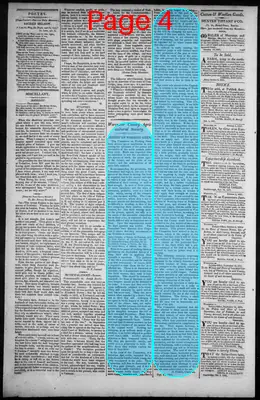
The Massachusetts Spy
Worcester, Worcester County, Massachusetts
What is this article about?
The Worcester County Agricultural Society's committee reports on an exhibition of working oxen, praising their power and training. Premiums awarded to top oxen teams from Sutton, Grafton, and Oxford. Advice given on early training, handling temperaments, and backing loads. Dated Sept. 27, 1821.
Clipping
OCR Quality
Full Text
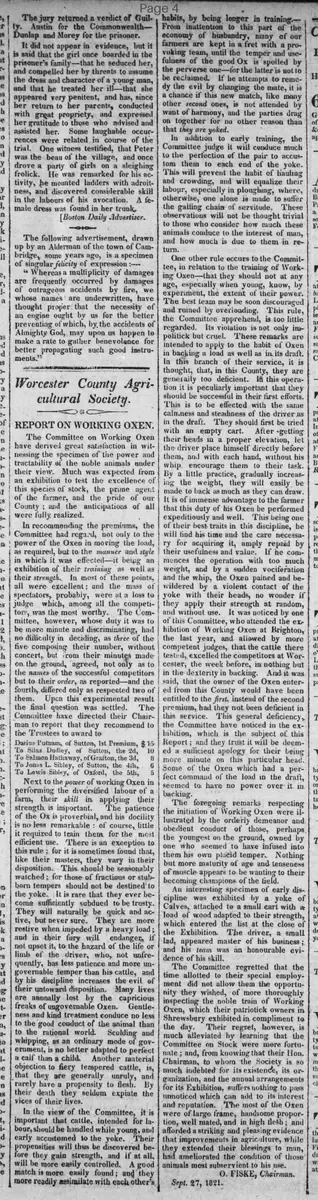
REPORT ON WORKING OXEN.
The Committee on Working Oxen have derived great satisfaction in witnessing the specimen of the power and tractability of the noble animals under their view. Much was expected from an exhibition to test the excellence of this species of stock, the prime agent of the farmer, and the pride of our County: and the anticipations of all were fully realized.
In recommending the premiums, the Committee had regard, not only to the power of the Oxen in moving the load, as required, but to the manner and style in which it was effected—it being an exhibition of their training as well as their strength. In most of these points, all were excellent; and the mass of spectators, probably, were at a loss to judge which, among all the competitors, was the most worthy. The Committee, however, whose duty it was to be more minute and discriminating, had no difficulty in deciding, as three of the five composing their number, without concert, but from their minutes made on the ground, agreed, not only as to the names of the successful competitors but to their order, as reported—and the fourth, differed only as respected two of them. Upon this experimental result the final question was settled. The Committee have directed their Chairman to report that they recommend to the Trustees to award to
Darius Putnam, of Sutton, 1st Premium, $15
To Silas Dudley, of Sutton, the 2d, 10
To Salmon Hathaway, of Grafton, the 3d, 8
To Jonas L. Sibley, of Sutton, the 4th, 6
To Lewis Sibley, of Oxford, the 5th, 5
Next to the power of working Oxen in performing the diversified labour of a farm, their skill in applying their strength, is important. The patience of the Ox is proverbial, and his docility is no less remarkable: of course, little is required to train them for the most efficient use. There is an exception to this rule; for it is sometimes found that, like their masters, they vary in their disposition. This should be seasonably watched; for those of fractious or stubborn tempers should not be destined to the yoke. It is rare that they ever become sufficiently subdued to be trusty. They will naturally be quick and active, but never sure. They are more restive when impeded by a heavy load; and in their fury will endanger, if not upset it, to the hazard of the life or limb of the driver, who, not unfrequently, has less patience and more ungovernable temper than his cattle, and by his discipline increases the evil of their untoward disposition. Many lives are annually lost by the capricious freaks of ungovernable Oxen. Gentleness and kind treatment conduce no less to the good conduct of the animal than to the rational world. Scolding and whipping, as an ordinary mode of government, is no better adapted to perfect a calf than a child. Another material objection to fiery tempered cattle, is, that they are generally unruly, and rarely have a propensity to fatten. By their death they seldom expiate the vices of their lives.
In the view of the Committee, it is important that cattle, intended for labour, should be handled while young, and early accustomed to the yoke. Their propensities will thus be discovered before they gain strength, and if at all, will be more easily controlled. A good match is more easily found; and they more readily assimilate with each other's habits, by being longer in training.
From inattention to this part of the economy of husbandry, many of our farmers are kept in a fret with a provoking team, until the temper and usefulness of the good Ox is spoiled by the perverse one—for the latter is not to be reclaimed. If he attempts to remedy the evil by changing the mate, it is a chance if this new match, like many other second ones, is not attended by want of harmony, and the parties drag on together for no other reason than that they are yoked.
In addition to early training, the Committee judge it will conduce much to the perfection of the pair to accustom them to each end of the yoke. This will prevent the habit of hauling and crowding, and will equalize their labour, especially in ploughing, where, otherwise, one alone is made to suffer the galling chain of servitude. These observations will not be thought trivial to those who consider how much these animals conduce to the interest of man, and how much is due to them in return.
One other rule occurs to the Committee, in relation to the training of Working Oxen—that they should not at any age, especially when young, know, by experiment, the extent of their power. The best team may be soon discouraged and ruined by overloading. This rule, the Committee apprehend, is too little regarded. Its violation is not only impolitick but cruel. These remarks are intended to apply to the habit of Oxen in backing a load as well as in its draft. In this branch of their service, it is thought, that, in this County, they are generally too deficient. In this operation it is peculiarly important that they should be successful in their first efforts. This is to be effected with the same calmness and steadiness of the driver as in the draft. They should first be tried with an empty cart. After getting their heads in a proper elevation, let the driver place himself directly before them, and with each hand, without his whip, encourage them to their task. By a little practice, gradually increasing the weight, they will easily be made to back as much as they can draw.
It is of immense advantage to the farmer that this duty of his Oxen be performed expeditiously and well. This being one of their best traits in this discipline, he will find his time and the care necessary for acquiring it, amply repaid by their usefulness and value. If he commences the operation with too much weight, and by a sudden vociferation and the whip, the Oxen pained and bewildered by a violent contact of the yoke with their heads, no wonder if they apply their strength at random, and without use. It was noticed by one of this Committee, who attended the exhibition of Working Oxen at Brighton, the last year, and allowed by more competent judges, that the cattle there tested, excelled the competitors at Worcester; the week before, in nothing but in the dexterity in backing. And it was said, that the owner of the Oxen entered from this County would have been entitled to the first, instead of the second premium, had they not been deficient in this service. This general deficiency, the Committee have noticed in the exhibition, which is the subject of this Report; and they trust it will be deemed a sufficient apology for their being more minute on this particular head. Some of the Oxen which had a perfect command of the load in the draft, seemed to have no power over it in backing.
The foregoing remarks respecting the initiation of Working Oxen were illustrated by the orderly demeanor and obedient conduct of those, perhaps the youngest on the ground, owned by one who seemed to have infused into them his own placid temper. Nothing but more maturity of age and tenseness of muscle appears to be wanting to their becoming champions of the field.
An interesting specimen of early discipline was exhibited by a yoke of Calves, attached to a small cart with a load of wood adapted to their strength, which entered the list at the close of the Exhibition. The driver, a small lad, appeared master of his business; and his team was an honourable evidence of his skill.
The Committee regretted that the time allotted to their special employment did not allow them the opportunity they wished, of more thoroughly inspecting the noble train of Working Oxen, which their patriotick owners in Shrewsbury exhibited in compliment to the day. Their regret, however, is much alleviated by learning that the Committee on Stock were more fortunate; and, from knowing that their Hon. Chairman, to whom the Society is so much indebted for its existence, its organization, and the annual arrangements for its Exhibition, suffers nothing to pass unnoticed which can add to its interest and reputation. The most of the Oxen were of large frame, handsome proportion, well mated, and in high flesh; and afforded a striking and pleasing evidence that improvements in agriculture, while they extended their blessings to man, had ameliorated the condition of those animals most subservient to his use.
O. FISKE, Chairman.
Sept. 27, 1821.
What sub-type of article is it?
What keywords are associated?
What entities or persons were involved?
Where did it happen?
Domestic News Details
Primary Location
Worcester County
Event Date
Sept. 27, 1821
Key Persons
Outcome
premiums awarded: darius putnam (sutton) $15 (1st), silas dudley (sutton) $10 (2nd), salmon hathaway (grafton) $8 (3rd), jonas l. sibley (sutton) $6 (4th), lewis sibley (oxford) $5 (5th). exhibition of young calves and shrewsbury oxen also noted.
Event Details
Committee report on exhibition testing power, tractability, and training of working oxen. Praises overall quality and recommends premiums based on performance in moving loads. Provides advice on selecting docile oxen, early training, equalizing labor, avoiding overload, and teaching backing.