Thank you for visiting SNEWPapers!
Sign up free
Editorial
May 6, 1870
Oxford Democrat
Paris, South Paris, Oxford County, Maine
What is this article about?
An editorial critiques the Maine Temperance Advocate for misrepresenting the Grand Lodge of Good Templars' final stance on endorsing the Temperance party, emphasizing that the final resolution urging votes for prohibition candidates without binding to a party overrides earlier actions.
Clipping
OCR Quality
96%
Excellent
Full Text
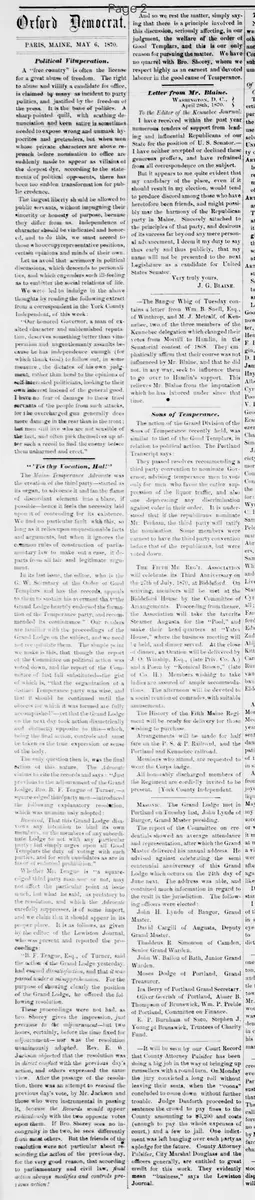
"Tis thy Vocation, Hal!"
The Maine Temperance Advocate was the creation of the third party—started as its organ, to advocate it and fan the flame of discordant element into a blaze, if possible—hence it feels the necessity laid upon it of contending for its existence.
We find no particular fault with this, so long as it relies upon unquestionable facts and arguments, but when it ignores the common rules of construction of parliamentary law to make out a case, it departs from all fair and legitimate argument.
In its last issue, the editor, who is the G. W. Secretary of the Order of Good Templars and has the records, appeals to them to sustain his averment that "the Grand Lodge heartily endorsed the formation of the Temperance party, and recommended its continuance." Our readers are familiar with the proceedings of the Grand Lodge on the subject, and we need not recapitulate them. The simple point we make is this, that though the report of the Committee on political action was voted down, and the report of the Committee of last fall substituted—the gist of which is, "that the organization of a distinct Temperance party was wise, and that it should be continued until the objects for which it was formed are fully accomplished"—yet that the Grand Lodge on the next day took action diametrically and distinctly opposite to this—which, being the final action, controls and must be taken as the true expression or sense of the body.
The only question then is, was the final action of this nature. The Advocate claims to cite the records and says: "Just previous to the adjournment of the Grand Lodge, Bro. B. F. Teague of Turner,—a square-edged third party man—introduced the following explanatory resolution, which was unanimously adopted:
Resolved, That this Grand Lodge disavows any intention to bind its own members, or the members of any subordinate Lodge to act with any particular party; but simply urges upon all Good Templars the duty of voting with such parties, and for such candidates as are in favor of enforced prohibition."
Whether Mr. Teague is "a square-edged third party man" or not, may not affect the particular point at issue much, but what he said, as prefatory to the resolution, and which the Advocate carefully suppresses, is of some import, and we claim that it should appear in its proper place. It is as follows, as given by the editor of the Lewiston Journal, who was present and reported the proceedings:
"B. F. Teague, Esq., of Turner, said the acts of the Grand Lodge yesterday had caused dissatisfaction, and that it was passed under a misapprehension. For the purpose of showing clearly the position of the Grand Lodge, he offered the following resolution."
These proceedings were not had, as bro. Shorey gives the impression, just previous to the adjournment but two hours, certainly, before the time fixed for adjournment—nor was the resolution unanimously adopted. Rev. E. B. Jackson objected that the resolution was in direct conflict with the previous day's action, and others expressed the same view. After the passage of the resolution, there was an attempt to rescind the previous day's vote, by Mr. Jackson and those who were instrumental in passing it, because the Records would appear ridiculously with the two opposite votes upon them. If Bro. Shorey sees no incongruity in the two, he sees differently from most others. But the friends of the resolution were not particular about rescinding the action of the previous day, for the very good reason, that according to parliamentary and civil law, final action always modifies and controls previous action!
And so we rest the matter, simply saying that there is a principle involved in this discussion, seriously affecting, in our judgment, the welfare of the order of Good Templars, and this is our only reason for pursuing the matter. We have no quarrel with Bro. Shorey, whom we respect highly as an earnest and devoted laborer in the good cause of Temperance.
The Maine Temperance Advocate was the creation of the third party—started as its organ, to advocate it and fan the flame of discordant element into a blaze, if possible—hence it feels the necessity laid upon it of contending for its existence.
We find no particular fault with this, so long as it relies upon unquestionable facts and arguments, but when it ignores the common rules of construction of parliamentary law to make out a case, it departs from all fair and legitimate argument.
In its last issue, the editor, who is the G. W. Secretary of the Order of Good Templars and has the records, appeals to them to sustain his averment that "the Grand Lodge heartily endorsed the formation of the Temperance party, and recommended its continuance." Our readers are familiar with the proceedings of the Grand Lodge on the subject, and we need not recapitulate them. The simple point we make is this, that though the report of the Committee on political action was voted down, and the report of the Committee of last fall substituted—the gist of which is, "that the organization of a distinct Temperance party was wise, and that it should be continued until the objects for which it was formed are fully accomplished"—yet that the Grand Lodge on the next day took action diametrically and distinctly opposite to this—which, being the final action, controls and must be taken as the true expression or sense of the body.
The only question then is, was the final action of this nature. The Advocate claims to cite the records and says: "Just previous to the adjournment of the Grand Lodge, Bro. B. F. Teague of Turner,—a square-edged third party man—introduced the following explanatory resolution, which was unanimously adopted:
Resolved, That this Grand Lodge disavows any intention to bind its own members, or the members of any subordinate Lodge to act with any particular party; but simply urges upon all Good Templars the duty of voting with such parties, and for such candidates as are in favor of enforced prohibition."
Whether Mr. Teague is "a square-edged third party man" or not, may not affect the particular point at issue much, but what he said, as prefatory to the resolution, and which the Advocate carefully suppresses, is of some import, and we claim that it should appear in its proper place. It is as follows, as given by the editor of the Lewiston Journal, who was present and reported the proceedings:
"B. F. Teague, Esq., of Turner, said the acts of the Grand Lodge yesterday had caused dissatisfaction, and that it was passed under a misapprehension. For the purpose of showing clearly the position of the Grand Lodge, he offered the following resolution."
These proceedings were not had, as bro. Shorey gives the impression, just previous to the adjournment but two hours, certainly, before the time fixed for adjournment—nor was the resolution unanimously adopted. Rev. E. B. Jackson objected that the resolution was in direct conflict with the previous day's action, and others expressed the same view. After the passage of the resolution, there was an attempt to rescind the previous day's vote, by Mr. Jackson and those who were instrumental in passing it, because the Records would appear ridiculously with the two opposite votes upon them. If Bro. Shorey sees no incongruity in the two, he sees differently from most others. But the friends of the resolution were not particular about rescinding the action of the previous day, for the very good reason, that according to parliamentary and civil law, final action always modifies and controls previous action!
And so we rest the matter, simply saying that there is a principle involved in this discussion, seriously affecting, in our judgment, the welfare of the order of Good Templars, and this is our only reason for pursuing the matter. We have no quarrel with Bro. Shorey, whom we respect highly as an earnest and devoted laborer in the good cause of Temperance.
What sub-type of article is it?
Temperance
Partisan Politics
What keywords are associated?
Temperance Party
Grand Lodge
Good Templars
Political Action
Prohibition
Parliamentary Law
What entities or persons were involved?
Maine Temperance Advocate
Bro. Shorey
Order Of Good Templars
Grand Lodge
B. F. Teague
Rev. E. B. Jackson
Lewiston Journal
Editorial Details
Primary Topic
Dispute Over Grand Lodge's Endorsement Of Temperance Party
Stance / Tone
Critical Of Misrepresentation By Maine Temperance Advocate
Key Figures
Maine Temperance Advocate
Bro. Shorey
Order Of Good Templars
Grand Lodge
B. F. Teague
Rev. E. B. Jackson
Lewiston Journal
Key Arguments
Final Action Of Grand Lodge Controls Over Previous Contradictory Votes
Advocate Suppresses Prefatory Remarks By Teague Indicating Misapprehension
Resolution Not Unanimously Adopted And Faced Objections
Parliamentary Law Dictates Final Action Modifies Previous
No Personal Quarrel With Shorey, Concern For Order's Welfare