Thank you for visiting SNEWPapers!
Sign up free
Editorial
July 25, 1857
The Washington Union
Washington, District Of Columbia
What is this article about?
This editorial contends that the United States has only two true political parties: Democrats, who support constitutional principles and Union, and their unified opponents (Whigs, Republicans, Know-Nothings), who under various names collaborate across states to defeat Democratic power and self-government.
Clipping
OCR Quality
98%
Excellent
Full Text
POLITICAL PARTIES IN THE UNITED STATES
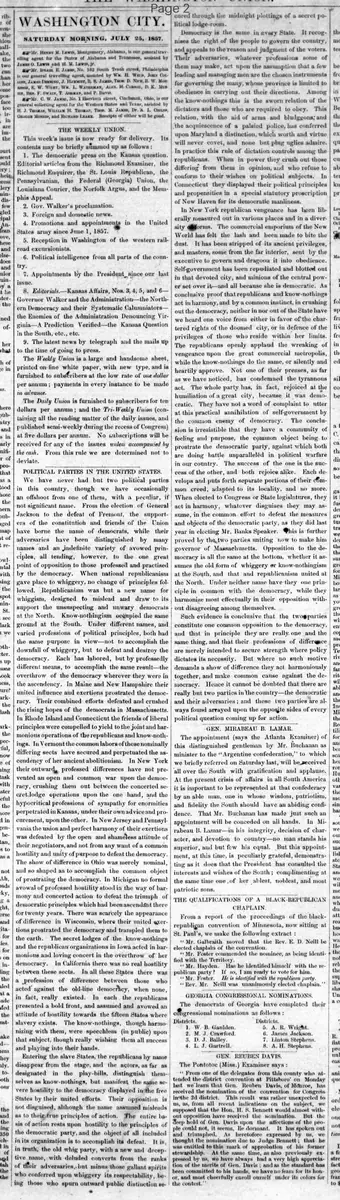
We have never had but two political parties in this country, though we have occasionally an offshoot from one of them, with a peculiar, if not significant name. From the election of General Jackson to the defeat of Fremont, the supporters of the constitution and friends of the Union have borne the name of democrats, while their adversaries have been distinguished by many names and an indefinite variety of avowed principles, all tending, however, to the one great point of opposition to those professed and practised by the democracy. When national republicanism gave place to whiggery, no change of principles followed. Republicanism was but a new name for whiggism, designed to mislead and draw to its support the unsuspecting and unwary democrats at the North. Know-nothingism occupied the same ground at the South. Under different names, and varied professions of political principles, both had the same purpose in view—not to accomplish the downfall of whiggery, but to defeat and destroy the democracy. Each has labored, but by professedly different means, to accomplish the same result—the overthrow of the democracy wherever they were in the ascendency. In Maine and New Hampshire their united influence and exertions prostrated the democracy. Their combined efforts defeated and crushed the rising hopes of the democrats in Massachusetts. In Rhode Island and Connecticut the friends of liberal principles were compelled to yield to the joint and harmonious operations of the republicans and know-nothings. In Vermont the common labors of these nominally differing sects have secured and perpetuated the ascendency of her ancient abolitionism. In New York their outward, professed differences have not prevented an open and common war upon the democracy, crushing them out between the concerted secret lodge operations upon the one hand, and the hypocritical professions of sympathy for enormities perpetrated in Kansas, under their own advice and procurement, upon the other. In New Jersey and Pennsylvania the union and perfect harmony of their exertions was defeated by the open and shameless attitude of their negotiators, and not from any want of a common hostility and unity of purpose to defeat the democracy. The show of difference in Ohio was merely nominal, and so shaped as to accomplish the common object of prostrating the democracy. In Michigan no formal avowal of professed hostility stood in the way of harmony and concerted action to defeat the triumph of democratic principles which had been ascendant there for twenty years. There was scarcely the appearance of difference in Wisconsin, where their united exertions prostrated the democracy and trampled them to the earth. The secret lodges of the know-nothings and the republican organizations in Iowa acted in harmonious and loving concert in the overthrow of her democracy. In California there was no real hostility between these sects. In all these States there was a profession of difference between those who acted against the old-line democracy, when none, in fact, really existed. In each the republicans presented a bold front, and assumed and avowed an attitude of hostility towards the fifteen States where slavery exists. The know-nothings, though harmonizing with them, were speechless (in public) upon that subject, though really wishing them all success and playing into their hands.
Entering the slave States, the republicans by name disappear from the stage, and the actors, as far as designated in the play-bills, distinguish themselves as know-nothings, but manifest the same severe hostility to the democracy displayed in the free States by their united efforts. Their opposition is not disguised, although the name assumed misleads as to their true principles of action. The entire basis of action rests upon hostility to the principles of the democratic party, and the object of all included in its organization is to accomplish its defeat. It is, in truth, the old whig party, with a new and deceptive name, with deluded converts from the ranks of their adversaries,—but minus those gallant spirits who conferred upon whiggery its respectability, being those who spurn outward public distinction secured through the midnight plottings of a secret political lodge-room.
Democracy is the same in every State. It recognizes the right of the people to govern the country, and appeals to the reason and judgment of the voters. Their adversaries, whatever professions some of them may make, act upon the assumption that a few leading and managing men are the chosen instruments for governing the many, whose province is limited to obedience in carrying out their directions. Among the know-nothings this is the sworn relation of the dictators and those who are required to obey. This relation, with the aid of arms and bludgeons, and the acquiescence of a palsied police, has conferred upon Maryland a distinction, which worth and virtue will never covet, and none but plug uglies admire. In practice this rule of dictation controls among the republicans. When in power they crush out those differing from them in opinion, and who refuse to conform to their wishes on political subjects. In Connecticut they displayed their political principles and propensities in a special statutory proscription of New Haven for its democratic manliness. In New York republican vengeance has been liberally measured out in various places and in a diversity of forms. The commercial emporium of the New World has felt the lash and been made to bite the dust. It has been stripped of its ancient privileges, and masters, some from the far interior, sent by the executive to govern and dragoon it into obedience. Self-government has been repudiated and blotted out in that devoted city, and minions of the central power set over it—and all because she is democratic. As conclusive proof that republicans and know-nothings act in harmony, and by a common instinct, in crushing out the democracy, neither in nor out of the State have we heard one voice from either in favor of the chartered rights of the doomed city, or in defence of the privileges of those who reside within her limits. The republicans openly applaud the wreaking of vengeance upon the great commercial metropolis, while the know-nothings do the same, or silently and heartily approve. Not one of their presses, as far as we have noticed, has condemned the tyrannous act. The whole party has, in fact, rejoiced at the humiliation of a great city, because it was democratic. They have not a word of complaint to utter at this practical annihilation of self-government by the common enemy of democracy. The conclusion is irresistible that they have a community of feeling and purpose, the common object being to prostrate the democratic party, against which both are doing battle unparalleled in political warfare in our country. The success of the one is the success of the other, and both rejoice alike. Each develops and puts forth separate portions of their common creed, adapted to its locality, and no more. When elected to Congress or State legislatures, they act in harmony, whatever disguises they may assume, in the common effort to defeat the measures and objects of the democratic party, as they did last year in electing Mr. Banks Speaker. This is further proved by the two parties uniting now to make him governor of Massachusetts. Opposition to the democracy is all the same at the bottom, whether it assumes the old form of whiggery or know-nothingism at the South, and that and republicanism united at the North. Under neither name have they one principle in common with the democracy, while they harmonize most effectually in their opposition without disagreeing among themselves.
Such evidence is conclusive that the two parties constitute one common opposition to the democracy, and that in principle they are really one and the same thing, and that their professions of difference are merely intended to secure strength where policy dictates its necessity. But where no such motive demands a show of difference they act harmoniously together, and make common cause against the democracy. Hence it cannot be doubted that there are really but two parties in the country—the democratic and their adversaries: and these two parties are always found arrayed upon the opposite sides of every political question coming up for action.
We have never had but two political parties in this country, though we have occasionally an offshoot from one of them, with a peculiar, if not significant name. From the election of General Jackson to the defeat of Fremont, the supporters of the constitution and friends of the Union have borne the name of democrats, while their adversaries have been distinguished by many names and an indefinite variety of avowed principles, all tending, however, to the one great point of opposition to those professed and practised by the democracy. When national republicanism gave place to whiggery, no change of principles followed. Republicanism was but a new name for whiggism, designed to mislead and draw to its support the unsuspecting and unwary democrats at the North. Know-nothingism occupied the same ground at the South. Under different names, and varied professions of political principles, both had the same purpose in view—not to accomplish the downfall of whiggery, but to defeat and destroy the democracy. Each has labored, but by professedly different means, to accomplish the same result—the overthrow of the democracy wherever they were in the ascendency. In Maine and New Hampshire their united influence and exertions prostrated the democracy. Their combined efforts defeated and crushed the rising hopes of the democrats in Massachusetts. In Rhode Island and Connecticut the friends of liberal principles were compelled to yield to the joint and harmonious operations of the republicans and know-nothings. In Vermont the common labors of these nominally differing sects have secured and perpetuated the ascendency of her ancient abolitionism. In New York their outward, professed differences have not prevented an open and common war upon the democracy, crushing them out between the concerted secret lodge operations upon the one hand, and the hypocritical professions of sympathy for enormities perpetrated in Kansas, under their own advice and procurement, upon the other. In New Jersey and Pennsylvania the union and perfect harmony of their exertions was defeated by the open and shameless attitude of their negotiators, and not from any want of a common hostility and unity of purpose to defeat the democracy. The show of difference in Ohio was merely nominal, and so shaped as to accomplish the common object of prostrating the democracy. In Michigan no formal avowal of professed hostility stood in the way of harmony and concerted action to defeat the triumph of democratic principles which had been ascendant there for twenty years. There was scarcely the appearance of difference in Wisconsin, where their united exertions prostrated the democracy and trampled them to the earth. The secret lodges of the know-nothings and the republican organizations in Iowa acted in harmonious and loving concert in the overthrow of her democracy. In California there was no real hostility between these sects. In all these States there was a profession of difference between those who acted against the old-line democracy, when none, in fact, really existed. In each the republicans presented a bold front, and assumed and avowed an attitude of hostility towards the fifteen States where slavery exists. The know-nothings, though harmonizing with them, were speechless (in public) upon that subject, though really wishing them all success and playing into their hands.
Entering the slave States, the republicans by name disappear from the stage, and the actors, as far as designated in the play-bills, distinguish themselves as know-nothings, but manifest the same severe hostility to the democracy displayed in the free States by their united efforts. Their opposition is not disguised, although the name assumed misleads as to their true principles of action. The entire basis of action rests upon hostility to the principles of the democratic party, and the object of all included in its organization is to accomplish its defeat. It is, in truth, the old whig party, with a new and deceptive name, with deluded converts from the ranks of their adversaries,—but minus those gallant spirits who conferred upon whiggery its respectability, being those who spurn outward public distinction secured through the midnight plottings of a secret political lodge-room.
Democracy is the same in every State. It recognizes the right of the people to govern the country, and appeals to the reason and judgment of the voters. Their adversaries, whatever professions some of them may make, act upon the assumption that a few leading and managing men are the chosen instruments for governing the many, whose province is limited to obedience in carrying out their directions. Among the know-nothings this is the sworn relation of the dictators and those who are required to obey. This relation, with the aid of arms and bludgeons, and the acquiescence of a palsied police, has conferred upon Maryland a distinction, which worth and virtue will never covet, and none but plug uglies admire. In practice this rule of dictation controls among the republicans. When in power they crush out those differing from them in opinion, and who refuse to conform to their wishes on political subjects. In Connecticut they displayed their political principles and propensities in a special statutory proscription of New Haven for its democratic manliness. In New York republican vengeance has been liberally measured out in various places and in a diversity of forms. The commercial emporium of the New World has felt the lash and been made to bite the dust. It has been stripped of its ancient privileges, and masters, some from the far interior, sent by the executive to govern and dragoon it into obedience. Self-government has been repudiated and blotted out in that devoted city, and minions of the central power set over it—and all because she is democratic. As conclusive proof that republicans and know-nothings act in harmony, and by a common instinct, in crushing out the democracy, neither in nor out of the State have we heard one voice from either in favor of the chartered rights of the doomed city, or in defence of the privileges of those who reside within her limits. The republicans openly applaud the wreaking of vengeance upon the great commercial metropolis, while the know-nothings do the same, or silently and heartily approve. Not one of their presses, as far as we have noticed, has condemned the tyrannous act. The whole party has, in fact, rejoiced at the humiliation of a great city, because it was democratic. They have not a word of complaint to utter at this practical annihilation of self-government by the common enemy of democracy. The conclusion is irresistible that they have a community of feeling and purpose, the common object being to prostrate the democratic party, against which both are doing battle unparalleled in political warfare in our country. The success of the one is the success of the other, and both rejoice alike. Each develops and puts forth separate portions of their common creed, adapted to its locality, and no more. When elected to Congress or State legislatures, they act in harmony, whatever disguises they may assume, in the common effort to defeat the measures and objects of the democratic party, as they did last year in electing Mr. Banks Speaker. This is further proved by the two parties uniting now to make him governor of Massachusetts. Opposition to the democracy is all the same at the bottom, whether it assumes the old form of whiggery or know-nothingism at the South, and that and republicanism united at the North. Under neither name have they one principle in common with the democracy, while they harmonize most effectually in their opposition without disagreeing among themselves.
Such evidence is conclusive that the two parties constitute one common opposition to the democracy, and that in principle they are really one and the same thing, and that their professions of difference are merely intended to secure strength where policy dictates its necessity. But where no such motive demands a show of difference they act harmoniously together, and make common cause against the democracy. Hence it cannot be doubted that there are really but two parties in the country—the democratic and their adversaries: and these two parties are always found arrayed upon the opposite sides of every political question coming up for action.
What sub-type of article is it?
Partisan Politics
What keywords are associated?
Political Parties
Democrats
Republicans
Know Nothings
Whigs
Partisan Opposition
Democratic Principles
Self Government
What entities or persons were involved?
Democrats
Republicans
Know Nothings
Whigs
General Jackson
Fremont
Mr. Banks
Maryland
New York
Massachusetts
Editorial Details
Primary Topic
Unity Of Opposition Parties Against The Democratic Party
Stance / Tone
Strongly Pro Democratic, Portraying Opponents As Unified Adversaries
Key Figures
Democrats
Republicans
Know Nothings
Whigs
General Jackson
Fremont
Mr. Banks
Maryland
New York
Massachusetts
Key Arguments
There Have Only Been Two Real Political Parties In The Us: Democrats And Their Adversaries
Adversaries Use Different Names (Whigs, Republicans, Know Nothings) But Share The Goal Of Defeating Democrats
In Various States, Republicans And Know Nothings Unite To Prostrate Democratic Power
Democracy Emphasizes People's Right To Govern; Opponents Rely On Dictation By Leading Men
Republicans And Know Nothings Crush Self Government In Democratic Areas, E.G., New York
Opposition Parties Act In Harmony In Legislatures And Elections Against Democratic Measures
Professions Of Difference Are Deceptive; They Harmonize Where Policy Allows