Thank you for visiting SNEWPapers!
Sign up free
Poem
March 11, 1786
Fowle's New Hampshire Gazette And General Advertiser
Portsmouth, Rockingham County, New Hampshire
What is this article about?
Verses composed in a company where detraction dominated the talk, using nature imagery to illustrate that beauty coexists with imperfection and urging mercy toward others' failings, as heaven grants forgiveness.
Clipping
OCR Quality
95%
Excellent
Full Text
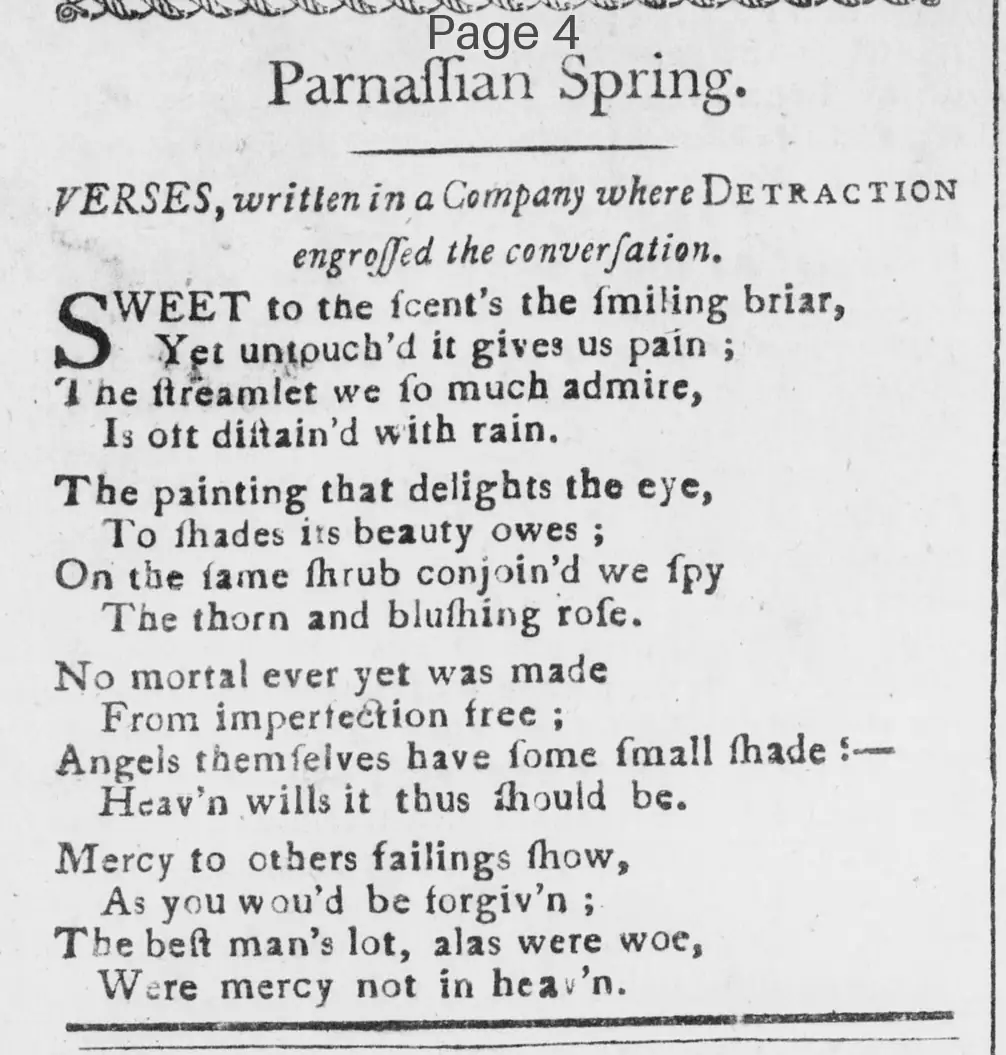
Parnassian Spring.
VERSES, written in a Company where DETRACTION
engrossed the conversation.
Sweet to the sense the smiling briar,
Yet untouched it gives us pain;
The streamlet we so much admire,
Is oft distain'd with rain.
The painting that delights the eye,
To shades its beauty owes;
On the same shrub conjoined we spy
The thorn and blushing rose.
No mortal ever yet was made
From imperfection free;
Angels themselves have some small shade:
Heav'n wills it thus should be.
Mercy to others failings show,
As you wou'd be forgiven;
The best man's lot, alas were woe,
Were mercy not in heav'n.
VERSES, written in a Company where DETRACTION
engrossed the conversation.
Sweet to the sense the smiling briar,
Yet untouched it gives us pain;
The streamlet we so much admire,
Is oft distain'd with rain.
The painting that delights the eye,
To shades its beauty owes;
On the same shrub conjoined we spy
The thorn and blushing rose.
No mortal ever yet was made
From imperfection free;
Angels themselves have some small shade:
Heav'n wills it thus should be.
Mercy to others failings show,
As you wou'd be forgiven;
The best man's lot, alas were woe,
Were mercy not in heav'n.
What sub-type of article is it?
Ode
What themes does it cover?
Moral Virtue
Religious Faith
What keywords are associated?
Mercy
Imperfection
Detraction
Forgiveness
Nature Imagery
Moral Instruction
Heavenly Mercy
Poem Details
Title
Parnassian Spring.
Subject
Written In A Company Where Detraction Engrossed The Conversation.
Form / Style
Rhymed Quatrains (Abab)
Key Lines
No Mortal Ever Yet Was Made
From Imperfection Free;
Angels Themselves Have Some Small Shade:
Heav'n Wills It Thus Should Be.
Mercy To Others Failings Show,
As You Wou'd Be Forgiven;
The Best Man's Lot, Alas Were Woe,
Were Mercy Not In Heav'n.