Thank you for visiting SNEWPapers!
Sign up free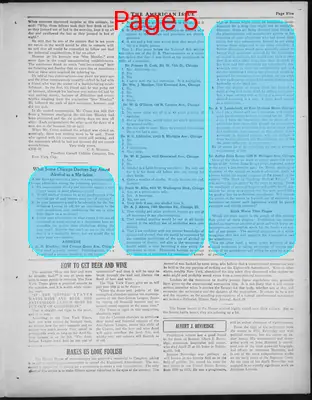
Story
May 1, 1927
The American Issue
Westerville, Delaware County, Ohio
What is this article about?
Compilation of responses from Chicago physicians to questions on the medical necessity of alcohol, its prohibition, and wood alcohol deaths during the Prohibition era. Most doctors deem alcohol unnecessary and support banning its medical use.
Clipping
OCR Quality
98%
Excellent
Full Text
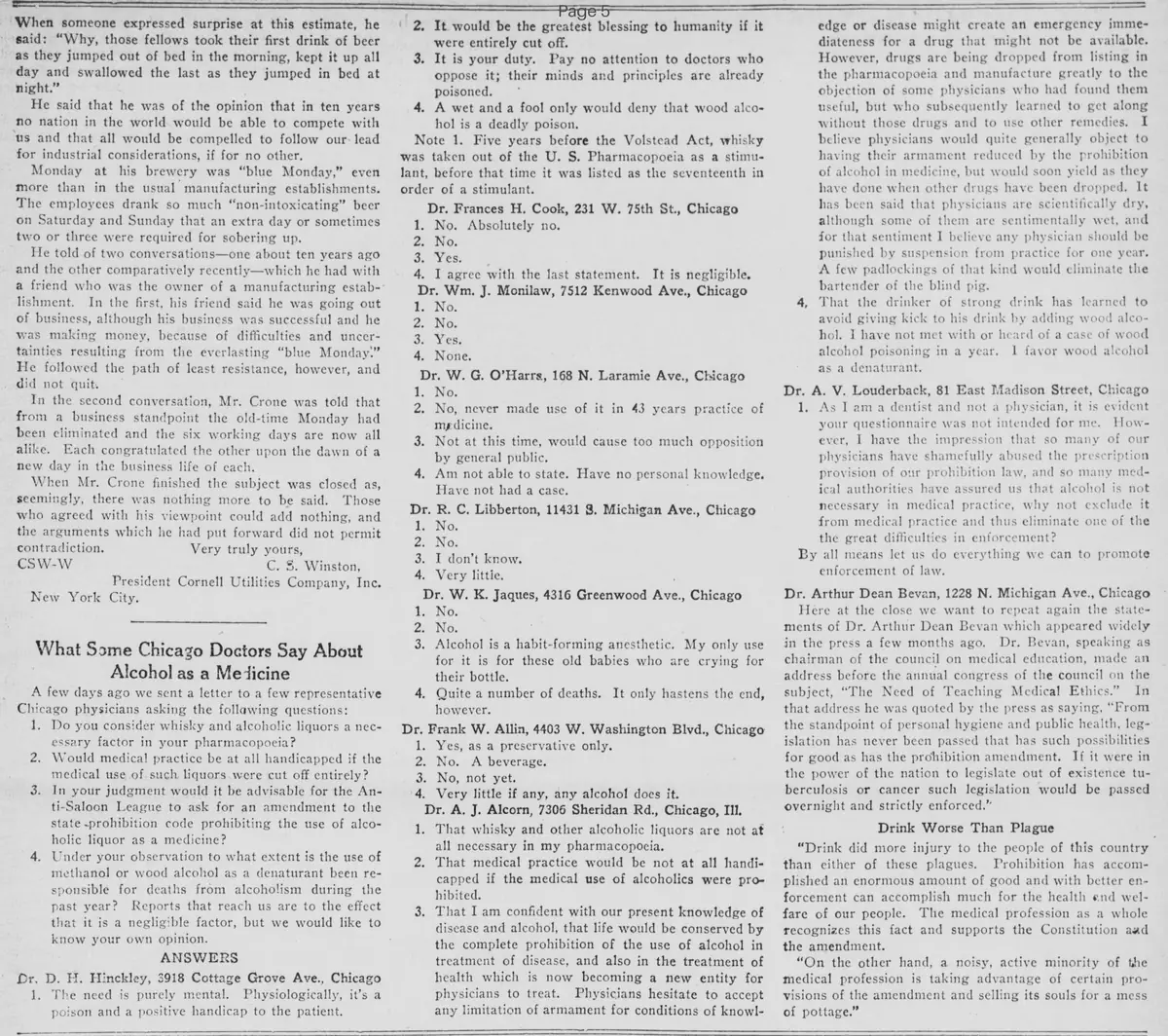
What Some Chicago Doctors Say About Alcohol as a Medicine
A few days ago we sent a letter to a few representative Chicago physicians asking the following questions:
1. Do you consider whisky and alcoholic liquors a necessary factor in your pharmacopoeia?
2. Would medical practice be at all handicapped if the medical use of such liquors were cut off entirely?
3. In your judgment would it be advisable for the Anti-Saloon League to ask for an amendment to the state prohibition code prohibiting the use of alcoholic liquor as a medicine?
4. Under your observation to what extent is the use of methanol or wood alcohol as a denaturant been responsible for deaths from alcoholism during the past year? Reports that reach us are to the effect that it is a negligible factor, but we would like to know your own opinion.
ANSWERS
Dr. D. H. Hinckley, 3918 Cottage Grove Ave., Chicago
1. The need is purely mental. Physiologically, it's a poison and a positive handicap to the patient.
2. It would be the greatest blessing to humanity if it were entirely cut off.
3. It is your duty. Pay no attention to doctors who oppose it; their minds and principles are already poisoned.
4. A wet and a fool only would deny that wood alcohol is a deadly poison.
Note 1. Five years before the Volstead Act, whisky was taken out of the U. S. Pharmacopoeia as a stimulant, before that time it was listed as the seventeenth in order of a stimulant.
Dr. Frances H. Cook, 231 W. 75th St., Chicago
1. No. Absolutely no.
2. No.
3. Yes.
4. I agree with the last statement. It is negligible.
Dr. Wm. J. Monilaw, 7512 Kenwood Ave., Chicago
1. No.
2. No.
3. Yes.
4. None.
Dr. W. G. O'Harrs, 168 N. Laramie Ave., Chicago
1. No.
2. No, never made use of it in 43 years practice of medicine.
3. Not at this time, would cause too much opposition by general public.
4. Am not able to state. Have no personal knowledge. Have not had a case.
Dr. R. C. Libberton, 11431 S. Michigan Ave., Chicago
1. No.
2. No.
3. I don't know.
4. Very little.
Dr. W. K. Jaques, 4316 Greenwood Ave., Chicago
1. No.
2. No.
3. Alcohol is a habit-forming anesthetic. My only use for it is for these old babies who are crying for their bottle.
4. Quite a number of deaths. It only hastens the end, however.
Dr. Frank W. Allin, 4403 W. Washington Blvd., Chicago
1. Yes, as a preservative only.
2. No. A beverage.
3. No, not yet.
4. Very little if any, any alcohol does it.
Dr. A. J. Alcorn, 7306 Sheridan Rd., Chicago, Ill.
1. That whisky and other alcoholic liquors are not at all necessary in my pharmacopoeia.
2. That medical practice would be not at all handicapped if the medical use of alcoholics were prohibited.
3. That I am confident with our present knowledge of disease and alcohol, that life would be conserved by the complete prohibition of the use of alcohol in treatment of disease, and also in the treatment of health which is now becoming a new entity for physicians to treat. Physicians hesitate to accept any limitation of armament for conditions of knowledge or disease might create an emergency immediateness for a drug that might not be available.
However, drugs are being dropped from listing in the pharmacopoeia and manufacture greatly to the objection of some physicians who had found them useful, but who subsequently learned to get along without those drugs and to use other remedies.
I believe physicians would quite generally object to having their armament reduced by the prohibition of alcohol in medicine, but would soon yield as they have done when other drugs have been dropped. It has been said that physicians are scientifically dry, although some of them are sentimentally wet, and for that sentiment I believe any physician should be punished by suspension from practice for one year.
A few padlockings of that kind would eliminate the bartender of the blind pig.
4. That the drinker of strong drink has learned to avoid giving kick to his drink by adding wood alcohol. I have not met with or heard of a case of wood alcohol poisoning in a year. I favor wood alcohol as a denaturant.
Dr. A. V. Louderback, 81 East Madison Street, Chicago
1. As I am a dentist and not a physician, it is evident your questionnaire was not intended for me. However, I have the impression that so many of our physicians have shamefully abused the prescription provision of our prohibition law, and so many medical authorities have assured us that alcohol is not necessary in medical practice, why not exclude it from medical practice and thus eliminate one of the great difficulties in enforcement?
By all means let us do everything we can to promote enforcement of law.
Dr. Arthur Dean Bevan, 1228 N. Michigan Ave., Chicago
Here at the close we want to repeat again the statements of Dr. Arthur Dean Bevan which appeared widely in the press a few months ago. Dr. Bevan, speaking as chairman of the council on medical education, made an address before the annual congress of the council on the subject, "The Need of Teaching Medical Ethics." In that address he was quoted by the press as saying, "From the standpoint of personal hygiene and public health, legislation has never been passed that has such possibilities for good as has the prohibition amendment. If it were in the power of the nation to legislate out of existence tuberculosis or cancer such legislation would be passed overnight and strictly enforced."
Drink Worse Than Plague
"Drink did more injury to the people of this country than either of these plagues. Prohibition has accomplished an enormous amount of good and with better enforcement can accomplish much for the health and welfare of our people. The medical profession as a whole recognizes this fact and supports the Constitution and the amendment.
"On the other hand, a noisy, active minority of the medical profession is taking advantage of certain provisions of the amendment and selling its souls for a mess of pottage."
A few days ago we sent a letter to a few representative Chicago physicians asking the following questions:
1. Do you consider whisky and alcoholic liquors a necessary factor in your pharmacopoeia?
2. Would medical practice be at all handicapped if the medical use of such liquors were cut off entirely?
3. In your judgment would it be advisable for the Anti-Saloon League to ask for an amendment to the state prohibition code prohibiting the use of alcoholic liquor as a medicine?
4. Under your observation to what extent is the use of methanol or wood alcohol as a denaturant been responsible for deaths from alcoholism during the past year? Reports that reach us are to the effect that it is a negligible factor, but we would like to know your own opinion.
ANSWERS
Dr. D. H. Hinckley, 3918 Cottage Grove Ave., Chicago
1. The need is purely mental. Physiologically, it's a poison and a positive handicap to the patient.
2. It would be the greatest blessing to humanity if it were entirely cut off.
3. It is your duty. Pay no attention to doctors who oppose it; their minds and principles are already poisoned.
4. A wet and a fool only would deny that wood alcohol is a deadly poison.
Note 1. Five years before the Volstead Act, whisky was taken out of the U. S. Pharmacopoeia as a stimulant, before that time it was listed as the seventeenth in order of a stimulant.
Dr. Frances H. Cook, 231 W. 75th St., Chicago
1. No. Absolutely no.
2. No.
3. Yes.
4. I agree with the last statement. It is negligible.
Dr. Wm. J. Monilaw, 7512 Kenwood Ave., Chicago
1. No.
2. No.
3. Yes.
4. None.
Dr. W. G. O'Harrs, 168 N. Laramie Ave., Chicago
1. No.
2. No, never made use of it in 43 years practice of medicine.
3. Not at this time, would cause too much opposition by general public.
4. Am not able to state. Have no personal knowledge. Have not had a case.
Dr. R. C. Libberton, 11431 S. Michigan Ave., Chicago
1. No.
2. No.
3. I don't know.
4. Very little.
Dr. W. K. Jaques, 4316 Greenwood Ave., Chicago
1. No.
2. No.
3. Alcohol is a habit-forming anesthetic. My only use for it is for these old babies who are crying for their bottle.
4. Quite a number of deaths. It only hastens the end, however.
Dr. Frank W. Allin, 4403 W. Washington Blvd., Chicago
1. Yes, as a preservative only.
2. No. A beverage.
3. No, not yet.
4. Very little if any, any alcohol does it.
Dr. A. J. Alcorn, 7306 Sheridan Rd., Chicago, Ill.
1. That whisky and other alcoholic liquors are not at all necessary in my pharmacopoeia.
2. That medical practice would be not at all handicapped if the medical use of alcoholics were prohibited.
3. That I am confident with our present knowledge of disease and alcohol, that life would be conserved by the complete prohibition of the use of alcohol in treatment of disease, and also in the treatment of health which is now becoming a new entity for physicians to treat. Physicians hesitate to accept any limitation of armament for conditions of knowledge or disease might create an emergency immediateness for a drug that might not be available.
However, drugs are being dropped from listing in the pharmacopoeia and manufacture greatly to the objection of some physicians who had found them useful, but who subsequently learned to get along without those drugs and to use other remedies.
I believe physicians would quite generally object to having their armament reduced by the prohibition of alcohol in medicine, but would soon yield as they have done when other drugs have been dropped. It has been said that physicians are scientifically dry, although some of them are sentimentally wet, and for that sentiment I believe any physician should be punished by suspension from practice for one year.
A few padlockings of that kind would eliminate the bartender of the blind pig.
4. That the drinker of strong drink has learned to avoid giving kick to his drink by adding wood alcohol. I have not met with or heard of a case of wood alcohol poisoning in a year. I favor wood alcohol as a denaturant.
Dr. A. V. Louderback, 81 East Madison Street, Chicago
1. As I am a dentist and not a physician, it is evident your questionnaire was not intended for me. However, I have the impression that so many of our physicians have shamefully abused the prescription provision of our prohibition law, and so many medical authorities have assured us that alcohol is not necessary in medical practice, why not exclude it from medical practice and thus eliminate one of the great difficulties in enforcement?
By all means let us do everything we can to promote enforcement of law.
Dr. Arthur Dean Bevan, 1228 N. Michigan Ave., Chicago
Here at the close we want to repeat again the statements of Dr. Arthur Dean Bevan which appeared widely in the press a few months ago. Dr. Bevan, speaking as chairman of the council on medical education, made an address before the annual congress of the council on the subject, "The Need of Teaching Medical Ethics." In that address he was quoted by the press as saying, "From the standpoint of personal hygiene and public health, legislation has never been passed that has such possibilities for good as has the prohibition amendment. If it were in the power of the nation to legislate out of existence tuberculosis or cancer such legislation would be passed overnight and strictly enforced."
Drink Worse Than Plague
"Drink did more injury to the people of this country than either of these plagues. Prohibition has accomplished an enormous amount of good and with better enforcement can accomplish much for the health and welfare of our people. The medical profession as a whole recognizes this fact and supports the Constitution and the amendment.
"On the other hand, a noisy, active minority of the medical profession is taking advantage of certain provisions of the amendment and selling its souls for a mess of pottage."
What sub-type of article is it?
Medical Opinion Survey
Prohibition Debate
What themes does it cover?
Moral Virtue
Justice
What keywords are associated?
Alcohol Medicine
Prohibition
Chicago Physicians
Wood Alcohol
Pharmacopoeia
Anti Saloon League
What entities or persons were involved?
Dr. D. H. Hinckley
Dr. Frances H. Cook
Dr. Wm. J. Monilaw
Dr. W. G. O'harrs
Dr. R. C. Libberton
Dr. W. K. Jaques
Dr. Frank W. Allin
Dr. A. J. Alcorn
Dr. A. V. Louderback
Dr. Arthur Dean Bevan
Where did it happen?
Chicago
Story Details
Key Persons
Dr. D. H. Hinckley
Dr. Frances H. Cook
Dr. Wm. J. Monilaw
Dr. W. G. O'harrs
Dr. R. C. Libberton
Dr. W. K. Jaques
Dr. Frank W. Allin
Dr. A. J. Alcorn
Dr. A. V. Louderback
Dr. Arthur Dean Bevan
Location
Chicago
Story Details
Article compiles responses from several Chicago doctors to four questions about the necessity of alcoholic liquors in medicine, potential handicaps if prohibited, advisability of banning medical use, and wood alcohol's role in deaths. Most responses indicate alcohol is unnecessary, support prohibition, and downplay wood alcohol dangers.