Thank you for visiting SNEWPapers!
Sign up free
Literary
July 7, 1828
The Virginian
Lynchburg, Virginia
What is this article about?
In a dialogue from the Village Record, Colonel Markham promotes Andrew Jackson for president, citing his bravery. Veteran Corporal Christie counters, questioning Jackson's Revolutionary War role and condemning the massacre of 16 Indian prisoners after the Battle of Horseshoe Bend as inhumane, refusing to support him.
Clipping
OCR Quality
70%
Good
Full Text
From the Village Record
A FRAGMENT
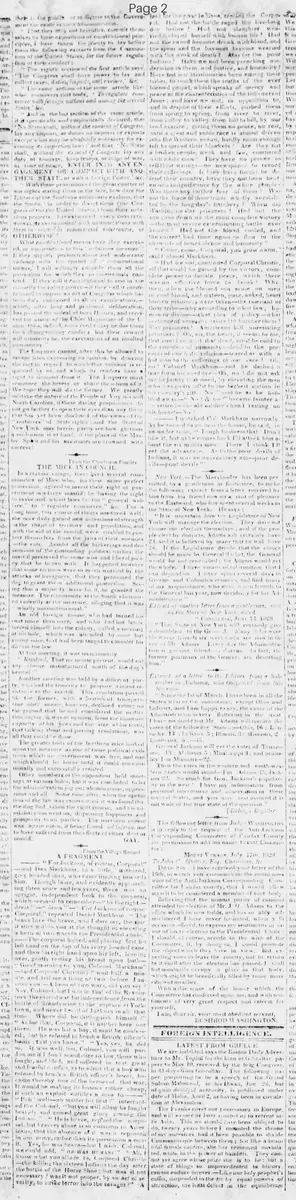
"For Jackson, of course, Corporal!"—said Dan Markham, to a little, withered, grey headed man, who came limping towards him. Though lame, and evidently approaching three score and ten years, there was an upright, independent look in the corporal, which seemed to remember—"to the right—dress! 'dress'"—"For Jackson of course Corporal," repeated Daniel Markham. "The brave love the brave, and I dare say, the spirit stirs within you at the thought of elevating a hero of two wars to the Presidential chair."—The corporal halted, and placing first his left hand on the top of his ivory headed cane, and then his right hand upon his left, leaning over, gently resting his breast upon both—
"Good morning to you, Colonel Markham'—said Corporal Christie, "wait half a minute and tell me a thing or two before I answer you—A hero in wars, did you say? No. Colonel but I was in that of the Revolution the sacred war for independence, from the battle of Brandywine to the capture at Yorktown, and never heard of Jackson in all that time. Where did he distinguish himself?"
"As for that, Corporal, it is neither here nor there". He was but a boy, it must be confessed, but he refused to brush a British officer's boots, that you know." "Yes, yes, he did so. It was well, but, Colonel, you will pardon me if I don't scandalize so low, those who fought, and bled, and suffered in that great and fearful conflict, as to admit that a boy who refused to brush a British officer's boots, became thereby one of the heroes of that war. It would be making its honors rather cheap if such an exploit entitles a man to—"
"Pshaw!—no matter for that" interrupted the Colonel, "but you will allow he fought bravely and gained great glory among the Indians?" "He is brave, replied the corporal, but bravery alone is so common to Americans, that the absence of it was a reproach in our army, rather than its possession a merit. Yes, he was brave—but I wish, Colonel, we could add, 'HE WAS HUMANE.' Ah! I know what you allude to, Corporal Christie—the killing the sixteen Indians the day after the battle of the Horse Shoe; but was it not necessary? was it not proper, by an act of severity, to strike terror into the savages?"
"Justice for the poor Indian, replied the Corporal. Had not the battle raged the whole long day before? Had not slaughter wearied herself with human life? Had not the sword become drunk with blood, and the spear and the bayonet become wearied with the work of death? As for the poor Indians—Have we not been preaching to them, and moderation, and justice, and humanity? Have not our missionaries been among their tribes, to teach them the truths of the everlasting gospel, which speaks of mercy and peace as the characteristics of the followers of Jesus, and have we not, in opposition to, and in despite of their efforts, pushed them from spring to spring, from river to river, from valley to valley, from hill to hill, by our land avarice, giving them no peace, no rest, until a great and noble race is almost driven into the Western ocean, hardly room enough left to spread their blankets? Are they not a broken people, weak and few, compared with what they have been? They have no presses to tell their wrongs—no newspapers to record their sufferings. If they have fought to defend their country, have they not been beaten into insignificance by the white people? Was there any further fear of them? Was not the force of their tribes wholly swept by the long day's butchery? When did Jackson examine his prisoners? Had not the sun come down on the most complete victory— that most severe exterminating battle ever known? Had not the blood cooled, Had the current of mercy had time again to flow in the channel of benevolence and humanity?
"Come, corporal, you grow warm, "—said Colonel Markham.
"Had we not, continued Corporal Christie, by that costly victory, complete power to dictate peace, which there was no effective force to look: Why, then, when the blessed sun rose on men unconquered looked upon sixteen, poor, naked, heart-broken prisoners were taken—the remnant of their tribe—why according to what law, human or divine—what plea of policy—what sentence of necessity existed in butchering them? Slaughtering unresisting Americans kill unresisting prisoners: Oh, no, the head, it seems to me, that could cease to bleed, must be cold to the impulse of humanity—cold to the precepts of our holy religion—seared as with a hot iron to the sufferings of our race. Oh, no! Colonel Markham—and he dashed a tear from his good eye—Oh, no! do not ask me to justify that deed, by elevating the man who was guilty of it to the highest station in his country's gift. No could he as he hobbled away—No: & no" became fainter and fainter as he retired — the old soldier's hand resting on his breast—), —watched by Markham narrowly As he turned to go into the house, he said in an under tone. "Tough business that. Don't like it, but necessary like. I'll attack him without the six militia men there I think I'll get the advantage. As to the poor devils Indians, it was an unnecessary act—poor devils—poor devils".
A FRAGMENT
"For Jackson, of course, Corporal!"—said Dan Markham, to a little, withered, grey headed man, who came limping towards him. Though lame, and evidently approaching three score and ten years, there was an upright, independent look in the corporal, which seemed to remember—"to the right—dress! 'dress'"—"For Jackson of course Corporal," repeated Daniel Markham. "The brave love the brave, and I dare say, the spirit stirs within you at the thought of elevating a hero of two wars to the Presidential chair."—The corporal halted, and placing first his left hand on the top of his ivory headed cane, and then his right hand upon his left, leaning over, gently resting his breast upon both—
"Good morning to you, Colonel Markham'—said Corporal Christie, "wait half a minute and tell me a thing or two before I answer you—A hero in wars, did you say? No. Colonel but I was in that of the Revolution the sacred war for independence, from the battle of Brandywine to the capture at Yorktown, and never heard of Jackson in all that time. Where did he distinguish himself?"
"As for that, Corporal, it is neither here nor there". He was but a boy, it must be confessed, but he refused to brush a British officer's boots, that you know." "Yes, yes, he did so. It was well, but, Colonel, you will pardon me if I don't scandalize so low, those who fought, and bled, and suffered in that great and fearful conflict, as to admit that a boy who refused to brush a British officer's boots, became thereby one of the heroes of that war. It would be making its honors rather cheap if such an exploit entitles a man to—"
"Pshaw!—no matter for that" interrupted the Colonel, "but you will allow he fought bravely and gained great glory among the Indians?" "He is brave, replied the corporal, but bravery alone is so common to Americans, that the absence of it was a reproach in our army, rather than its possession a merit. Yes, he was brave—but I wish, Colonel, we could add, 'HE WAS HUMANE.' Ah! I know what you allude to, Corporal Christie—the killing the sixteen Indians the day after the battle of the Horse Shoe; but was it not necessary? was it not proper, by an act of severity, to strike terror into the savages?"
"Justice for the poor Indian, replied the Corporal. Had not the battle raged the whole long day before? Had not slaughter wearied herself with human life? Had not the sword become drunk with blood, and the spear and the bayonet become wearied with the work of death? As for the poor Indians—Have we not been preaching to them, and moderation, and justice, and humanity? Have not our missionaries been among their tribes, to teach them the truths of the everlasting gospel, which speaks of mercy and peace as the characteristics of the followers of Jesus, and have we not, in opposition to, and in despite of their efforts, pushed them from spring to spring, from river to river, from valley to valley, from hill to hill, by our land avarice, giving them no peace, no rest, until a great and noble race is almost driven into the Western ocean, hardly room enough left to spread their blankets? Are they not a broken people, weak and few, compared with what they have been? They have no presses to tell their wrongs—no newspapers to record their sufferings. If they have fought to defend their country, have they not been beaten into insignificance by the white people? Was there any further fear of them? Was not the force of their tribes wholly swept by the long day's butchery? When did Jackson examine his prisoners? Had not the sun come down on the most complete victory— that most severe exterminating battle ever known? Had not the blood cooled, Had the current of mercy had time again to flow in the channel of benevolence and humanity?
"Come, corporal, you grow warm, "—said Colonel Markham.
"Had we not, continued Corporal Christie, by that costly victory, complete power to dictate peace, which there was no effective force to look: Why, then, when the blessed sun rose on men unconquered looked upon sixteen, poor, naked, heart-broken prisoners were taken—the remnant of their tribe—why according to what law, human or divine—what plea of policy—what sentence of necessity existed in butchering them? Slaughtering unresisting Americans kill unresisting prisoners: Oh, no, the head, it seems to me, that could cease to bleed, must be cold to the impulse of humanity—cold to the precepts of our holy religion—seared as with a hot iron to the sufferings of our race. Oh, no! Colonel Markham—and he dashed a tear from his good eye—Oh, no! do not ask me to justify that deed, by elevating the man who was guilty of it to the highest station in his country's gift. No could he as he hobbled away—No: & no" became fainter and fainter as he retired — the old soldier's hand resting on his breast—), —watched by Markham narrowly As he turned to go into the house, he said in an under tone. "Tough business that. Don't like it, but necessary like. I'll attack him without the six militia men there I think I'll get the advantage. As to the poor devils Indians, it was an unnecessary act—poor devils—poor devils".
What sub-type of article is it?
Dialogue
Satire
Prose Fiction
What themes does it cover?
Political
War Peace
Moral Virtue
What keywords are associated?
Andrew Jackson
Presidential Campaign
Battle Horseshoe Bend
Indian Massacre
Revolutionary War
Humanity
Political Dialogue
Literary Details
Title
A Fragment
Subject
Debate On Andrew Jackson's Presidential Candidacy And Military Actions Against Indians
Form / Style
Satirical Political Dialogue In Prose
Key Lines
"The Brave Love The Brave, And I Dare Say, The Spirit Stirs Within You At The Thought Of Elevating A Hero Of Two Wars To The Presidential Chair."
"Yes, He Was Brave—But I Wish, Colonel, We Could Add, 'He Was Humane.'"
"Justice For The Poor Indian... Why According To What Law, Human Or Divine—What Plea Of Policy—What Sentence Of Necessity Existed In Butchering Them?"
"Oh, No! Do Not Ask Me To Justify That Deed, By Elevating The Man Who Was Guilty Of It To The Highest Station In His Country's Gift."