Thank you for visiting SNEWPapers!
Sign up free
The Enquirer
Richmond, Henrico County, Virginia
What is this article about?
Editorial in Richmond Enquirer discusses recovery from anxiety over British April orders, satisfaction with Erskine’s assurances on the April 19 Washington agreement revoking non-intercourse and British orders post-June 10. Critiques new British tariff on US exports like cotton, and attacks Federalist papers for excusing potential British perfidy.
Merged-components note: Tariff table is directly referenced and integral to the editorial discussion.
Clipping
OCR Quality
Full Text
RICHMOND, JUNE 20, 1809.
CURSORY REFLECTIONS.
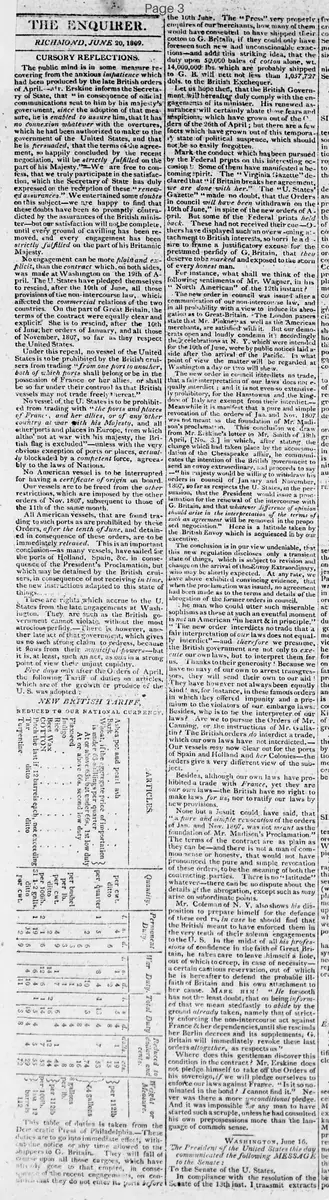
The public mind is in some measure recovering from the anxious impatience which had been produced by the late British orders of April. Mr. Erskine informs the Secretary of State, that "in consequence of official communications sent to him by his majesty's government, since the adoption of that measure, he is enabled to assure him, that it has no connexion whatever with the overtures, which he had been authorized to make to the government of the United States, and that he is persuaded, that the terms of the agreement, so happily concluded by the recent negociation, will be strictly fulfilled on the part of his Majesty." We are free to confess, that we truly participate in the satisfaction, which the Secretary of State has duly expressed on the reception of these "renewed assurances." We entertained some doubts on this subject—we are happy to find that these doubts have been so promptly contradicted by the assurances of the British minister—but our satisfaction will not be complete, until every ground of cavilling has been removed, and every engagement has been strictly fulfilled on the part of his Britannic Majesty.
No engagement can be more plain and explicit, than the contract which, on both sides, was made at Washington on the 19th of April. The U. States have pledged themselves to rescind, after the 10th of June, all those provisions of the non-intercourse law, which affected the commercial relations of the two countries. On the part of Great Britain, the terms of the contract were equally clear and explicit. She is to rescind, after the 10th of June, her orders of January, and all those of November, 1807, so far as they respect the United States.
Under this repeal, no vessel of the United States is to be prohibited by the British cruisers from trading "from one port to another, both of which ports shall belong or be in the possession of France or her allies, or shall be so far under their controul as that British vessels may not trade freely hereat."
No vessel of the U. States is to be prohibited from trading with "the ports and places of France, and her allies, or of any other country at war with his Majesty, and all other ports and places in Europe, from which altho' not at war with his majesty, the British flag is excluded"—unless with the very obvious exception of ports or places, actually blockaded by a competent force, agreeably to the laws of Nations.
No American vessel is to be interrupted for having a certificate of origin on board.
Our vessels are to be freed from the other restrictions, which are imposed by the other orders of Nov. 1807, subsequent to those of the 11th of the same month.
All American vessels, that are found trading to such ports as are prohibited by these Orders, after the tenth of June, and detained in consequence of these orders, are to be immediately released. This is an important conclusion—as many vessels, have sailed for the ports of Holland, Spain, &c. in consequence of the President's Proclamation, but which may be detained by the British cruisers, in consequence of not receiving in time, the new instructions adapted to this state of things.
These are rights which accrue to the U. States from the late engagements at Washington. They are such as the British government cannot violate without the most atrocious perfidy. There is, however, another late act of that government, which gives us no such strong claim to redress, because it flows from their municipal powers—but it is, at least, such an act, as sets in a strong point of view their unjust cupidity.
Five days only after the Orders of April, the following Tariff of duties on articles, which are of the growth or produce of the U. S. was adopted:
NEW BRITISH TARIFF,
REDUCED TO OUR NATIONAL CURRENCY
This table of duties is taken from the Democratic Press of Philadelphia. These duties are to go into immediate effect; without due notice or any time allowed to the shippers to G. Britain. They will fall of course upon all those cargoes, which have already gone to that empire, in consequence of the recent engagements, on condition that they do not enter its ports before the 10th June. The "Press" very properly enquires of our merchants, how many of them would have consented to have shipped their cotton to G. Britain, if they could only have foreseen such new and unconscionable exactions—and adds this striking idea, that the duty upon 500,000 bales of cotton alone, wt. 140,000,000 lbs. which are probably shipped to G. B. will net not less than 1,087,727 dols. to the British Exchequer.
Let us hope then, that the British Government, will hereafter duly comply with the engagements of its minister. His renewed assurances will certainly abate those fears and suspicions; which have grown out of the orders of the 26th of April; but there are a few facts which have grown out of this temporary state of political suspence, which should not be so easily forgotten.
Mark the conduct which has been pursued by the Federal prints on this interesting occasion! Some of them have manifested a becoming spirit. The "Virginia Gazette" declared that "if Britain breaks her agreement, we are done with her." The "U. States' Gazette" made no doubt, that the Orders in council will have been withdrawn on the 10th of June," in spite of the new orders of April. But some of the Federal prints held back. These had not received their cue—Others have displayed such an overweening attachment to British interests, so horrible a desire to frame a justificatory excuse for the presumed perfidy of G. Britain, that they deserve to be marked and exposed to the scorn of every honest man.
For instance, what shall we think of the following sentiments of Mr. Wagner, in his "North American" of the 12th instant?
The new order in council was issued after a communication of our non-intercourse law, and in all probability with a view to induce its abrogation as to Great-Britain. The London papers state that Mr. Pinkney as well as the American merchants, are satisfied with it. But our democrats open and loudly condemn it: accordingly the celebrations at N. Y. which were intended for the 10th of June, were by public notices laid aside after the arrival of the Pacific. In what point of view the matter will be regarded at Washington a day or two will shew.
The new order in council interdicts no trade, that a fair interpretation of our laws does not equally interdict; and it is not even so extensively prohibitory, for the Hanstowns and the kingdom of Italy are exempt from their interdict.
Meanwhile it is manifest that a pure and simple revocation of the orders of Jan. and Nov. 1807 was not meant as the foundation of Mr. Madison's proclamation. This conclusion we draw from Mr. Erskine's letter to Mr. Smith of 18th April, [No. 3.] in which, after stating the change which had taken place by the accommodation of the Chesapeake affair, he communicates the intention of the British government to send an envoy extraordinary, and proceeds to say—"his majesty would be willing to withdraw his orders in council of January and November, 1807, so far as respects the U. States, in the persuasion, that the President would issue a proclamation for the renewal of the intercourse with G. Britain, and that whatever difference of opinion should arise in the interpretation of the terms of such an agreement will be removed in the proposed negociation." Here is a latitude taken by the British Envoy which is acquiesced in by our executive.
The conclusion is in our view undeniable, that this new regulation discloses only a transient state of things, which is subject to revision and change on the arrival of the Envoy Extraordinary, who may be shortly expected. At any rate, we have above exhibited convincing evidence, "that when the proclamation was issued, no agreement had been made as to the terms and details of the abrogation of the former orders in council."
The man who could utter such miserable sophisms as these at such an eventful moment is not an American "in heart & in principle."
"The new order interdicts no trade that a fair interpretation of our laws does not equally interdict"—and therefore we presume, the British government are not only to execute our own laws, but to interpret them for us. Thanks to their generosity! Because we have no navy of our own to arrest transgressors, they will send their own to our aid. They have however not always been equally kind: as, for instance, in these famous orders in which they offered impunity and a premium to the violators of our embargo laws.
Besides, who is to be the interpreter of our laws? Are we to pursue the Orders of Mr. Canning, or the instructions of Mr. Gallatin? The British orders do interdict a trade, which our own laws have not interdicted. Our vessels may now clear out for the ports of Spain and Holland and her Colonies—the orders give a very different view of the subject.
Besides, although our own laws have prohibited a trade with France, yet they are our own laws—the British have no right to make laws for us, nor to ratify our laws by new provisions.
None but a Jesuit could have said, that "a pure and simple revocation of the orders of Jan. and Nov. 1807, was not meant as the foundation of Mr. Madison's Proclamation."
The terms of the contract are as plain as they can be—and there is not a man of common sense or honesty, that would not have pronounced the pure and simple revocation of these orders, to be the meaning of both the contracting parties. There is no "latitude" whatever—there can be no dispute about the details of the abrogation, except such as may arise on subordinate points.
Mr. Coleman of N. Y. also shows his disposition to prepare himself for the defence of these orders, in case he should find that the British meant to have enforced them in the very teeth of their solemn engagements to the U. S. In the midst of all his professions of confidence in the faith of Great Britain, he takes care to leave himself a hole, out of which to creep, in case of necessity—a certain cautious reservation, out of which he is hereafter to defend the probable ill-faith of Britain and his own attachment to her cause. Mark him! He forsooth has not the least doubt, that on being informed that we mean steadfastly to abide by the ground already taken, namely that of strictly enforcing the non-intercourse act against France & her dependencies, until she rescinds her Berlin decrees and its supplements; G. Britain will immediately revoke these last orders altogether, as respects us.
Where does this gentleman discover this condition in the contract? Mr. Erskine does not pledge himself to take off the Orders of his sovereign, if we will pledge ourselves to enforce our laws against France. Is it so nominated in the bond? I cannot find it. Never was there a more unconditional pledge. And it was impossible for any man to have started such a scruple, unless he had consulted his own prepossessions more than the language of common sense.
| ARTICLES. | Quantity. | Permanent Duty. | Mar Duty. | Total Duty | Reduced to dollars and cents. | Weight or Measure. |
| Ashes pot and pearl ash | per cwt. | 4 | 4 | 4 | 4 | 1 |
| Bark | ditto | 6 | 2 | 8 | 15 | 19 |
| Wheat, if the aggregate price of importation | per quarter | 1 | 5 | 8 | 13 | 7 |
| is under 63 shillings per quarter | per bushel | 2 | 6 | 10 | 3 | 74 |
| At or above 63s. but under 66s. 1st low duty | per bushel | 3 | 3 | 1 | 4 | 16 |
| At or above 66s. second low duty | per lb. | 3 | 3 | 1 | 4 | 8 |
| Flaxseed | per cwt. | 4 | 9 | 1 | 6 | 1 |
| Indigo | ditto | 2 | 6 | 14 | 16 | 12 |
| Rice | per 100 lbs. | 1 | 12 | 6 | 14 | 7 |
| Bees Wax | per 100 lbs. | 1 | 19 | 6 | 5 | 55 |
| COTTON | per 100 lbs. | 1 | 14 | 4 | 19 | 29 |
| Pitch the last if 12 barrels each, not exceeding | 51 1-2 galls. | 1 | 6 | 10 | 3 | 72 |
| Tar | ditto | 2 | 9 | 11 | 8 | 112 |
| Turpentine | per cwt. | 2 | 9 | 11 | 8 | 112 |
What sub-type of article is it?
What keywords are associated?
What entities or persons were involved?
Editorial Details
Primary Topic
British Compliance With Erskine Agreement And New Tariff Impositions
Stance / Tone
Cautiously Satisfied But Critical Of British Actions And Federalist Defenses
Key Figures
Key Arguments