Thank you for visiting SNEWPapers!
Sign up free
The New Hampshire Gazette And General Advertiser
Portsmouth, Exeter, Rockingham County, New Hampshire
What is this article about?
A Citizen of New Hampshire rebuts 'A Member of Convention's' misrepresentations in the New-Hampshire Gazette, defending the Convention's constitutional proposals for the executive branch, explaining the shift to an alternative plan due to voter rejection, and critiquing the opponent's weak arguments favoring a President over Governor.
Clipping
OCR Quality
Full Text
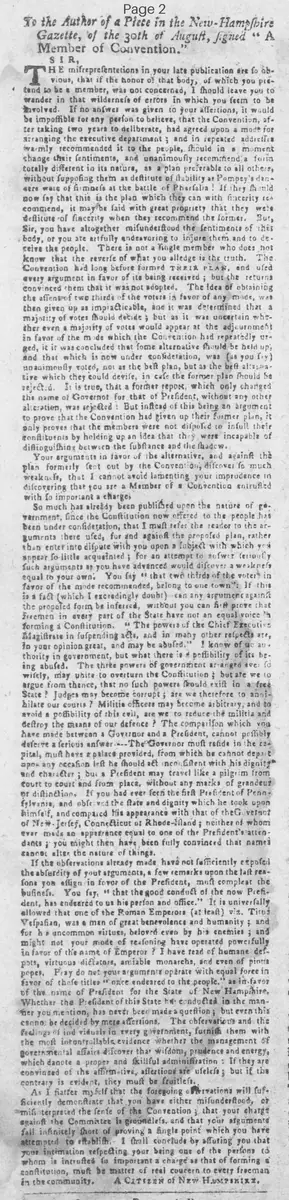
SIR,
The misrepresentations in your late publication are so obvious, that if the honor of that body, of which you pretend to be a member, was not concerned, I should leave you to wander in that wilderness of errors in which you seem to be involved. If no answer was given to your assertions, it would be impossible for any person to believe, that the Convention, after taking two years to deliberate, had agreed upon a mode for arranging the executive department; and in repeated addresses warmly recommended it to the people, should in a moment change their sentiments, and unanimously recommend a form totally different in its nature, as a plan preferable to all others, without opposing that as destitute of stability as Pompey's daggers were of firmness at the battle of Pharsalia! If they should now say that this is the plan which they can with sincerity recommend, it may be said with great propriety that they were destitute of sincerity when they recommend the former. But, Sir, you have altogether misunderstood the sentiments of that body, or you are artfully endeavoring to injure them, and to deceive the people. There is not a single member who does not know that the reverse of what you allege is the truth. The Convention had long before formed their plan, and used every argument in favor of its being received; but the returns convinced them that it was not adopted. The idea of obtaining the assent of two thirds of the voters in favor of any mode, was then given up as impracticable, and it was determined that a majority of voters should decide; but as it was uncertain whether even a majority of votes would appear at the adjournment in favor of the mode which the Convention had repeatedly urged, it was concluded that some alternative should be held up; and that which is now under consideration, was (as you say) unanimously voted, not as the best plan, but as the best alternative which they could devise, in case the former plan should be rejected. It is true, that a former report, which only changed the name of Governor for that of President, without any other alteration, was rejected: But instead of this being an argument to prove that the Convention had given up their former plan, it only proves that the members were not disposed to insult their constituents by holding up an idea that they were incapable of distinguishing between the substance and the shadow.
Your arguments in favor of the alternative, and against the plan formerly sent out by the Convention, discover so much weakness, that I cannot avoid lamenting your imprudence in discovering that you are a Member of Convention entrusted with so important a charge.
So much has already been published upon the nature of government, since the Constitution now offered to the people has been under consideration, that I must refer the reader to the arguments there used, for and against this proposed plan, rather than enter into dispute with you upon a subject with which you appear so little acquainted; for an attempt to confute seriously such arguments as you have advanced would discover a weakness equal to your own. You say "that two thirds of the voters in favor of the mode recommended, belong to one town": If this is a fact (which I exceedingly doubt) can any argument against the proposed form be inferred, without you can also prove that Freemen in every part of the State have not an equal voice in forming a Constitution. "The powers of the Chief Executive Magistrate in suspending acts, and in many other respects are, in your opinion great, and may be abused." I know of no authority in government, but what there is a possibility of its being abused. The three powers of government are ranged so wisely, many unite to overturn the Constitution; but are we to argue from thence, that no such powers should exist in a free State? Judges may become corrupt; are we therefore to annihilate our courts? Militia officers may become arbitrary, and to avoid a possibility of this evil, are we to reduce the militia and destroy the means of our defence? The comparison which you have made between a Governor and a President, cannot possibly deserve a serious answer.---The "Governor must reside in the capital, must have a palace provided, from which he cannot depart upon any occasion lest he should be inconsistent with his dignity and character; but a President may travel like a pilgrim from court to court and from place to place, without any marks of grandeur or distinction. If you had ever seen the first President of Pennsylvania, and observed the state and dignity which he took upon himself, and compared his appearance with that of the Governor of New Jersey, Connecticut or Rhode-Island; neither of whom ever makes an appearance equal to one of the President's attendances, you might then have been fully convinced that a name cannot alter the nature of things.
If the observations already made have not sufficiently exposed the absurdity of your arguments, a few remarks upon the last reason you assign in favor of the President, must complete the business. You say, "that the good conduct of the now President, has endeared to us his person and office." It is universally allowed that one of the Roman Emperors (at least) viz. Titus Vespasian, was a man of great benevolence and humanity; and for his uncommon virtues, beloved even by his enemies; and might not your mode of reasoning have operated powerfully in favor of the name of Emperor? I have read of humane despots, virtuous dictators, amiable monarchs, and even of pious popes, Pray do not your arguments operate with equal force in favor of those titles "once endeared to the people." as in favor of the name of President for the State of New Hampshire.
Whether the President of this State has conducted in the manner you mention, has never been made a question: but even this cannot be decided by mere assertions. The observations and the feelings of individuals in every government, furnish them with the most incontrovertible evidence whether the management of governmental affairs discover that wisdom, prudence and energy, which denote a proper and skillful administration: If they are convinced of the affirmative, assertions are useless; but if the contrary is evident, they must be fruitless.
As I flatter myself that the foregoing observations will sufficiently demonstrate that you have either misunderstood, or misinterpreted the sense of the Convention; that your charge against the Committee is groundless, and that your arguments fall infinitely short of proving a single point which you have attempted to establish. - I shall conclude by assuring you that your intimation respecting your being one of the persons entrusted with so important a charge as that of forming constitution, must be matter of real concern to every freeman in the community.
A Citizen of New Hampshire.
What sub-type of article is it?
What themes does it cover?
What keywords are associated?
What entities or persons were involved?
Letter to Editor Details
Author
A Citizen Of New Hampshire
Recipient
To The Author Of A Piece In The New Hampshire Gazette, Of The 20th Of August, Signed "A Member Of Convention."
Main Argument
the writer defends the new hampshire convention's constitutional proposals for the executive department, explaining that the alternative plan was adopted only as a fallback due to voter rejection of the original, and refutes the opponent's misrepresentations and weak arguments favoring a president over governor.
Notable Details