Thank you for visiting SNEWPapers!
Sign up free
Story
May 20, 1887
The Morning News
Savannah, Chatham County, Georgia
What is this article about?
Secretary Lamar implements the Indian allotment law, distributing land to 250,000 Native Americans, dissolving the corrupt Indian Bureau, and promoting their integration as citizens with substantial wealth from land sales.
Clipping
OCR Quality
98%
Excellent
Full Text
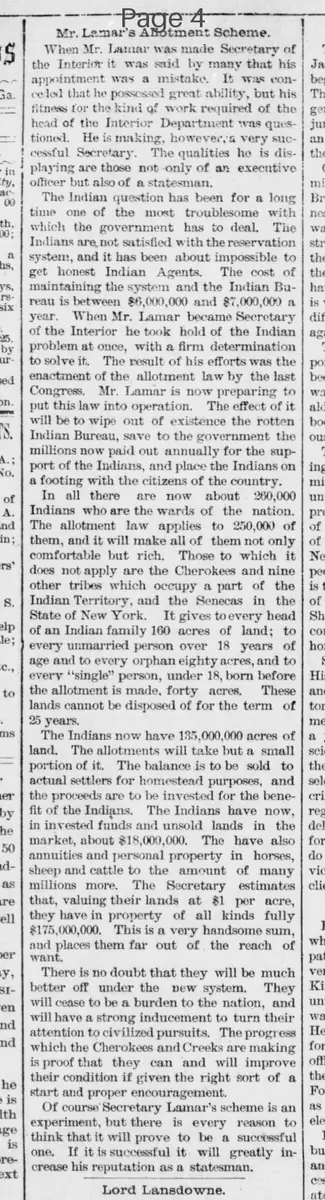
Mr. Lamar's Allotment Scheme
When Mr. Lamar was made Secretary of the Interior it was said by many that his appointment was a mistake. It was conceded that he possessed great ability, but his fitness for the kind of work required of the head of the Interior Department was questioned. He is making, however, a very successful Secretary. The qualities he is displaying are those not only of an executive officer but also of a statesman.
The Indian question has been for a long time one of the most troublesome with which the government has to deal. The Indians are not satisfied with the reservation system, and it has been about impossible to get honest Indian Agents. The cost of maintaining the system and the Indian Bureau is between $6,000,000 and $7,000,000 a year. When Mr. Lamar became Secretary of the Interior he took hold of the Indian problem at once, with a firm determination to solve it. The result of his efforts was the enactment of the allotment law by the last Congress. Mr. Lamar is now preparing to put this law into operation. The effect of it will be to wipe out of existence the rotten Indian Bureau, save to the government the millions now paid out annually for the support of the Indians, and place the Indians on a footing with the citizens of the country.
In all there are now about 260,000 Indians who are the wards of the nation. The allotment law applies to 250,000 of them, and it will make all of them not only comfortable but rich. Those to which it does not apply are the Cherokees and nine other tribes which occupy a part of the Indian Territory, and the Senecas in the State of New York. It gives to every head of an Indian family 160 acres of land; to every unmarried person over 18 years of age and to every orphan eighty acres, and to every "single" person, under 18, born before the allotment is made, forty acres. These lands cannot be disposed of for the term of 25 years.
The Indians now have 135,000,000 acres of land. The allotments will take but a small portion of it. The balance is to be sold to actual settlers for homestead purposes, and the proceeds are to be invested for the benefit of the Indians. The Indians have now, in invested funds and unsold lands in the market, about $18,000,000. They have also annuities and personal property in horses, sheep and cattle to the amount of many millions more. The Secretary estimates that, valuing their lands at $1 per acre, they have in property of all kinds fully $175,000,000. This is a very handsome sum, and places them far out of the reach of want.
There is no doubt that they will be much better off under the new system. They will cease to be a burden to the nation, and will have a strong inducement to turn their attention to civilized pursuits. The progress which the Cherokees and Creeks are making is proof that they can and will improve their condition if given the right sort of a start and proper encouragement.
Of course Secretary Lamar's scheme is an experiment, but there is every reason to think that it will prove to be a successful one. If it is successful it will greatly increase his reputation as a statesman.
When Mr. Lamar was made Secretary of the Interior it was said by many that his appointment was a mistake. It was conceded that he possessed great ability, but his fitness for the kind of work required of the head of the Interior Department was questioned. He is making, however, a very successful Secretary. The qualities he is displaying are those not only of an executive officer but also of a statesman.
The Indian question has been for a long time one of the most troublesome with which the government has to deal. The Indians are not satisfied with the reservation system, and it has been about impossible to get honest Indian Agents. The cost of maintaining the system and the Indian Bureau is between $6,000,000 and $7,000,000 a year. When Mr. Lamar became Secretary of the Interior he took hold of the Indian problem at once, with a firm determination to solve it. The result of his efforts was the enactment of the allotment law by the last Congress. Mr. Lamar is now preparing to put this law into operation. The effect of it will be to wipe out of existence the rotten Indian Bureau, save to the government the millions now paid out annually for the support of the Indians, and place the Indians on a footing with the citizens of the country.
In all there are now about 260,000 Indians who are the wards of the nation. The allotment law applies to 250,000 of them, and it will make all of them not only comfortable but rich. Those to which it does not apply are the Cherokees and nine other tribes which occupy a part of the Indian Territory, and the Senecas in the State of New York. It gives to every head of an Indian family 160 acres of land; to every unmarried person over 18 years of age and to every orphan eighty acres, and to every "single" person, under 18, born before the allotment is made, forty acres. These lands cannot be disposed of for the term of 25 years.
The Indians now have 135,000,000 acres of land. The allotments will take but a small portion of it. The balance is to be sold to actual settlers for homestead purposes, and the proceeds are to be invested for the benefit of the Indians. The Indians have now, in invested funds and unsold lands in the market, about $18,000,000. They have also annuities and personal property in horses, sheep and cattle to the amount of many millions more. The Secretary estimates that, valuing their lands at $1 per acre, they have in property of all kinds fully $175,000,000. This is a very handsome sum, and places them far out of the reach of want.
There is no doubt that they will be much better off under the new system. They will cease to be a burden to the nation, and will have a strong inducement to turn their attention to civilized pursuits. The progress which the Cherokees and Creeks are making is proof that they can and will improve their condition if given the right sort of a start and proper encouragement.
Of course Secretary Lamar's scheme is an experiment, but there is every reason to think that it will prove to be a successful one. If it is successful it will greatly increase his reputation as a statesman.
What sub-type of article is it?
Historical Event
Biography
What themes does it cover?
Triumph
Justice
Fortune Reversal
What keywords are associated?
Indian Allotment
Secretary Lamar
Indian Bureau
Land Distribution
Native American Policy
Reservation System
What entities or persons were involved?
Mr. Lamar
Cherokees
Creeks
Senecas
Where did it happen?
Indian Reservations, Indian Territory, State Of New York
Story Details
Key Persons
Mr. Lamar
Cherokees
Creeks
Senecas
Location
Indian Reservations, Indian Territory, State Of New York
Story Details
Secretary Lamar enacts and prepares to implement the allotment law, distributing land to Native American families and individuals, dissolving the Indian Bureau, selling surplus land for their benefit, and promoting their prosperity and citizenship.