Thank you for visiting SNEWPapers!
Sign up free
Daily National Intelligencer
Washington, District Of Columbia
What is this article about?
In London, the Princess of Wales is excluded from court by the Prince Regent, prompting a letter from her dated May 26, 1814, asserting her innocence and rights amid parliamentary debate and upcoming events like her daughter's potential marriage to the Prince of Orange and European peace celebrations.
Clipping
OCR Quality
Full Text
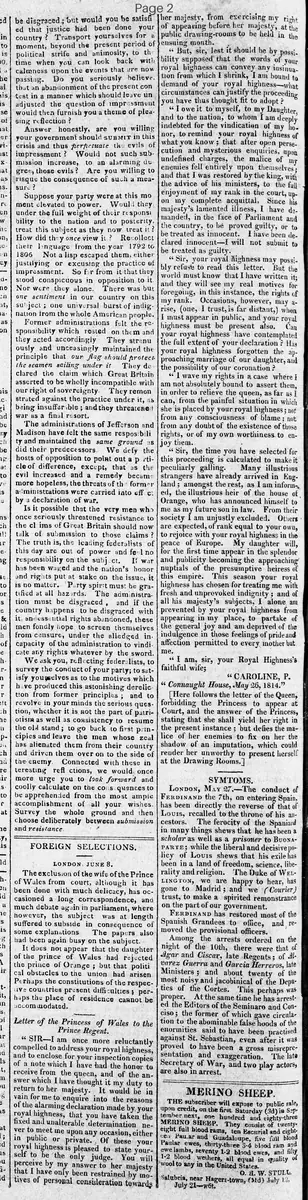
LONDON, JUNE 8.
The exclusion of the wife of the Prince of Wales from court, although it has been done with much delicacy, has occasioned a long correspondence, and much debate again in parliament, where however, the subject was at length suffered to subside in consequence of some explanations. The papers also had been again busy on the subject. It does not appear that the daughter of the prince of Wales had rejected the prince of Orange; but that political obstacles to the union had arisen. Perhaps the constitutions of the respective countries present difficulties; perhaps the place of residence cannot be accommodated.
Letter of the Princess of Wales to the Prince Regent.
"SIR—I am once more reluctantly compelled to address your royal highness, and to enclose for your inspection copies of a note which I have had the honor to receive from the queen, and of the answer which I have thought it my duty to return to her majesty. It would be in vain for me to enquire into the reasons of the alarming declaration made by your royal highness, that you have taken the fixed and unalterable determination never to meet me upon any occasion, either in public or private. Of these your royal highness is pleased to state yourself to be the only judge. You will perceive by my answer to her majesty that I have only been restrained by motives of personal consideration towards her majesty, from exercising my right of appearing before her majesty, at the public drawing-rooms to be held in the ensuing month.
"But, sir, lest it should be by possibility supposed that the words of your royal highness can convey any insinuation from which I shrink, I am bound to demand of your royal highness—what circumstances can justify the proceeding you have thus thought fit to adopt?
"I owe it to myself, to my Daughter, and to the nation, to whom I am deeply indebted for the vindication of my honor, to remind your royal highness of what you know; that after open persecution and mysterious enquiries, upon undefined charges, the malice of my enemies fell entirely upon themselves; and that I was restored by the king, with the advice of his ministers, to the full enjoyment of my rank in the court, upon my complete acquittal. Since his majesty's lamented illness, I have demanded, in the face of Parliament and the country, to be proved guilty, or to be treated as innocent. I have been declared innocent—I will not submit to be treated as guilty.
"Sir, your royal highness may possibly refuse to read this letter. But the world must know that I have written it; and they will see my real motives for foregoing, in this instance, the rights of my rank. Occasions, however, may arise, (one, I trust, is far distant,) when I must appear in public, and your royal highness must be present also. Can your royal highness have contemplated the full extent of your declaration? Has your royal highness forgotten the approaching marriage of our daughter, and the possibility of our coronation?
I wave my rights in a case where I am not absolutely bound to assert them, in order to relieve the queen, as far as I can, from the painful situation in which she is placed by your royal highness; not from any consciousness of blame; not from any doubt of the existence of those rights, or of my own worthiness to enjoy them.
"Sir, the time you have selected for this proceeding is calculated to make it peculiarly galling. Many illustrious strangers have already arrived in England; amongst the rest, as I am informed, the illustrious heir of the house of Orange, who has announced himself to me as my future son in law. From their society I am unjustly excluded. Others are expected, of rank equal to your own, to rejoice with your royal highness in the peace of Europe. My daughter will, for the first time appear in the splendor and publicity becoming the approaching nuptials of the presumptive heiress of this empire. This season your royal highness has chosen for treating me with fresh and unprovoked indignity; and of all his majesty's subjects, I alone am prevented by your royal highness from appearing in my place, to partake of the general joy and am deprived of the indulgence in those feelings of pride and affection permitted to every mother but me.
"I am, sir, your Royal Highness's faithful wife,
"CAROLINE, P.
"Connaught House, May 26, 1814."
Here follows the letter of the Queen, forbidding the Princess to appear at Court, and the answer of the Princess, stating that she shall yield her right in the present instance; but defies the malice of her enemies to fix on her the shadow of an imputation, which could render her unworthy to present herself at the Drawing Rooms.
What sub-type of article is it?
What keywords are associated?
What entities or persons were involved?
Where did it happen?
Foreign News Details
Primary Location
London
Event Date
June 8, 1814
Key Persons
Outcome
princess yields right to appear at court drawing-rooms for now but asserts innocence and demands justification; parliamentary debate subsides after explanations.
Event Details
Exclusion of Princess of Wales from court occasions correspondence and parliamentary debate; she writes to Prince Regent enclosing note from Queen forbidding her appearance and her reply yielding the right temporarily; references past acquittal, daughter's marriage obstacles to Prince of Orange, and upcoming public events like coronation or wedding.