Thank you for visiting SNEWPapers!
Sign up free
The New Hampshire Gazette
Portsmouth, Rockingham County, New Hampshire
What is this article about?
Description from a London paper of the treadmill invention for prison hard labor, recommended by the Society for Prison Discipline to employ prisoners effectively and deter recidivism through fatiguing but simple operation.
Clipping
OCR Quality
Full Text
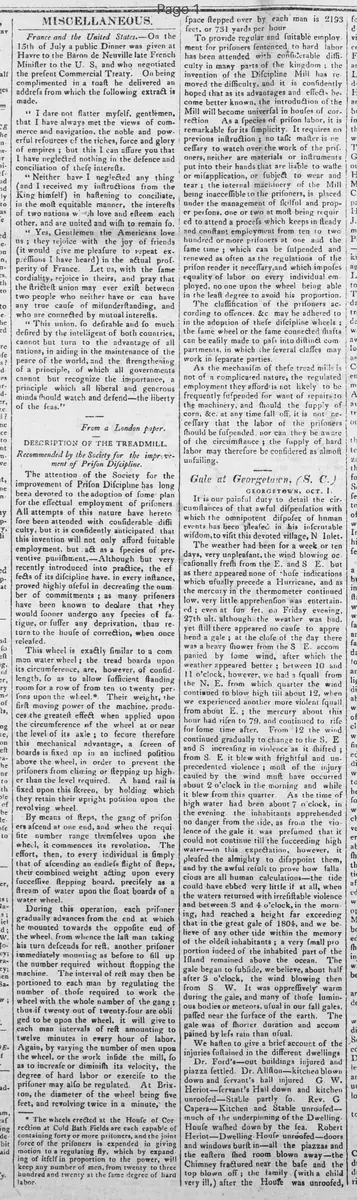
DESCRIPTION OF THE TREADMILL.
Recommended by the Society for the improvement of Prison Discipline.
The attention of the Society for the improvement of Prison Discipline has long been devoted to the adoption of some plan for the effectual employment of prisoners. All attempts of this nature have heretofore been attended with considerable difficulty, but it is confidently anticipated that this invention will not only afford suitable employment, but act as a species of preventive punishment.—Although but very recently introduced into practice, the effects of its discipline have, in every instance, proved highly useful in decreasing the number of commitments; as many prisoners have been known to declare that they would sooner undergo any species of fatigue, or suffer any deprivation, than return to the house of correction, when once released.
This wheel is exactly similar to a common water wheel; the tread boards upon its circumference, are, however, of considerable length, so as to allow sufficient standing room for a row of from ten to twenty persons upon the wheel.* Their weight, the first moving power of the machine, produces the greatest effect when applied upon the circumference of the wheel at or near the level of its axle: to secure therefore this mechanical advantage, a screen of boards is fixed up in an inclined position above the wheel, in order to prevent the prisoners from climbing or stepping up higher than the level required. A hand rail is fixed upon this screen, by holding which they retain their upright position upon the revolving wheel.
By means of steps, the gang of prisoners ascend at one end, and when the requisite number range themselves upon the wheel, it commences its revolution. The effort, then, to every individual is simply that of ascending an endless flight of steps, their combined weight acting upon every successive stepping board, precisely as a stream of water upon the float boards of a water wheel.
During this operation, each prisoner gradually advances from the end at which he mounted towards the opposite end of the wheel, from whence the last man taking his turn descends for rest, another prisoner immediately mounting as before to fill up the number required without stopping the machine. The interval of rest may then be portioned to each man by regulating the number of those required to work the wheel with the whole number of the gang; thus if twenty out of twenty-four are obliged to be upon the wheel, it will give to each man intervals of rest amounting to twelve minutes in every hour of labor. Again, by varying the number of men upon the wheel, or the work inside the mill, so as to increase or diminish its velocity, the degree of hard labor or exercise to the prisoner may also be regulated. At Brixton, the diameter of the wheel being five feet, and revolving twice in a minute, the space stepped over by each man is 2193 feet, or 731 yards per hour
* The wheels erected at the House of Correction at Cold Bath Fields are each capable of containing forty or more prisoners, and the joint force of the prisoners is expended in giving motion to a regulating fly, which by expanding of itself in proportion to the power, will keep any number of men, from twenty to three hundred and twenty at the same degree of hard labor.
To provide regular and suitable employment for prisoners sentenced to hard labor has been attended with considerable difficulty in many parts of the kingdom; the invention of the Discipline Mill has removed the difficulty, and it is confidently hoped that as its advantages and effects become better known, the introduction of the Mill will become universal in houses of correction As a species of prison labor, it is remarkable for its simplicity. It requires no previous instruction; no task master is necessary to watch over the work of the prisoners, neither are materials or instruments put into their hands that are liable to waste or misapplication, or subject to wear and tear: the internal machinery of the Mill being inaccessible to the prisoners, is placed under the management of skillful and proper persons, One or two at most being required to attend a process which keeps in steady and constant employment from ten to two hundred or more prisoners at one and the same time: which can be suspended and renewed as often as the regulations of the prison render it necessary, and which imposes equality of labor on every individual employed, no one upon the wheel being able in the least degree to avoid his proportion.
The classification of the prisoners according to offences. &c may be adhered to in the adoption of these discipline wheels: the same wheel or the same connected shafts can be easily made to pass into distinct compartments, in which the several classes may work in separate parties.
As the mechanism of these tread mills is not of a complicated nature, the regulated employment they afford is not likely to be frequently suspended for want of repairs to the machinery, and should the supply of corn, &c. at any time fall off, it is not necessary that the labor of the prisoners should be suspended, nor can they be aware of the circumstance; the supply of hard labor may therefore be considered as almost unfailing.
What sub-type of article is it?
What keywords are associated?
What entities or persons were involved?
Where did it happen?
Foreign News Details
Primary Location
London
Key Persons
Outcome
decreasing the number of commitments; prisoners declare they would sooner undergo any other fatigue or deprivation than return to the house of correction
Event Details
The Society for the Improvement of Prison Discipline recommends the treadmill, a wheel similar to a water wheel with tread boards for 10-20 prisoners to stand on. Their weight powers the machine as they ascend endless steps. It provides employment, preventive punishment, and regulates labor. At Brixton, the 5-foot diameter wheel revolves twice per minute, covering 2193 feet per hour per man. Larger wheels at Cold Bath Fields hold 40+ prisoners, powering a fly for equal labor. It simplifies prison labor without need for instruction, taskmasters, or materials, ensuring constant employment and equality.