Thank you for visiting SNEWPapers!
Sign up free
Editorial
October 5, 1808
The National Intelligencer And Washington Advertiser
Washington, District Of Columbia
What is this article about?
This editorial defends President Jefferson and his administration against Federalist accusations of hostility to England and partiality to France. It argues that Jefferson's early sympathy for France stemmed from the American Revolution and French support, not personal bias, and refutes claims of hatred for England by citing his roles under Washington and lack of hostile actions.
Clipping
OCR Quality
95%
Excellent
Full Text
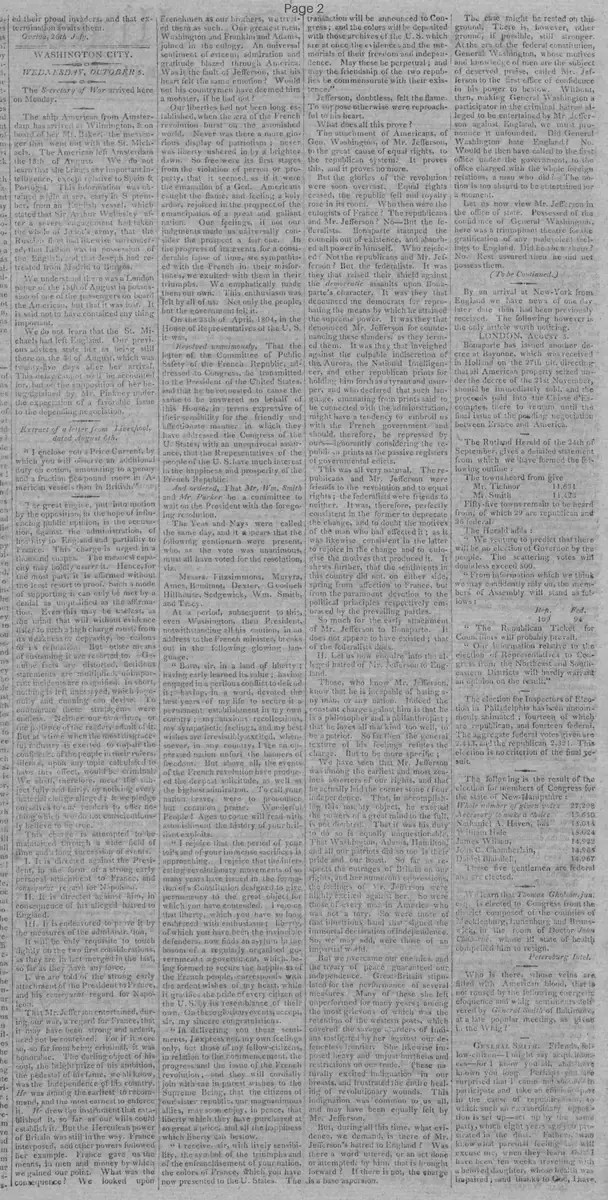
The great engine, put into motion by the opposition, in the hope of influencing public opinion, is the accusation, against the administration, of hostility to England and partiality to France. This charge is urged in a thousand shapes. The meanest capacity may boldly assert it. Hence, for the most part, it is affirmed without the least resort to proof. Such a mode of supporting it can only be met by a denial as unqualified as the affirmation. Even this may be useless, as the mind that will without evidence listen to such a high charge must, from its weakness or depravity, be callous to its refutation. But other means of sustaining it are resorted to. Genuine facts are distorted, fictitious statements are multiplied, unimportant incidents are magnified. In short, nothing is left unessayed, which ingenuity and cunning can devise. To enumerate these stratagems were endless. Neither our own time, or the patience of the readers admit of it. But at a time when the most disgraceful industry is excited to impair the confidence of the people in their rulers, silence, upon any topic calculated to have this effect, would be criminal. We shall, therefore, meet the subject fully and fairly, by noticing every material charge alleged; & we pledge ourselves to our readers to offer nothing which we do not conscientiously believe to be true.
This charge is attempted to be maintained though a wide field of time and a long succession of events.
I. It is directed against the President, in the form of a strong early personal attachment to France, and consequent regard for Napoleon.
II. It is directed against him, in consequence of his alleged hatred to England.
III. It is endeavored to prove it by the measures of the administration.
It will be only requisite to touch lightly on the two first considerations, as they are in fact merged in the last, so far as they have any force.
I. we are told of the strong early attachment of the President to France, and his consequent regard for Napoleon.
That Mr. Jefferson entertained, during our war, a regard for France, that it may have been strong and ardent, need not be contested. For if it were so, so far from being criminal, it was honorable. The darling object of his soul, the bright prize of his ambition, the pedestal of his fame, we all know, was the independence of his country. He was among the earliest to recommend, and the most earnest to enforce it. He drew the instrument that established it, so far as our wills could establish it. But the Herculean power of Britain was still in the way. France interposed, and other powers followed her example. France gave us the means, in men and money by which we gained our point. What was the consequence? We looked upon Frenchmen as our brothers, we treated them as such. Our greatest men, Washington and Franklin and Adams, joined in the eulogy. An universal sentiment of esteem, admiration and gratitude blazed through America.
Was it the fault of Jefferson, that his heart felt the same emotion? Would not his countrymen have deemed him a monster, if he had not?
Our liberties had not been long established, when the ara of the French revolution burst on the astonished world. Never was there a more glorious display of patriotism; never was liberty ushered in by a brighter dawn. So free were its first stages from the violation of person or property, that it seemed as if it were the emanation of a God. Americans caught the flame, and feeling a holy ardor, rejoiced in the prospect of the emancipation of a great and gallant nation. Our feelings, if not our judgments made us universally consider the prospect a fair one. In the progress of its events for a considerable lapse of time, we sympathised with the French in their misfortunes, we exulted with them in their triumphs. We emphatically made them our own. This enthusiasm was felt by all of us. Not only the people, but the government felt it.
On the 25th of April, 1794, in the House of Representatives of the U. S. it was,
Resolved unanimously, That the letter of the Committee of Public Safety of the French Republic, addressed to Congress, be transmitted to the President of the United States, and that he be requested to cause the same to be answered on behalf of this House, in terms expressive of their sensibility for the friendly and affectionate manner in which they have addressed the Congress of the U. States, with an unequivocal assurance, that the Representatives of the people of the U. S. have much interest in the happiness and prosperity of the French Republic.
And ordered, That Mr. Wm. Smith and Mr. Parker be a committee to wait on the President with the foregoing resolution.
The Yeas and Nays were called the same day, and it appears that the following gentlemen were present, who, as the vote was unanimous, must all have voted for the resolution, viz. Messrs. Fitzsimmons, Murray, Ames, Boudinot, Dexter, Goodhue, Hillhouse, Sedgwick, Wm. Smith, and Tracy.
At a period, subsequent to this, even Washington, then President, notwithstanding all his caution, in an address to the French minister, breaks out in the following glowing language.
Born, sir, in a land of liberty; having early learned its value; having engaged in a perilous conflict to defend it; having, in a word, devoted the best years of my life to secure it a permanent establishment in my own country; my anxious recollections, my sympathetic feelings, and my best wishes are irresistibly excited, whensoever, in any country, I see an oppressed nation unfurl the banners of freedom. But above all, the events of the French revolution have produced the deepest solicitude, as well as the highest admiration. To call your nation brave, were to pronounce but common praise. Wonderful People! Ages to come will read with astonishment the history of your brilliant exploits.
I rejoice that the period of your toils and of your immense sacrifices is approaching. I rejoice that the interesting revolutionary movements of so many years have issued in the formation of a Constitution designed to give permanency to the great object for which you have contended. I rejoice that liberty, which you have so long embraced with enthusiasm; liberty, of which you have been the invincible defenders, now finds an asylum in the bosom of a regularly organised government: a government, which, being formed to secure the happiness of the French people, corresponds with the ardent wishes of my heart, while it gratifies the pride of every citizen of the U. S. by its resemblance of their own. On these glorious events, accept, sir, my sincere congratulations.
In delivering you these sentiments, I express not my own feelings only, but those of my fellow-citizens, in relation to the commencement, the progress and the issue of the French revolution;—and they will cordially join with me in purest wishes to the Supreme Being, that the citizens of our sister republic, our magnanimous allies, may soon enjoy, in peace, that liberty which they have purchased at so great a price, and all the happiness which liberty can bestow.
I receive, sir, with lively sensibility, the symbol of the triumphs and of the enfranchisement of your nation, the colors of France, which you have now presented to the U. States. The transaction will be announced to Congress; and the colors will be deposited with those archives of the U. S. which are at once the evidences and the memorials of their freedom and independence. May these be perpetual; and may the friendship of the two republics be commensurate with their existence.
Jefferson, doubtless, felt the flame. To suppose otherwise were reproachful to his heart.
What does all this prove? The attachment of Americans, of Gen. Washington, of Mr. Jefferson, to the great cause of equal rights, to the republican system. It proves this, and it proves no more.
But the glories of the revolution were soon overcast. Equal rights ceased, the republic fell and royalty rose in its room. Who then were the eulogists of France? The republicans and Mr. Jefferson? No—But the federalists. Bonaparte stamped the councils out of existence, and absorbed all power in himself. Who rejoiced? Not the republicans and Mr. Jefferson? But the federalists. It was they that raised their shield against the democratic assaults upon Bonaparte's character. It was they that denounced the democrats for reprobating the means by which he attained the supreme power. It was they that denounced Mr. Jefferson for countenancing these slanders, as they termed them. It was they that inveighed against the culpable indiscretion of the Aurora, the National Intelligencer, and other republican prints for holding him forth as a tyrant and usurper, and who declared that such language, emanating from prints said to be connected with the administration, might have a tendency to embroil us with the French government and should, therefore, be repressed by ours—ignorantly considering the republican prints as the passive registers of governmental edicts.
This was all very natural. The republicans and Mr. Jefferson were friends to the revolution and to equal rights; the federalists were friends to neither. It was, therefore, perfectly consistent in the former to deprecate the change, and to doubt the motives of the man who had effected it; as it was likewise consistent in the latter to rejoice in the change and to eulogise the motives that produced it. It shews further, that the sentiments in this country did not, on either side, spring from affection to France, but from the paramount devotion to the political principles respectively embraced by the prevailing parties.
So much for the early attachment of Mr. Jefferson to Bonaparte. It does not appear to have existed; that of the federalists does.
II. Let us now enquire into the alleged hatred of Mr. Jefferson to England.
Those, who know Mr. Jefferson, know that he is incapable of hating any man, or any nation. Indeed the constant charge against him is that he is a philosopher and a philanthropist; that he loves all mankind too well, to be a patriot. So far then the general texture of his feelings refutes the charge. But to be more specific;
We have seen that Mr. Jefferson was among the earliest and most zealous asserters of our rights, and that he actually laid the corner stone (four independence. That, in accomplishing this mighty object, he exerted the powers of a great mind to the full, is not doubted. That it was his duty to do so is equally unquestionable. That Washington, Adams, Hamilton, and all our patriots did so too is their pride and our boast. So far as respects the outrages of Britain on our rights, and her numerous oppressions, the feelings of Mr. Jefferson were highly excited against her. So were those of every man in America who was not a tory. So were those of that illustrious band that signed the immortal declaration of independence. So, we may add, were those of an impartial world.
But we overcame our enemies, and the treaty of peace guaranteed our independence. Great-Britain stipulated for the performance of several measures. Many of these she left unperformed for many years; among the most grievous of which was the retention of the western posts, which covered the savage murders of Indians instigated by her against our defenceless frontier. She likewise imposed heavy and unjust burthens and restrictions on our trade. These naturally excited indignation in our breasts, and frustrated the entire healing of revolutionary wounds. This indignation was common to us all, and may have been equally felt by Mr. Jefferson.
But, during all this time, what evidence, we demand, is there of Mr. Jefferson's hatred to England? Was there a word uttered, or an act done or attempted, by him, that is brought forward? If there is not, the charge is a base aspersion.
The case might be rested on this ground. There is, however, other ground, if possible, still stronger. At the era of the federal constitution, General Washington, whose motives and knowledge of men are the subject of deserved praise, called Mr. Jefferson to the first office of confidence in his power to bestow. Without, then, making General Washington a participator in the criminal hatred alleged to be entertained by Mr Jefferson against England, we must pronounce it unfounded. Did General Washington hate England? No. Would he then have called to the first office under the government, to the office charged with the whole foreign relations, a man who did? The notion is too absurd to be entertained for a moment.
Let us now view Mr. Jefferson in the office of state. Possessed of the confidence of General Washington, here was a triumphant theatre for the gratification of any malevolent feelings to England. Did he shew them? No. Rest assured then he did not possess them.
(To be Continued.)
This charge is attempted to be maintained though a wide field of time and a long succession of events.
I. It is directed against the President, in the form of a strong early personal attachment to France, and consequent regard for Napoleon.
II. It is directed against him, in consequence of his alleged hatred to England.
III. It is endeavored to prove it by the measures of the administration.
It will be only requisite to touch lightly on the two first considerations, as they are in fact merged in the last, so far as they have any force.
I. we are told of the strong early attachment of the President to France, and his consequent regard for Napoleon.
That Mr. Jefferson entertained, during our war, a regard for France, that it may have been strong and ardent, need not be contested. For if it were so, so far from being criminal, it was honorable. The darling object of his soul, the bright prize of his ambition, the pedestal of his fame, we all know, was the independence of his country. He was among the earliest to recommend, and the most earnest to enforce it. He drew the instrument that established it, so far as our wills could establish it. But the Herculean power of Britain was still in the way. France interposed, and other powers followed her example. France gave us the means, in men and money by which we gained our point. What was the consequence? We looked upon Frenchmen as our brothers, we treated them as such. Our greatest men, Washington and Franklin and Adams, joined in the eulogy. An universal sentiment of esteem, admiration and gratitude blazed through America.
Was it the fault of Jefferson, that his heart felt the same emotion? Would not his countrymen have deemed him a monster, if he had not?
Our liberties had not been long established, when the ara of the French revolution burst on the astonished world. Never was there a more glorious display of patriotism; never was liberty ushered in by a brighter dawn. So free were its first stages from the violation of person or property, that it seemed as if it were the emanation of a God. Americans caught the flame, and feeling a holy ardor, rejoiced in the prospect of the emancipation of a great and gallant nation. Our feelings, if not our judgments made us universally consider the prospect a fair one. In the progress of its events for a considerable lapse of time, we sympathised with the French in their misfortunes, we exulted with them in their triumphs. We emphatically made them our own. This enthusiasm was felt by all of us. Not only the people, but the government felt it.
On the 25th of April, 1794, in the House of Representatives of the U. S. it was,
Resolved unanimously, That the letter of the Committee of Public Safety of the French Republic, addressed to Congress, be transmitted to the President of the United States, and that he be requested to cause the same to be answered on behalf of this House, in terms expressive of their sensibility for the friendly and affectionate manner in which they have addressed the Congress of the U. States, with an unequivocal assurance, that the Representatives of the people of the U. S. have much interest in the happiness and prosperity of the French Republic.
And ordered, That Mr. Wm. Smith and Mr. Parker be a committee to wait on the President with the foregoing resolution.
The Yeas and Nays were called the same day, and it appears that the following gentlemen were present, who, as the vote was unanimous, must all have voted for the resolution, viz. Messrs. Fitzsimmons, Murray, Ames, Boudinot, Dexter, Goodhue, Hillhouse, Sedgwick, Wm. Smith, and Tracy.
At a period, subsequent to this, even Washington, then President, notwithstanding all his caution, in an address to the French minister, breaks out in the following glowing language.
Born, sir, in a land of liberty; having early learned its value; having engaged in a perilous conflict to defend it; having, in a word, devoted the best years of my life to secure it a permanent establishment in my own country; my anxious recollections, my sympathetic feelings, and my best wishes are irresistibly excited, whensoever, in any country, I see an oppressed nation unfurl the banners of freedom. But above all, the events of the French revolution have produced the deepest solicitude, as well as the highest admiration. To call your nation brave, were to pronounce but common praise. Wonderful People! Ages to come will read with astonishment the history of your brilliant exploits.
I rejoice that the period of your toils and of your immense sacrifices is approaching. I rejoice that the interesting revolutionary movements of so many years have issued in the formation of a Constitution designed to give permanency to the great object for which you have contended. I rejoice that liberty, which you have so long embraced with enthusiasm; liberty, of which you have been the invincible defenders, now finds an asylum in the bosom of a regularly organised government: a government, which, being formed to secure the happiness of the French people, corresponds with the ardent wishes of my heart, while it gratifies the pride of every citizen of the U. S. by its resemblance of their own. On these glorious events, accept, sir, my sincere congratulations.
In delivering you these sentiments, I express not my own feelings only, but those of my fellow-citizens, in relation to the commencement, the progress and the issue of the French revolution;—and they will cordially join with me in purest wishes to the Supreme Being, that the citizens of our sister republic, our magnanimous allies, may soon enjoy, in peace, that liberty which they have purchased at so great a price, and all the happiness which liberty can bestow.
I receive, sir, with lively sensibility, the symbol of the triumphs and of the enfranchisement of your nation, the colors of France, which you have now presented to the U. States. The transaction will be announced to Congress; and the colors will be deposited with those archives of the U. S. which are at once the evidences and the memorials of their freedom and independence. May these be perpetual; and may the friendship of the two republics be commensurate with their existence.
Jefferson, doubtless, felt the flame. To suppose otherwise were reproachful to his heart.
What does all this prove? The attachment of Americans, of Gen. Washington, of Mr. Jefferson, to the great cause of equal rights, to the republican system. It proves this, and it proves no more.
But the glories of the revolution were soon overcast. Equal rights ceased, the republic fell and royalty rose in its room. Who then were the eulogists of France? The republicans and Mr. Jefferson? No—But the federalists. Bonaparte stamped the councils out of existence, and absorbed all power in himself. Who rejoiced? Not the republicans and Mr. Jefferson? But the federalists. It was they that raised their shield against the democratic assaults upon Bonaparte's character. It was they that denounced the democrats for reprobating the means by which he attained the supreme power. It was they that denounced Mr. Jefferson for countenancing these slanders, as they termed them. It was they that inveighed against the culpable indiscretion of the Aurora, the National Intelligencer, and other republican prints for holding him forth as a tyrant and usurper, and who declared that such language, emanating from prints said to be connected with the administration, might have a tendency to embroil us with the French government and should, therefore, be repressed by ours—ignorantly considering the republican prints as the passive registers of governmental edicts.
This was all very natural. The republicans and Mr. Jefferson were friends to the revolution and to equal rights; the federalists were friends to neither. It was, therefore, perfectly consistent in the former to deprecate the change, and to doubt the motives of the man who had effected it; as it was likewise consistent in the latter to rejoice in the change and to eulogise the motives that produced it. It shews further, that the sentiments in this country did not, on either side, spring from affection to France, but from the paramount devotion to the political principles respectively embraced by the prevailing parties.
So much for the early attachment of Mr. Jefferson to Bonaparte. It does not appear to have existed; that of the federalists does.
II. Let us now enquire into the alleged hatred of Mr. Jefferson to England.
Those, who know Mr. Jefferson, know that he is incapable of hating any man, or any nation. Indeed the constant charge against him is that he is a philosopher and a philanthropist; that he loves all mankind too well, to be a patriot. So far then the general texture of his feelings refutes the charge. But to be more specific;
We have seen that Mr. Jefferson was among the earliest and most zealous asserters of our rights, and that he actually laid the corner stone (four independence. That, in accomplishing this mighty object, he exerted the powers of a great mind to the full, is not doubted. That it was his duty to do so is equally unquestionable. That Washington, Adams, Hamilton, and all our patriots did so too is their pride and our boast. So far as respects the outrages of Britain on our rights, and her numerous oppressions, the feelings of Mr. Jefferson were highly excited against her. So were those of every man in America who was not a tory. So were those of that illustrious band that signed the immortal declaration of independence. So, we may add, were those of an impartial world.
But we overcame our enemies, and the treaty of peace guaranteed our independence. Great-Britain stipulated for the performance of several measures. Many of these she left unperformed for many years; among the most grievous of which was the retention of the western posts, which covered the savage murders of Indians instigated by her against our defenceless frontier. She likewise imposed heavy and unjust burthens and restrictions on our trade. These naturally excited indignation in our breasts, and frustrated the entire healing of revolutionary wounds. This indignation was common to us all, and may have been equally felt by Mr. Jefferson.
But, during all this time, what evidence, we demand, is there of Mr. Jefferson's hatred to England? Was there a word uttered, or an act done or attempted, by him, that is brought forward? If there is not, the charge is a base aspersion.
The case might be rested on this ground. There is, however, other ground, if possible, still stronger. At the era of the federal constitution, General Washington, whose motives and knowledge of men are the subject of deserved praise, called Mr. Jefferson to the first office of confidence in his power to bestow. Without, then, making General Washington a participator in the criminal hatred alleged to be entertained by Mr Jefferson against England, we must pronounce it unfounded. Did General Washington hate England? No. Would he then have called to the first office under the government, to the office charged with the whole foreign relations, a man who did? The notion is too absurd to be entertained for a moment.
Let us now view Mr. Jefferson in the office of state. Possessed of the confidence of General Washington, here was a triumphant theatre for the gratification of any malevolent feelings to England. Did he shew them? No. Rest assured then he did not possess them.
(To be Continued.)
What sub-type of article is it?
Foreign Affairs
Partisan Politics
What keywords are associated?
Jefferson Defense
Pro French Accusations
Anti England Claims
French Revolution Sympathy
Federalist Opposition
American Foreign Policy
What entities or persons were involved?
Thomas Jefferson
Napoleon Bonaparte
George Washington
Federalists
Republicans
France
England
Editorial Details
Primary Topic
Defense Against Accusations Of Pro French Bias And Anti English Sentiment In Jefferson's Administration
Stance / Tone
Strongly Defensive And Refutatory
Key Figures
Thomas Jefferson
Napoleon Bonaparte
George Washington
Federalists
Republicans
France
England
Key Arguments
Accusations Of Pro French Partiality Are Baseless And Stem From Political Opposition
Jefferson's Sympathy For France Arose From American Revolution Gratitude And Shared Republican Ideals, Shared By All Americans Including Washington
Federalists, Not Republicans, Supported Bonaparte After The French Revolution's Fall
Jefferson Harbors No Hatred For England; His Revolutionary Feelings Were Justified And Ceased Post Independence
Washington Appointed Jefferson To Key Roles, Indicating No Anti English Bias
No Evidence Of Jefferson's Personal Hatred For England During His Service