Thank you for visiting SNEWPapers!
Sign up free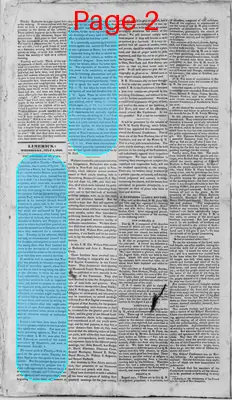
Literary
July 9, 1828
Morning Star
Limerick, York County, Maine
What is this article about?
Continuation of an article on St. Paul's Epistles, focusing on the first and second to Timothy. Details Timothy's background, his role as an evangelist, the context and purpose of the first epistle (c. A.D. 60), and the second epistle written during Paul's imprisonment in Rome, likely his second, preparing Timothy for sufferings and church apostasy.
Clipping
OCR Quality
95%
Excellent
Full Text
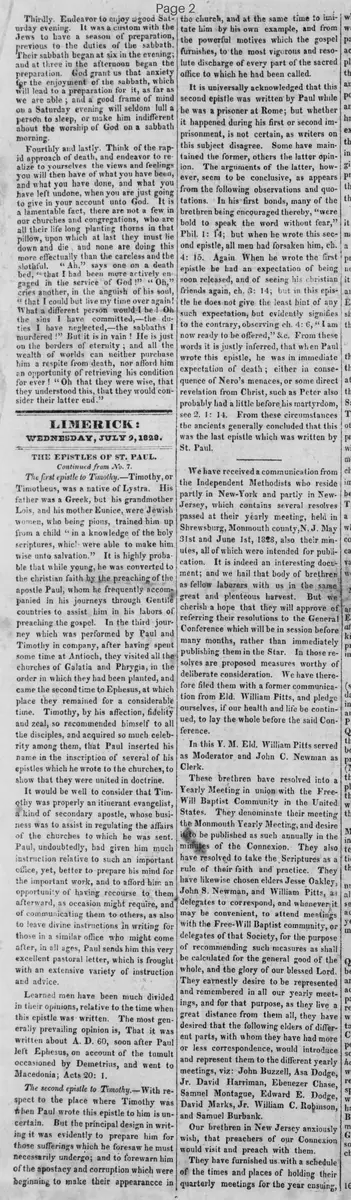
THE EPISTLES OF ST. PAUL.
Continued from No. 7.
The first epistle to Timothy.--Timothy, or Timotheus, was a native of Lystra. His father was a Greek, but his grandmother Lois, and his mother Eunice, were Jewish women, who being pious, trained him up from a child "in a knowledge of the holy scriptures, which were able to make him wise unto salvation." It is highly probable that while young, he was converted to the christian faith by the preaching of the apostle Paul, whom he frequently accompanied in his journeys through Gentile countries to assist him in his labors of preaching the gospel. In the third journey which was performed by Paul and Timothy in company, after having spent some time at Antioch, they visited all the churches of Galatia and Phrygia, in the order in which they had been planted, and came the second time to Ephesus, at which place they remained for a considerable time. Timothy, by his affection, fidelity and zeal, so recommended himself to all the disciples, and acquired so much celebrity among them, that Paul inserted his name in the inscription of several of his epistles which he wrote to the churches, to show that they were united in doctrine. It would be well to consider that Timothy was properly an itinerant evangelist, a kind of secondary apostle, whose business was to assist in regulating the affairs of the churches to which he was sent. Paul, undoubtedly, had given him much instruction relative to such an important office, yet, better to prepare his mind for the important work, and to afford him an opportunity of having recourse to them afterward, as occasion might require, and of communicating them to others, as also to leave divine instructions in writing for those in a similar office who might come after, in all ages, Paul sends him this very excellent pastoral letter, which is fraught with an extensive variety of instruction and advice.
Learned men have been much divided in their opinions, relative to the time when this epistle was written. The most generally prevailing opinion is, That it was written about A. D. 60, soon after Paul left Ephesus, on account of the tumult occasioned by Demetrius, and went to Macedonia; Acts 20: 1.
The second epistle to Timothy.--With respect to the place where Timothy was when Paul wrote this epistle to him is uncertain. But the principal design in writing it was evidently to prepare him for those sufferings which he foresaw he must necessarily undergo; and to forewarn him of the apostacy and corruption which were beginning to make their appearance in the church, and at the same time to imitate him by his own example, and from the powerful motives which the gospel furnishes, to the most vigorous and resolute discharge of every part of the sacred office to which he had been called.
It is universally acknowledged that this second epistle was written by Paul while he was a prisoner at Rome; but whether it happened during his first or second imprisonment, is not certain, as writers on this subject disagree. Some have maintained the former, others the latter opinion. The arguments of the latter, however, seem to be conclusive, as appears from the following observations and quotations. In his first bonds, many of the brethren being encouraged thereby, "were bold to speak the word without fear," Phil. 1: 14; but when he wrote this second epistle, all men had forsaken him, ch. 4: 15. Again. When he wrote the first epistle he had an expectation of being soon released, and of seeing his christian friends again, ch. 3: 14; but in this epistle he does not give the least hint of any such expectation, but evidently signifies to the contrary, observing ch. 4: 6, "I am now ready to be offered," &c. From these words it is justly inferred, that when Paul wrote this epistle, he was in immediate expectation of death; either in consequence of Nero's menaces, or some direct revelation from Christ, such as Peter also probably had a little before his martyrdom, see 2. 1: 14. From these circumstances the ancients generally concluded that this was the last epistle which was written by St. Paul.
Continued from No. 7.
The first epistle to Timothy.--Timothy, or Timotheus, was a native of Lystra. His father was a Greek, but his grandmother Lois, and his mother Eunice, were Jewish women, who being pious, trained him up from a child "in a knowledge of the holy scriptures, which were able to make him wise unto salvation." It is highly probable that while young, he was converted to the christian faith by the preaching of the apostle Paul, whom he frequently accompanied in his journeys through Gentile countries to assist him in his labors of preaching the gospel. In the third journey which was performed by Paul and Timothy in company, after having spent some time at Antioch, they visited all the churches of Galatia and Phrygia, in the order in which they had been planted, and came the second time to Ephesus, at which place they remained for a considerable time. Timothy, by his affection, fidelity and zeal, so recommended himself to all the disciples, and acquired so much celebrity among them, that Paul inserted his name in the inscription of several of his epistles which he wrote to the churches, to show that they were united in doctrine. It would be well to consider that Timothy was properly an itinerant evangelist, a kind of secondary apostle, whose business was to assist in regulating the affairs of the churches to which he was sent. Paul, undoubtedly, had given him much instruction relative to such an important office, yet, better to prepare his mind for the important work, and to afford him an opportunity of having recourse to them afterward, as occasion might require, and of communicating them to others, as also to leave divine instructions in writing for those in a similar office who might come after, in all ages, Paul sends him this very excellent pastoral letter, which is fraught with an extensive variety of instruction and advice.
Learned men have been much divided in their opinions, relative to the time when this epistle was written. The most generally prevailing opinion is, That it was written about A. D. 60, soon after Paul left Ephesus, on account of the tumult occasioned by Demetrius, and went to Macedonia; Acts 20: 1.
The second epistle to Timothy.--With respect to the place where Timothy was when Paul wrote this epistle to him is uncertain. But the principal design in writing it was evidently to prepare him for those sufferings which he foresaw he must necessarily undergo; and to forewarn him of the apostacy and corruption which were beginning to make their appearance in the church, and at the same time to imitate him by his own example, and from the powerful motives which the gospel furnishes, to the most vigorous and resolute discharge of every part of the sacred office to which he had been called.
It is universally acknowledged that this second epistle was written by Paul while he was a prisoner at Rome; but whether it happened during his first or second imprisonment, is not certain, as writers on this subject disagree. Some have maintained the former, others the latter opinion. The arguments of the latter, however, seem to be conclusive, as appears from the following observations and quotations. In his first bonds, many of the brethren being encouraged thereby, "were bold to speak the word without fear," Phil. 1: 14; but when he wrote this second epistle, all men had forsaken him, ch. 4: 15. Again. When he wrote the first epistle he had an expectation of being soon released, and of seeing his christian friends again, ch. 3: 14; but in this epistle he does not give the least hint of any such expectation, but evidently signifies to the contrary, observing ch. 4: 6, "I am now ready to be offered," &c. From these words it is justly inferred, that when Paul wrote this epistle, he was in immediate expectation of death; either in consequence of Nero's menaces, or some direct revelation from Christ, such as Peter also probably had a little before his martyrdom, see 2. 1: 14. From these circumstances the ancients generally concluded that this was the last epistle which was written by St. Paul.
What sub-type of article is it?
Essay
What themes does it cover?
Religious
What keywords are associated?
Paul
Timothy
Epistles
Christian
Apostle
Church
Gospel
Imprisonment
Literary Details
Title
The Epistles Of St. Paul.
Key Lines
"In A Knowledge Of The Holy Scriptures, Which Were Able To Make Him Wise Unto Salvation."
"I Am Now Ready To Be Offered," &C.
"Were Bold To Speak The Word Without Fear,"