Thank you for visiting SNEWPapers!
Sign up free
Alexandria Daily Advertiser
Alexandria, Virginia
What is this article about?
Reports from Paris detail the execution of the Duke of Enghien by Italian Guards, his final requests, and widespread terror, arrests, and discontent in France under Bonaparte. Includes Talleyrand's letter justifying the abduction, reactions of French exiles in England, and French army discontent over delayed invasion plans.
Clipping
OCR Quality
Full Text
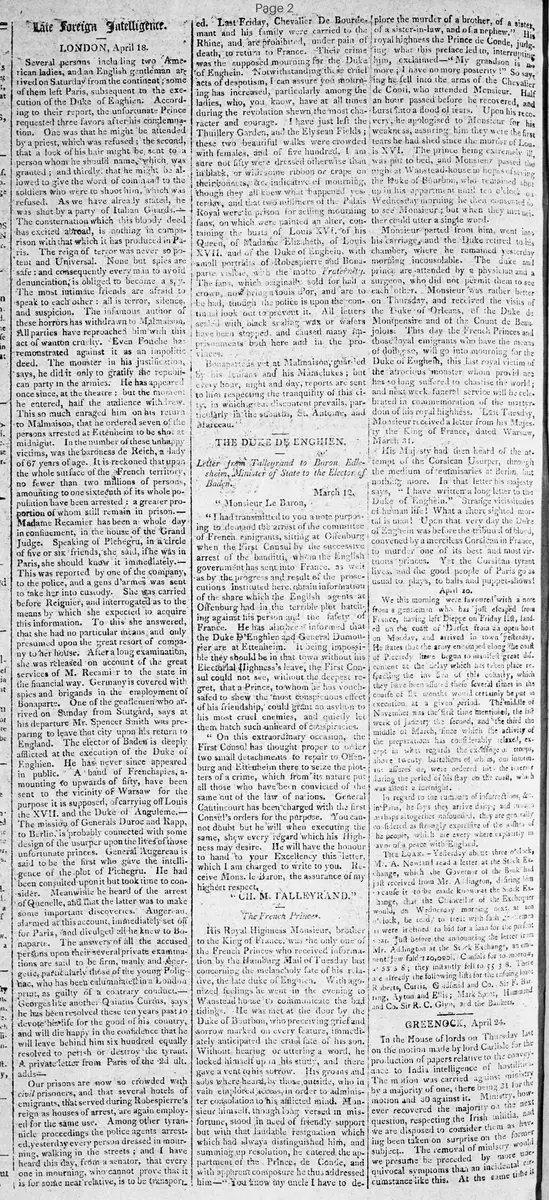
LONDON, April 18.
Several persons including two American ladies, and an English gentleman arrived on Saturday from the continent; some of them left Paris, subsequent to the execution of the Duke of Enghien: According to their report, the unfortunate Prince requested three favors after his condemnation. One was that he might be attended by a priest, which was refused; the second, that a lock of his hair might be sent to a person whom he should name, which was granted; and thirdly, that he might be allowed to give the word of command to the soldiers who were to shoot him, which was refused. As we have already stated, he was shot by a party of Italian Guards.
The consternation which this bloody deed has excited abroad, is nothing in comparison with that which it has produced in Paris. The reign of terror was never so potent and universal. None but spies are safe: and consequently every man to avoid denunciation, is obliged to become a spy. The most intimate friends are afraid to speak to each other: all is terror, silence and suspicion. The infamous author of these horrors has withdrawn to Malmaison. All parties have reproached him with this act of wanton cruelty. Even Fouche has remonstrated against it as an impolitic deed. The monster in his justification, says, he did it only to gratify the republican party in the armies: He has appeared once since, at the theatre: but the moment he entered, half the audience withdrew. This so much enraged him on his return to Malmaison, that he ordered seven of the persons arrested at Ettenheim to be shot at midnight. In the number of these unhappy victims, was the baroness de Reich, a lady of 67 years of age. It is reckoned that upon the whole surface of the French territory, no fewer than two millions of persons, amounting to one sixteenth of its whole population have been arrested: a greater proportion of whom still remain in prison.
Madame Recamier has been a whole day in confinement, in the house of the Grand Judge. Speaking of Pichegru, in a circle of five or six friends, she said, if he was in Paris, she should know it immediately. This was reported by one of the company, to the police, and a gens d'armes was sent to take her into custody. She was carried before Reignier, and interrogated as to the means by which she expected to acquire this information. To this she answered, that she had no particular means, and only presumed upon the great resort of company to her house. After a long examination, she was released on account of the great services of M. Recamier to the state in the financial way. Germany is covered with spies and brigands in the employment of Bonaparte. One of the gentlemen who arrived on Sunday from Stutgard, says at his departure Mr. Spencer Smith was preparing to leave that city upon his return to England. The elector of Baden is deeply afflicted at the execution of the Duke of Enghien. He has never since appeared in public. A band of French spies, amounting to upwards of fifty, have been sent to the vicinity of Warsaw for the purpose it is supposed, of carrying off Louis the XVII. and the Duke of Angouleme.
The mission of Generals Duroc and Rapp, to Berlin, is probably connected with some design of the usurper upon the lives of those unfortunate princes. General Augereau is said to be the first who gave the intelligence of the plot of Pichegru. He had been consulted upon it but took time to consider. Meanwhile he heard of the arrest of Quenelle, and that the latter was to make some important discoveries. Augereau, alarmed at this account, immediately set off for Paris, and divulged all he knew to Bonaparte. The answers of all the accused persons upon their several private examinations are said to be firm, manly and energetic, particularly those of the young Polignac, who has been calumniated in a London print, as guilty of a contrary conduct. Georges like another Quintus Curtius, says he has been resolved these ten years past to devote his life for the good of his country, and will die happy in the confidence that he will leave behind him six hundred equally resolved to perish or destroy the tyrant.
A private letter from Paris of the 2d ult. adds,
Our prisons are now so crowded with civil prisoners, and that several hotels of emigrants, that served during Robespierre's reign as houses of arrest, are again employed for the same use. Among other tyrannical proceedings the police agents arrested, yesterday every person dressed in mourning, walking in the streets; and I have heard this day, from a senator, that every one in mourning, who cannot prove that it is for some near relative, is to be transported.
Last Friday, Chevalier De Bourcemont and his family were carried to the Rhine; and are prohibited, under pain of death, to return to France. Their crime was the supposed mourning for the Duke of Enghien. Notwithstanding these cruel acts of despotism, I can assure you mourning has increased, particularly among the ladies, who, you know, have at all times during the revolution shewn the most character and courage. I have just left the Thuilleries Garden, and the Elysian Fields: these two beautiful walks were crowded with females, and of five hundred, I am sure not fifty were dressed otherwise than in black, or with some ribbon or crape on their bonnets, &c. indicative of mourning, though they all knew what happened yesterday, and that two milliners of the Palais Royal were in prison for selling mourning fans, on which were painted an altar, containing the busts of Louis XVI. of his Queen, of Madame Elizabeth, of Louis XVII. and of the Duke of Enghien, with small portraits of Robespierre and Bonaparte visible, with the motto Fraternity. The fans, which originally sold for half a crown, now bring a louis d'or, and are to be had, though the police is upon the continual look out to prevent it. All letters sealed with black sealing wax or wafers have been stopped, and caused many imprisonments both here and in the provinces.
Bonaparte is yet at Malmaison, guarded by his Italians and his Mamelukes; but every hour, night and day, reports are sent to him respecting the tranquility of this city, in which great discontent prevails, particularly in the suburbs, St. Antoine, and Marceau.
THE DUKE DE ENGHIEN.
Letter from Talleyrand to Baron Belleheim, Minister of State to the Elector of Baden.
March 12.
Monsieur Le Baron,
I had transmitted to you a note purposing to demand the arrest of the committee of French emigrants, sitting at Offenburg when the First Consul by the successive arrest of the banditti, whom the English government has sent into France, as well as by the progress and result of the prosecutions instituted here obtain information of the share which the English agents at Offenburg had in the terrible plot hatching against his person and the safety of France. He has also been informed that the Duke D'Enghien and General Dumouriez are at Ettenheim: It being impossible they should be in that town without his Electoral Highness's leave, the First Consul could not see, without the deepest regret, that a Prince, to whom he has vouchsafed to shew the most conspicuous effects of his friendship, could grant an asylum to his most cruel enemies, and quietly let them hatch such unheard of conspiracies.
On this extraordinary occasion, the First Consul has thought proper to order two small detachments to repair to Offenburg and Ettenheim there to seize the plotters of a crime, which from its nature put all those who have been convicted of the same out of the law of nations. General Caulincourt has been charged with the First Consul's orders for the purpose. You cannot doubt but he will when executing the same, shew every regard which his Highness may desire. He will have the honour to hand to your Excellency this letter, which I am charged to write to you. Receive Mons. le Baron, the assurance of my highest respect.
CH. M. TALLEYRAND.
The French Princes.
His Royal Highness Monsieur, brother to the King of France, was the only one of the French Princes who received information by the Hamburg Mail of Tuesday last concerning the melancholy fate of his relative, the late duke of Enghien. With agonized feelings he went in the evening to Wanstead House to communicate the bad tidings. He was met at the door by the Duke of Bourbon, who perceiving grief and sorrow marked on every feature, immediately anticipated the cruel fate of his son. Without hearing or uttering a word, he locked himself up in his study, and there gave a vent to his sorrow. His groans and sobs were heard by those outside, who in vain implored access, in order to administer consolation to his afflicted mind. Monsieur himself, though long versed in misfortune, stood in need of friendly support but with that laudable resignation which had always distinguished him, and summing up resolution, he entered the apartment of the Prince de Conde, and with apparent composure he thus addressed him--"You know my uncle I have to deplore the murder of a brother, of a sister of a sister-in-law, and of a nephew." His royal highness the Prince de Conde, judging what this preface led to interrupting him, exclaimed--"My grandson is no more; I have no more posterity!" So saying he fell into the arms of the Chevalier de Conti, who attended Monsieur. Half an hour passed before he recovered, and burst into a flood of tears. Upon his recovery, he apologised to Monsieur for his weakness, assuring him they were the first tears he had shed since the murder of Louis XVI. The prince being extremely ill, was put to bed, and Monsieur passed the night at Wanstead-house in hopes of seeing the Duke of Bourbon, who remained shut up in his apartment until ten o'clock on Wednesday morning he then consented to see Monsieur; but when they met neither could utter a single word. Monsieur parted from him, went into his carriage--and the Duke retired to his chamber, where he remained yesterday morning inconsolable. The duke and prince are attended by a physician and a surgeon, who did not permit them to see each other. Monsieur was rather better on Thursday, and received the visits of the Duke of Orleans, of the Duke de Montpensier and of the Count de Beaujolois: This day the French Princes and those loyal emigrants who have the means of doing so, will go into mourning for the Duke of Enghien, this last royal victim of the atrocious monster whom providence has so long suffered to chastise the world; and next week funeral service will be celebrated in commemoration of the martyrdom of his royal highness. Last Tuesday, Monsieur received a letter from his Majesty the King of France, dated Warsaw, March 31.
His Majesty had then heard of the attempt of the Corsican Usurper, through the medium of emissaries at Berlin, but nothing more. In that letter his majesty says, "I have written a long letter to the Duke of Enghien." Strange vicissitudes of human life! What a short sighted mortal is man! Upon that very day the Duke of Enghien was before the tribunal of blood, convened by a merciless Corsican in France, to murder one of its best and most virtuous princes. Yet the Corsican tyrant lives, and the good people of Paris go as usual to plays, to balls and puppet-shows!
April 20.
We this morning were favoured with a note from a gentleman who has just escaped from France, having left Dieppe on Friday last, landed on the coast of Dorset from an open boat on Monday, and arrived in town yesterday. He states that the army encamped along the coast of Picardy have begun to manifest great discontent at the delay which has taken place respecting the invasion of this country, which they have been assured these several times in the course of six months would certainly be put in execution at a given period. The middle of November was the first time mentioned, the last week of January the second, and the third the middle of March, Since which the activity of the preparations has considerably relaxed, except in what regards the exchange of troops, above twenty battalions of which, our informant assures us, were ordered into the interior during the period of his stay on the coast, which was about a fortnight.
In regard to the rumours of insurrections, &c. in Paris, he says they arrive daily: and though perhaps altogether unfounded, they are generally considered as strongly expressive of the wishes of the people, which are every where explicitly in favor of a peace with England.
What sub-type of article is it?
What keywords are associated?
What entities or persons were involved?
Where did it happen?
Foreign News Details
Primary Location
Paris
Event Date
Subsequent To March 12, 1804
Key Persons
Outcome
execution of duke of enghien by italian guards; seven persons including baroness de reich shot; two million arrests across france; increased mourning and discontent despite repressions; french princes in mourning; army discontent over delayed invasion.
Event Details
Reports from continent arrivals describe Duke of Enghien's execution requests and shooting; Paris gripped by terror, spies, arrests, and Bonaparte's withdrawal to Malmaison; remonstrations from parties including Fouche; theater incident leads to midnight executions; Madame Recamier's brief arrest; spies in Germany and mission to Berlin; Augereau's betrayal of plot; private letter details prison overcrowding, mourning arrests, and public defiance; Talleyrand's letter justifies abduction from Ettenheim; French Princes' grief in England; escaped gentleman's note on Picardy army discontent and peace wishes.