Thank you for visiting SNEWPapers!
Sign up free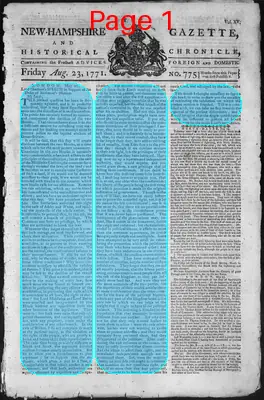
The New Hampshire Gazette And Historical Chronicle
Portsmouth, Greenland, Rockingham County, New Hampshire
What is this article about?
Lord Chatham's speech in the House of Lords on May 16 supports the Duke of Richmond's motion to address the unconstitutional handling of the Middlesex Election by the Commons, particularly the expulsion and rejection of John Wilkes, urging rescission to restore electoral rights and constitutional balance.
Clipping
OCR Quality
Full Text
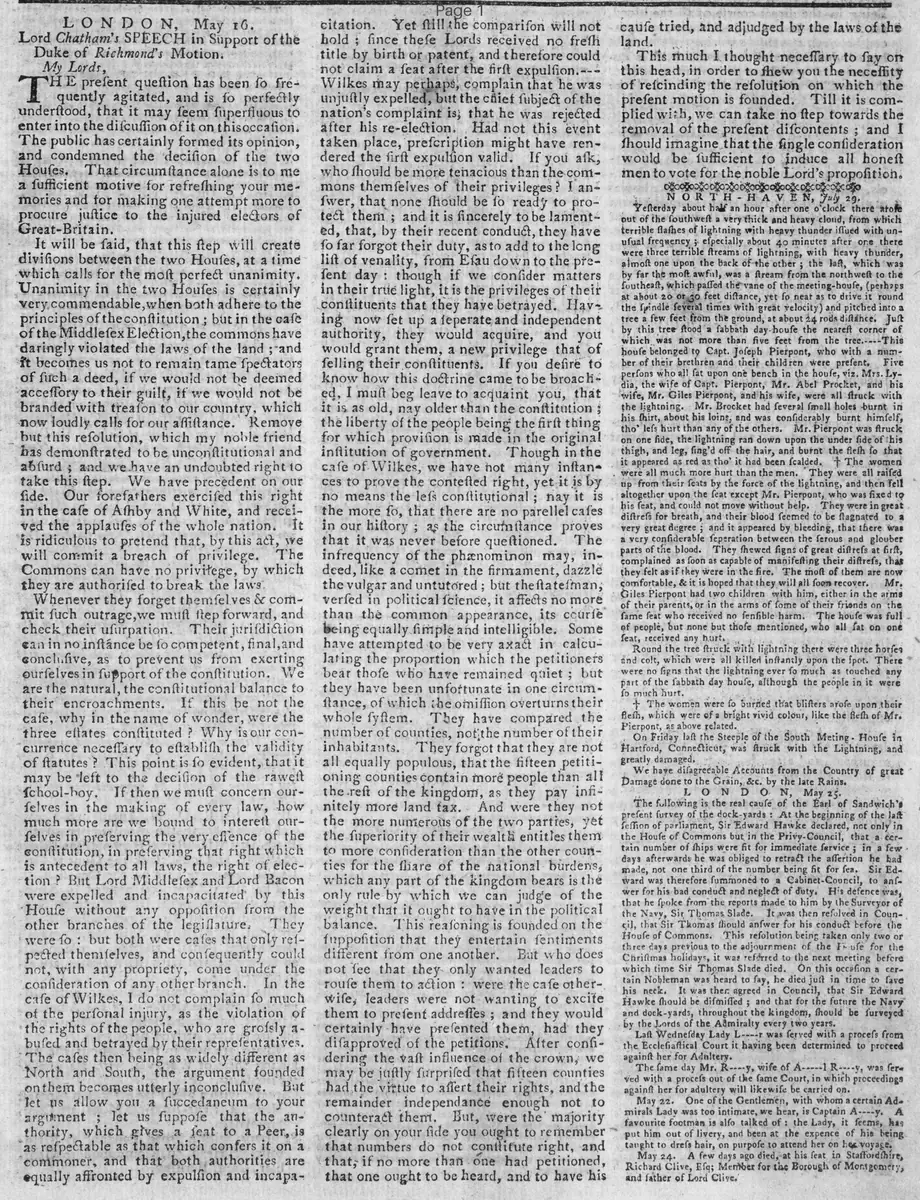
Lord Chatham's SPEECH in Support of the Duke of Richmond's Motion:
My Lords.
The present question has been so frequently agitated, and is so perfectly understood, that it may seem superfluous to enter into the discussion of it on this occasion. The public has certainly formed its opinion, and condemned the decision of the two Houses. That circumstance alone is to me a sufficient motive for refreshing your memories and for making one attempt more to procure justice to the injured electors of Great-Britain. It will be said, that this step will create divisions between the two Houses, at a time which calls for the most perfect unanimity. Unanimity in the two Houses is certainly very commendable, when both adhere to the principles of the constitution: but in the case of the Middlesex Election, the commons have daringly violated the laws of the land: and it becomes us not to remain tame spectators of such a deed, if we would not be deemed accessory to their guilt, if we would not be branded with treason to our country, which now loudly calls for our assistance. Remove but this resolution, which my noble friend has demonstrated to be unconstitutional and absurd: and we have an undoubted right to take this step. We have precedent on our side. Our forefathers exercised this right in the case of Ashby and White, and received the applauses of the whole nation. It is ridiculous to pretend that, by this act, we will commit a breach of privilege. The Commons can have no privilege, by which they are authorised to break the laws. Whenever they forget themselves & commit such outrage, we must step forward, and check their usurpation. Their jurisdiction can in no instance be so competent, final, and conclusive, as to prevent us from exerting ourselves in support of the constitution. We are the natural, the constitutional balance to their encroachments. If this be not the case, why in the name of wonder, were the three estates constituted? Why is our concurrence necessary to establish the validity of statutes? This point is so evident, that it may be left to the decision of the rawest school-boy. If then we must concern ourselves in the making of every law, how much more are we bound to interest ourselves in preserving the very essence of the constitution, in preserving that right which is antecedent to all laws, the right of election? But Lord Middlesex and Lord Bacon were expelled and incapacitated by this House without any opposition from the other branches of the legislature. They were so: but both were cases that only respected themselves, and consequently could not, with any propriety, come under the consideration of any other branch. In the case of Wilkes, I do not complain so much of the personal injury, as the violation of the rights of the people, who are grossly abused and betrayed by their representatives. The cases then being as widely different as North and South, the argument founded on them becomes utterly inconclusive. But let us allow you a succedaneum to your argument; let us suppose that the authority, which gives a Seat to a Peer, is as respectable as that which confers it on a commoner, and that both authorities are equally affronted by expulsion and incapacitation. Yet still the comparison will not hold: since these Lords received no fresh title by birth or patent, and therefore could not claim a seat after the first expulsion.-- Wilkes may perhaps complain that he was unjustly expelled, but the chief subject of the nation's complaint is, that he was rejected after his re-election. Had not this event taken place, prescription might have rendered the first expulsion valid. If you ask: who should be more tenacious than the commons themselves of their privileges? I answer, that none should be so ready to protect them: and it is sincerely to be lamented, that, by their recent conduct, they have so far forgot their duty, as to add to the long list of venality, from Esau down to the present day: though if we consider matters in their true light, it is the privileges of their constituents that they have betrayed. Having now set up a separate and independent authority, they would acquire, and you would grant them, a new privilege that of selling their constituents. If you desire to know how this doctrine came to be broached, I must beg leave to acquaint you, that it is as old, nay older than the constitution the liberty of the people being the first thing for which provision is made in the original institution of government. Though in the case of Wilkes, we have not many instances to prove the contested right, yet it is by no means the less constitutional; nay it is the more so, that there are no parallel cases in our history; as the circumstance proves that it was never before questioned. The infrequency of the phenomenon may, indeed, like a comet in the firmament, dazzle the vulgar and untutored; but the statesman, versed in political science, it affects no more than the common appearance, its course being equally simple and intelligible. Some have attempted to be very exact in calculating the proportion which the petitioners bear to those who have remained quiet; but they have been unfortunate in one circumstance, of which the omission overturns their whole system. They have compared the number of counties, not the number of their inhabitants. They forgot that they are not all equally populous, that the fifteen petitioning counties contain more people than all the rest of the kingdom, as they pay infinitely more land tax. And were they not the more numerous of the two parties, yet the superiority of their wealth entitles them to more consideration than the other counties for the share of the national burdens, which any part of the kingdom bears is the only rule by which we can judge of the weight that it ought to have in the political balance. This reasoning is founded on the supposition that they entertain sentiments different from one another. But who does not see that they only wanted leaders to rouse them to action: were the case otherwise, leaders were not wanting to excite them to present addresses: and they would certainly have presented them, had they disapproved of the petitions. After considering the vast influence of the crown, we may be justly surprised that fifteen counties had the virtue to assert their rights, and the remainder independance enough not to counteract them. But, were the majority clearly on your side you ought to remember that numbers do not constitute right, and that, if no more than one had petitioned, that one ought to be heard, and to have his cause tried, and adjudged by the laws of the land. This much I thought necessary to say on this head, in order to shew you the necessity of rescinding the resolution on which the present motion is founded. Till it is complied with, we can take no step towards the removal of the present discontents: and I should imagine that the single consideration would be sufficient to induce all honest men to vote for the noble Lord's proposition:
What sub-type of article is it?
What keywords are associated?
What entities or persons were involved?
Where did it happen?
Foreign News Details
Primary Location
London
Event Date
May 16
Key Persons
Outcome
urges rescission of the commons' resolution on the middlesex election to address public discontent and restore constitutional rights; no specific casualties mentioned.
Event Details
Lord Chatham delivers a speech in the House of Lords supporting the Duke of Richmond's motion to challenge the House of Commons' unconstitutional decision in the Middlesex Election case, particularly the expulsion and subsequent rejection of John Wilkes despite re-election, emphasizing the violation of electoral rights, precedents like Ashby and White, the role of the Lords as a check on Commons' encroachments, and the significance of petitions from fifteen populous counties.