Thank you for visiting SNEWPapers!
Sign up free
Editorial
January 3, 1815
The Enquirer
Richmond, Henrico County, Virginia
What is this article about?
Editorial from January 3, 1815, laments dire US situation in War of 1812: facing powerful Britain alone, with weak army, empty treasury, rebellious states, dying militia, and coastal ravages. Criticizes Congress's factional inaction despite burned capital, urges vigorous measures like revolutionaries, warns of ruin without energy.
Clipping
OCR Quality
95%
Excellent
Full Text
ENQUIRER-OFFICE,
RICHMOND, [Va.] January 3, 1815
FOR THE ENQUIRER.
THE PROSPECT BEFORE US!
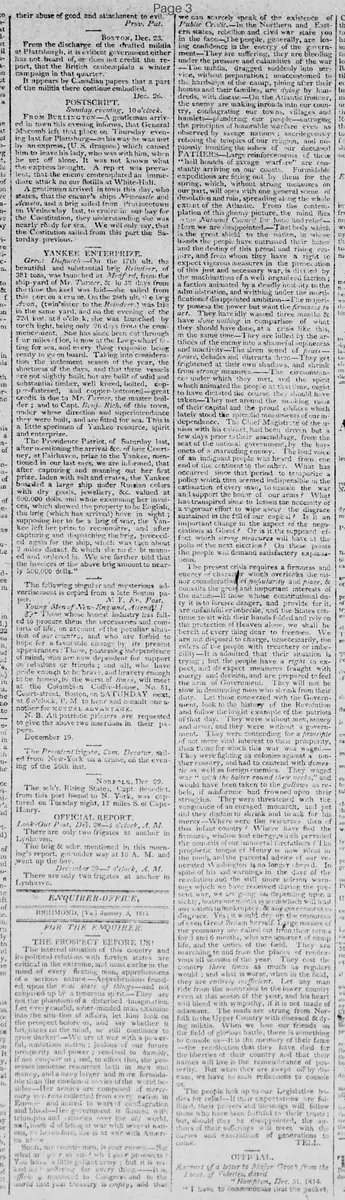
The internal situation of this Country and its political relations with foreign states are Critical in the extreme, and must excite in the mind of every reflecting man, apprehensions of a serious nature.—Apprehensions founded upon the real state of things—and not conjured up by a timorous spirit.—They are not the phantoms of a disturbed imagination. Let every candid, sober-minded man examine into the situation of affairs, let him look on the prospect before us, and say whether it brightens on the mind, or still continues to grow darker.—We are at war with a powerful, ambitious nation: jealous of our future prosperity and power; resolved to humble, if not conquer us; and, to effect this, she possesses immense resources both in men and money, and a navy larger and more formidable than the combined navies of the world besides—Her armies are composed of mercenary veterans collected from every nation in Europe and inured to wars conflagration and blood—Her government is flushed with triumphs and victories over the old world, and, instead of being at war with several nations, as heretofore, she is at war with America alone!
Such, my countrymen, is your enemy—But what are your prospects? You have a little gallant army; but it is naked and suffering for every thing—It is, officially announced to Congress and to the world that your treasury is empty, and that we can scarcely speak of the existence of Public Credit.—In the Northern and Eastern states, rebellion and civil war stare you in the face—The people, generally, are losing confidence in the energy of the government—They are suffering. they are bleeding under the pressure and calamities of the war—The militia, dragged suddenly into service, without preparation; unaccustomed to the hardships of the camp, pining after their homes and their families, are dying by hundreds, with disease—On the Atlantic frontier, the enemy are making inroads into our country, conflagrating our towns, villages and hamlets—plundering our people—outraging the principles of honorable warfare even as observed by savage nations; sacrilegiously robbing the temples of our religion, and impiously insulting the ashes of our deceased FATHERS—Large reinforcements of these "hell hounds of savage warfare" are constantly arriving on our coasts. Formidable expeditions are fitting out by them for the spring, which, without strong measures on our part, will open with one general scene of desolation and ruin, spreading along the whole extent of the Atlantic. From the contemplation of this gloomy picture, the mind flies to the National Council for hope and relief—Here we are disappointed.—That body which is the great shield to the nation, in whose hands the people have entrusted their honor and the destiny of this proud and rising empire, and from whom they have a right to expect vigorous measures in the prosecution of this just and necessary war, is divided by the machinations of a well organized faction; a faction animated by a deadly hostility to the administration, and writhing under the mortification of disappointed ambition—The majority possess the power but want the firmness to act. They have idly wasted three months & have done nothing in comparison of what they should have done, at a crisis like this. in the same time—They are lulled by the artifices of the enemy into a shameful supineness and inactivity—The siren sound of peace—treace, deludes and distracts them—They get frightened at their own shadows, and shrink from strong measures.—The circumstances under which they met, and the spirit which animated the people at that time, ought to have dictated the course they should have taken—They met around the smoking ruins of their capital and the proud edifices which lately stood the splendid monuments of our independence. The Chief Magistrate of the union with his cabinet, had been driven but a few days prior to their assemblage, from the seat of the national government, by the bayonets of a marauding enemy. The loud voice of an indignant people was heard from one end of the continent to the other. What has occurred since that period to temporize a policy which then seemed indispensable in the estimation of every man, to sustain the war and support the honor of our arms? What has transpired since to lessen the necessity of a vigorous effort to wipe away the disgrace sustained in the fall of our capital? Is it an important change in the aspect of the negotiations at Ghent? Or is it the supposed effect which strong measures will have at the polls of the next election? On these points the people will demand satisfactory explanations.
The present crisis requires a firmness and energy of character which overlooks the minor considerations of popularity and place, & consults the great and important interests of the nation—if those whose constitutional duty it is to foresee danger, and provide for it, are unfaithful or imbecile, and the States continue to sit with their hands folded and rely on the protection of Heaven alone, we shall be bereft of every thing dear to freemen. We are not disposed to charge, unnecessarily, the rulers of the people with treachery or imbecility—It is admitted that their situation is trying; but the people have a right to expect, and do expect measures fraught with energy and decision, and are prepared to feel the arm of Government. They will not be slow in denouncing men who shrink from their duty. Let those connected with the Government, look to the history of the Revolution and follow the bright example of the patriots of that day. They were without men, money and arms, and they were without a government. They were contending for a principle of not more vital interest to their prosperity, than those for which this war was waged. They were fighting as colonies against a mother country, and had to contend with domestic as well as foreign enemies. They waged war "with the halter round their necks," and would have been taken to the gallows as rebels, if misfortune had frowned upon their struggles. They were threatened with the vengeance of an enraged monarch, and yet did they disdain to shrink and to ask for his mercy—Where were the resources then of this infant country? Where have fled the firmness, wisdom and energy, which pervaded the councils of our immortal forefathers? The prophetic tongue of Henry is now silent in the tomb, and the parental advice of our venerated Washington is no longer obeyed. In spite of his sad warnings in the days of the revolution and the still more solemn warnings which we have received during the present war, we are going on depending upon a sickly, loathsome militia system which will lead any nation to bankruptcy, & any government to disgrace. Yes; it would dry up the resources of even Great Britain herself. Large masses of the yeomanry are called out from their farms for 3 and 6 months., who are ignorant of camp life, and the duties of the field. They are marching to and from the places of rendezvous all seasons of the year. They cost the Country three times as much as regulars would; and what is worse, when in the field, they are entirely inefficient. Let any man ride from the mountains to the lower country even at this season of the year, and his heart will bleed with sympathy. if it is not made of adamant. The roads are strung from Norfolk to the Upper Country with diseased & dying militia. When we lose our friends on the field of glorious battle, there is something to console us—It is the memory of their fame—the recollection that they have died for the liberties of their country and that their names will live in the remembrance of posterity. But when they are swept off by disease, we have no such reflections to console us.
The people look up to our Legislative bodies for relief—if their expectations are fulfilled, their prayers and blessings will follow those who have been faithful to their trusts: but, should they be disappointed, the authors of their sufferings will meet with the curses and execrations of generations to come.
TELL.
RICHMOND, [Va.] January 3, 1815
FOR THE ENQUIRER.
THE PROSPECT BEFORE US!
The internal situation of this Country and its political relations with foreign states are Critical in the extreme, and must excite in the mind of every reflecting man, apprehensions of a serious nature.—Apprehensions founded upon the real state of things—and not conjured up by a timorous spirit.—They are not the phantoms of a disturbed imagination. Let every candid, sober-minded man examine into the situation of affairs, let him look on the prospect before us, and say whether it brightens on the mind, or still continues to grow darker.—We are at war with a powerful, ambitious nation: jealous of our future prosperity and power; resolved to humble, if not conquer us; and, to effect this, she possesses immense resources both in men and money, and a navy larger and more formidable than the combined navies of the world besides—Her armies are composed of mercenary veterans collected from every nation in Europe and inured to wars conflagration and blood—Her government is flushed with triumphs and victories over the old world, and, instead of being at war with several nations, as heretofore, she is at war with America alone!
Such, my countrymen, is your enemy—But what are your prospects? You have a little gallant army; but it is naked and suffering for every thing—It is, officially announced to Congress and to the world that your treasury is empty, and that we can scarcely speak of the existence of Public Credit.—In the Northern and Eastern states, rebellion and civil war stare you in the face—The people, generally, are losing confidence in the energy of the government—They are suffering. they are bleeding under the pressure and calamities of the war—The militia, dragged suddenly into service, without preparation; unaccustomed to the hardships of the camp, pining after their homes and their families, are dying by hundreds, with disease—On the Atlantic frontier, the enemy are making inroads into our country, conflagrating our towns, villages and hamlets—plundering our people—outraging the principles of honorable warfare even as observed by savage nations; sacrilegiously robbing the temples of our religion, and impiously insulting the ashes of our deceased FATHERS—Large reinforcements of these "hell hounds of savage warfare" are constantly arriving on our coasts. Formidable expeditions are fitting out by them for the spring, which, without strong measures on our part, will open with one general scene of desolation and ruin, spreading along the whole extent of the Atlantic. From the contemplation of this gloomy picture, the mind flies to the National Council for hope and relief—Here we are disappointed.—That body which is the great shield to the nation, in whose hands the people have entrusted their honor and the destiny of this proud and rising empire, and from whom they have a right to expect vigorous measures in the prosecution of this just and necessary war, is divided by the machinations of a well organized faction; a faction animated by a deadly hostility to the administration, and writhing under the mortification of disappointed ambition—The majority possess the power but want the firmness to act. They have idly wasted three months & have done nothing in comparison of what they should have done, at a crisis like this. in the same time—They are lulled by the artifices of the enemy into a shameful supineness and inactivity—The siren sound of peace—treace, deludes and distracts them—They get frightened at their own shadows, and shrink from strong measures.—The circumstances under which they met, and the spirit which animated the people at that time, ought to have dictated the course they should have taken—They met around the smoking ruins of their capital and the proud edifices which lately stood the splendid monuments of our independence. The Chief Magistrate of the union with his cabinet, had been driven but a few days prior to their assemblage, from the seat of the national government, by the bayonets of a marauding enemy. The loud voice of an indignant people was heard from one end of the continent to the other. What has occurred since that period to temporize a policy which then seemed indispensable in the estimation of every man, to sustain the war and support the honor of our arms? What has transpired since to lessen the necessity of a vigorous effort to wipe away the disgrace sustained in the fall of our capital? Is it an important change in the aspect of the negotiations at Ghent? Or is it the supposed effect which strong measures will have at the polls of the next election? On these points the people will demand satisfactory explanations.
The present crisis requires a firmness and energy of character which overlooks the minor considerations of popularity and place, & consults the great and important interests of the nation—if those whose constitutional duty it is to foresee danger, and provide for it, are unfaithful or imbecile, and the States continue to sit with their hands folded and rely on the protection of Heaven alone, we shall be bereft of every thing dear to freemen. We are not disposed to charge, unnecessarily, the rulers of the people with treachery or imbecility—It is admitted that their situation is trying; but the people have a right to expect, and do expect measures fraught with energy and decision, and are prepared to feel the arm of Government. They will not be slow in denouncing men who shrink from their duty. Let those connected with the Government, look to the history of the Revolution and follow the bright example of the patriots of that day. They were without men, money and arms, and they were without a government. They were contending for a principle of not more vital interest to their prosperity, than those for which this war was waged. They were fighting as colonies against a mother country, and had to contend with domestic as well as foreign enemies. They waged war "with the halter round their necks," and would have been taken to the gallows as rebels, if misfortune had frowned upon their struggles. They were threatened with the vengeance of an enraged monarch, and yet did they disdain to shrink and to ask for his mercy—Where were the resources then of this infant country? Where have fled the firmness, wisdom and energy, which pervaded the councils of our immortal forefathers? The prophetic tongue of Henry is now silent in the tomb, and the parental advice of our venerated Washington is no longer obeyed. In spite of his sad warnings in the days of the revolution and the still more solemn warnings which we have received during the present war, we are going on depending upon a sickly, loathsome militia system which will lead any nation to bankruptcy, & any government to disgrace. Yes; it would dry up the resources of even Great Britain herself. Large masses of the yeomanry are called out from their farms for 3 and 6 months., who are ignorant of camp life, and the duties of the field. They are marching to and from the places of rendezvous all seasons of the year. They cost the Country three times as much as regulars would; and what is worse, when in the field, they are entirely inefficient. Let any man ride from the mountains to the lower country even at this season of the year, and his heart will bleed with sympathy. if it is not made of adamant. The roads are strung from Norfolk to the Upper Country with diseased & dying militia. When we lose our friends on the field of glorious battle, there is something to console us—It is the memory of their fame—the recollection that they have died for the liberties of their country and that their names will live in the remembrance of posterity. But when they are swept off by disease, we have no such reflections to console us.
The people look up to our Legislative bodies for relief—if their expectations are fulfilled, their prayers and blessings will follow those who have been faithful to their trusts: but, should they be disappointed, the authors of their sufferings will meet with the curses and execrations of generations to come.
TELL.
What sub-type of article is it?
War Or Peace
Military Affairs
Partisan Politics
What keywords are associated?
War Of 1812
British Threat
Government Inaction
Militia Inefficiency
Congressional Division
Revolutionary Example
Atlantic Invasions
National Crisis
What entities or persons were involved?
British Enemy
Congress
Administration
Militia
Washington
Henry
Editorial Details
Primary Topic
Critique Of War Prospects And Government Inaction In 1815
Stance / Tone
Alarmist And Exhortatory, Urging Firmness Against British Threat
Key Figures
British Enemy
Congress
Administration
Militia
Washington
Henry
Key Arguments
America At War With Powerful Britain Alone, Who Seeks To Conquer
Us Army Naked And Suffering, Treasury Empty, No Public Credit
Rebellion In Northern And Eastern States, Loss Of Confidence In Government
Militia Dying From Disease, Inefficient And Costly
Enemy Ravaging Coasts, Insulting Sacred Sites
Congress Divided By Faction, Inactive Despite Crisis
Need Vigorous Measures Post Burning Of Capital
Contrast With Revolutionary Patriots' Energy
Militia System Leads To Bankruptcy And Disgrace
People Expect Relief From Legislature Or Will Denounce Leaders