Thank you for visiting SNEWPapers!
Sign up free
Fowle's New Hampshire Gazette And General Advertiser
Portsmouth, Rockingham County, New Hampshire
What is this article about?
A letter from Nashville, North Carolina, dated May 28, reports recent alarming Indian attacks by Cherokees and Chickemagoes on western settlers, with multiple white men killed in the last four weeks. It criticizes a recent treaty for provoking conflict and expresses settlers' determination to defend their fertile lands despite threats.
Clipping
OCR Quality
Full Text
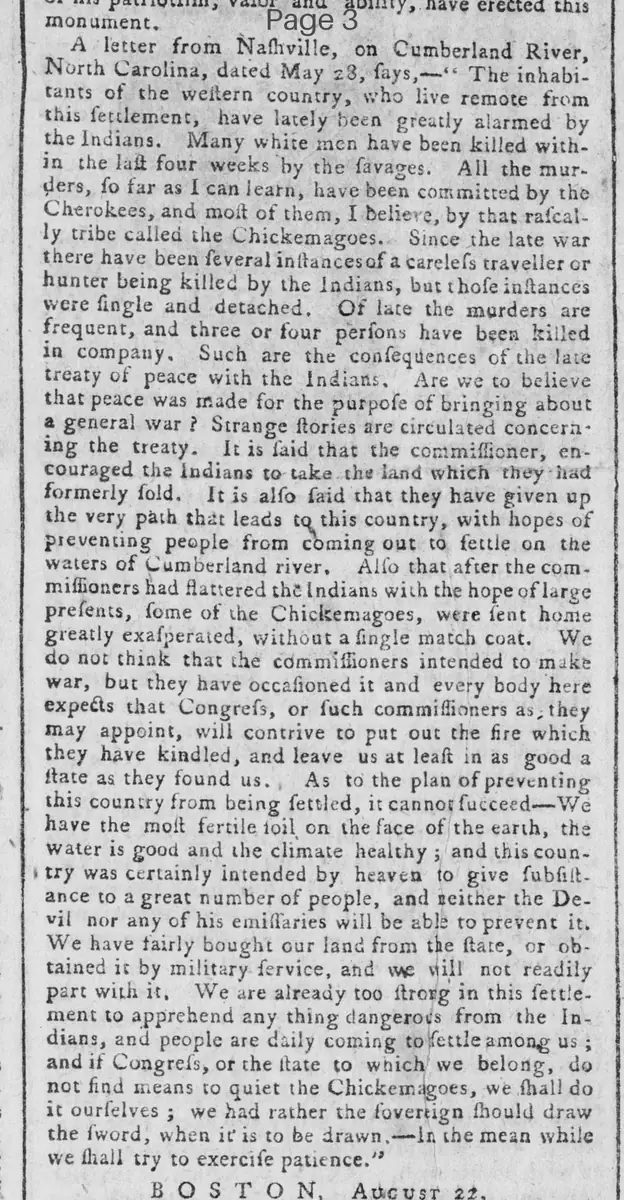
"The inhabitants of the western country, who live remote from this settlement, have lately been greatly alarmed by the Indians. Many white men have been killed within the last four weeks by the savages. All the murders, so far as I can learn, have been committed by the Cherokees, and most of them, I believe, by that rascally tribe called the Chickemagoes. Since the late war there have been several instances of a careless traveller or hunter being killed by the Indians, but those instances were single and detached. Of late the murders are frequent, and three or four persons have been killed in company. Such are the consequences of the late treaty of peace with the Indians. Are we to believe that peace was made for the purpose of bringing about a general war? Strange stories are circulated concerning the treaty. It is said that the commissioner, encouraged the Indians to take the land which they had formerly sold. It is also said that they have given up the very path that leads to this country, with hopes of preventing people from coming out to settle on the waters of Cumberland river. Also that after the commissioners had flattered the Indians with the hope of large presents, some of the Chickemagoes, were sent home greatly exasperated, without a single match coat. We do not think that the commissioners intended to make war, but they have occasioned it and every body here expects that Congress, or such commissioners as they may appoint, will contrive to put out the fire which they have kindled, and leave us at least in as good a state as they found us. As to the plan of preventing this country from being settled, it cannot succeed--We have the most fertile soil on the face of the earth, the water is good and the climate healthy; and this country was certainly intended by heaven to give subsistence to a great number of people, and neither the Devil nor any of his emissaries will be able to prevent it. We have fairly bought our land from the state, or obtained it by military service, and we will not readily part with it. We are already too strong in this settlement to apprehend any thing dangerous from the Indians, and people are daily coming to settle among us; and if Congress, or the state to which we belong, do not find means to quiet the Chickemagoes, we shall do it ourselves; we had rather the sovereign should draw the sword, when it is to be drawn,--in the mean while we shall try to exercise patience."
What sub-type of article is it?
What keywords are associated?
What entities or persons were involved?
Where did it happen?
Domestic News Details
Primary Location
Nashville, On Cumberland River, North Carolina
Event Date
May 28
Key Persons
Outcome
many white men killed within the last four weeks; three or four persons killed in company; settlers expect congress to resolve the conflict or will defend themselves
Event Details
Inhabitants alarmed by frequent Indian murders committed by Cherokees, especially Chickemagoes; consequences of recent treaty criticized for encouraging Indians and provoking war; settlers determined to hold fertile lands despite threats