Thank you for visiting SNEWPapers!
Sign up free
Norfolk Gazette And Publick Ledger
Norfolk, Virginia
What is this article about?
Commentary from an English paper critiquing the British army's outdated tactics, lack of training schools, and reliance on foreign systems like Frederick the Great's, contrasting with innovative French Revolutionary approaches under Bonaparte that emphasized decisive battles and individual initiative over rigid discipline.
Merged-components note: Single article on the character of the British Army, continued across components due to parsing.
Clipping
OCR Quality
Full Text
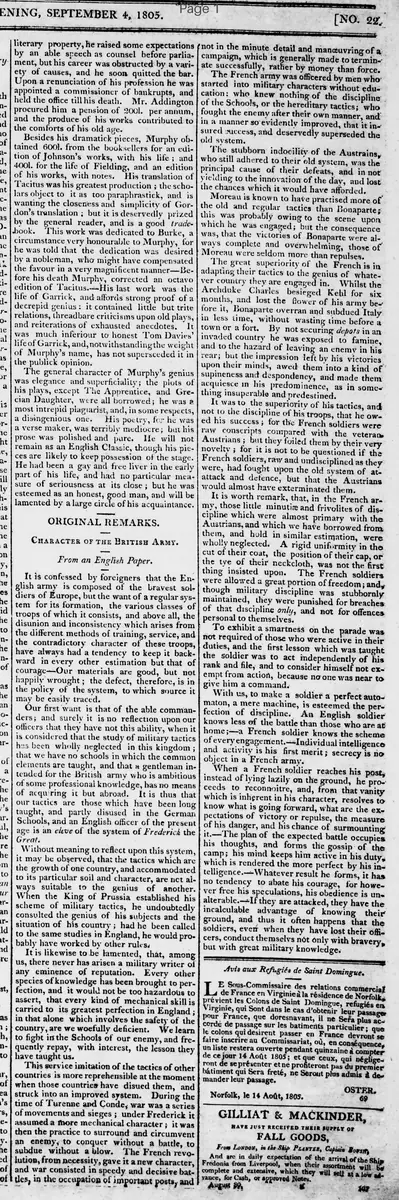
Character Of the British Army.
From an English Paper.
It is confessed by foreigners that the English army is composed of the bravest soldiers of Europe, but the want of a regular system for its formation, the various classes of troops of which it consists, and above all, the disunion and inconsistency which arises from the different methods of training, service, and the contradictory character of these troops, have always had a tendency to keep it backward in every other estimation but that of courage. Our materials are good, but not happily wrought: the defect, therefore, is in the policy of the system, to which source it may be easily traced.
Our first want is that of the able commanders; and surely it is no reflection upon our officers that they have not this ability, when it is considered that the study of military tactics has been wholly neglected in this kingdom; that we have no schools in which the common elements are taught, and that a gentleman intended for the British army who is ambitious of some professional knowledge, has no means of acquiring it but abroad. It is thus that our tactics are those which have been long taught, and partly disused in the German Schools, and an English officer of the present age is an élève of the system of Frederick the Great.
Without meaning to reflect upon this system, it may be observed, that the tactics which are the growth of one country, and accommodated to its particular soil and character, are not always suitable to the genius of another.
When the King of Prussia established his scheme of military tactics, he undoubtedly consulted the genius of his subjects and the situation of his country; had he been called to the same studies in England, he would probably have worked by other rules.
It is likewise to be lamented, that, among us, there never has arisen a military writer of any eminence of reputation. Every other species of knowledge has been brought to perfection, and it would not be too hazardous to assert, that every kind of mechanical skill is carried to its greatest perfection in England; in that alone which involves the safety of the country, are we woefully deficient. We learn to fight in the Schools of our enemy, and frequently repay, with interest, the lesson they have taught us.
This servile imitation of the tactics of other countries is more reprehensible at the moment when those countries have disused them, and struck into an improved system. During the time of Turenne and Condé, war was a series of movements and sieges; under Frederick it assumed a more mechanical character; it was then the practice to surround and circumvent an enemy, to conquer without a battle, to subdue without a blow. The French revolution, from necessity, gave it a new character, and war consisted in speedy and decisive battles, in the occupation of important posts, and
[NO. 22]
not in the minute detail and manoeuvring of a campaign, which is generally made to terminate successfully rather by money than force.
The French army was officered by men who started into military characters without education: who knew nothing of the discipline of the Schools, or the hereditary tactics; who fought the enemy after their own manner, and in a manner so evidently improved, that it insured success, and deservedly superseded the old system.
The stubborn indocility of the Austrians, who still adhered to their old system, was the principal cause of their defeats, and in not yielding to the innovation of the day, and lost the chances which it would have afforded.
Moreau is known to have practised more of the old and regular tactics than Bonaparte; this was probably owing to the scene upon which he was engaged; but the consequence was, that the victories of Bonaparte were always complete and overwhelming, those of Moreau were seldom more than repulses.
The great superiority of the French is in adapting their tactics to the genius of whatever country they are engaged in. Whilst the Archduke Charles besieged Kehl for six months, and lost the flower of his army before it, Bonaparte overran and subdued Italy in less time, without wasting time before a town or a fort. By not securing depots in an invaded country he was exposed to famine, and to the hazard of leaving an enemy in his rear; but the impression left by his victories upon their minds, awed them into a kind of supineness and despondency, and made them acquiesce in his predominence, as in something insuperable and predestined.
It was to the superiority of his tactics, and not to the discipline of his troops, that he owed his success; for the French soldiers were raw conscripts compared with the veteran Austrians; but they foiled them by their very novelty; for it is not to be questioned if the French soldiers, raw and undisciplined as they were, had fought upon the old system of attack and defence, but that the Austrians would almost have exterminated them.
It is worth remark, that, in the French army, those little minutiae and frivolities of discipline which were almost primary with the Austrians, and which we have borrowed from them, and hold in similar estimation, were wholly neglected. A rigid uniformity in the cut of their coat, the position of their cap, or the tye of their neckcloth, was not the first thing insisted upon. The French soldiers were allowed a great portion of freedom; and, though military discipline was stubbornly maintained, they were punished for breaches of that discipline only, and not for offences personal to themselves.
To exhibit a smartness on the parade was not required of those who were active in their duties, and the first lesson which was taught the soldier was to act independently of his rank and file, and to consider himself not exempt from action, because no one was near to give him a command.
With us, to make a soldier a perfect automaton, a mere machine, is esteemed the perfection of discipline. An English soldier knows less of the battle than those who are at home; a French soldier knows the scheme of every engagement. Individual intelligence and activity is his first merit; secrecy is no object in a French army.
When a French soldier reaches his post, instead of lying lazily on the ground, he proceeds to reconnoitre, and, from that vanity which is inherent in his character, resolves to know what is going forward, what are the expectations of victory or repulse, the measure of his danger, and his chance of surmounting it. The plan of the expected battle occupies his thoughts, and forms the gossip of the camp; his mind keeps him active in his duty, which is rendered the more perfect by his intelligence. Whatever result he forms, it has no tendency to abate his courage, for however free his speculations, his obedience is unalterable. If they are attacked, they have the incalculable advantage of knowing their ground, and thus it often happens that the soldiers, even when they have lost their officers, conduct themselves not only with bravery, but with great military knowledge.
What sub-type of article is it?
What keywords are associated?
What entities or persons were involved?
Where did it happen?
Foreign News Details
Primary Location
Europe
Key Persons
Outcome
bonaparte's victories were complete and overwhelming; moreau's were repulses; archduke charles lost the flower of his army besieging kehl; french innovations led to success over veteran austrians despite raw conscripts.
Event Details
Critique of British army's outdated tactics derived from Frederick the Great's system, lacking domestic training schools and adapting to national genius; contrasts with French Revolutionary army's innovative, adaptive tactics emphasizing decisive battles, individual initiative, and minimal rigid discipline, leading to superior outcomes against Austrians.