Thank you for visiting SNEWPapers!
Sign up free
Editorial
May 27, 1841
The Charlotte Journal
Charlotte, Mecklenburg County, North Carolina
What is this article about?
Editorial from National Intelligencer anticipates extra session of Congress under President Tyler to reform revenue and finances, criticizing prior administrations' policies. Advocates distributing public lands proceeds to states, revising import duties, repealing sub-treasury, and establishing a national fiscal agent to stabilize currency and economy.
Clipping
OCR Quality
85%
Good
Full Text
From the National Intelligencer
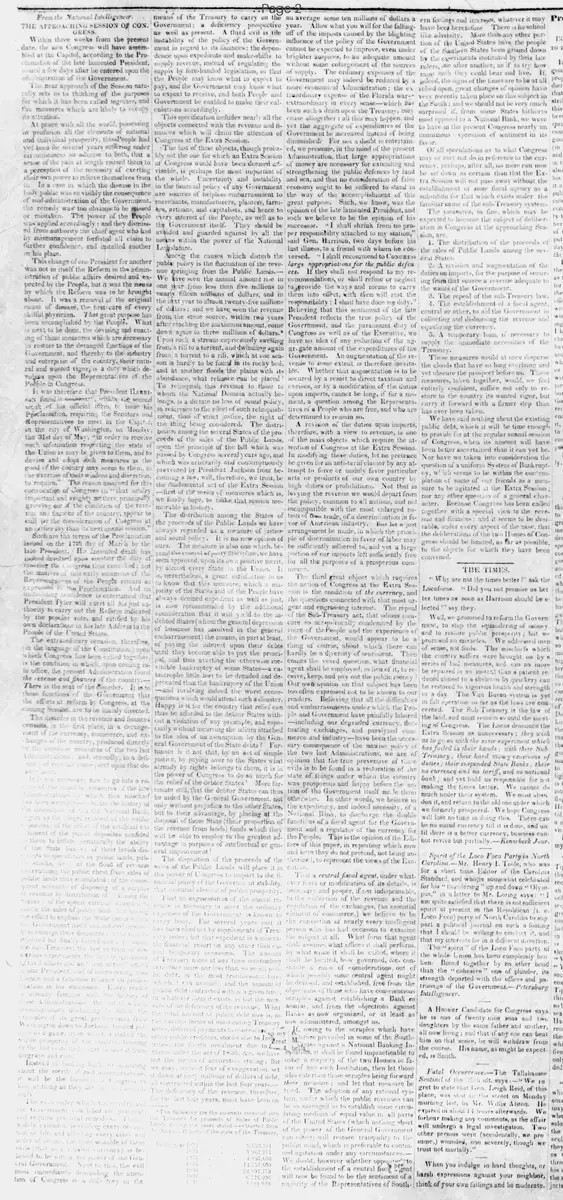
THE APPROACHING SESSION OF CONGRESS.
Within three weeks from the present date, the new Congress will have assembled at the Capitol, according to the Proclamation of the late lamented President, issued a few days after he entered upon the administration of the Government. The near approach of the Session naturally sets us to thinking of the purposes for which it has been called together, and the measures which are likely to occupy its attention.
At peace with all the world, possessing in profusion all the elements of national and individual prosperity, this People had yet been for several years suffering under circumstances so adverse to both, that a sense of the pain at length roused them to a perception of the necessity of exerting their own power to relieve themselves from it. In a case in which the disease in the body politic was so visibly the consequence of mal-administration of the Government, the remedy was too obvious to be missed or mistaken. The power of the People was applied accordingly: and they dismissed from authority the chief agent who had by mismanagement forfeited all claim to further confidence, and installed another in his place.
This change of one President for another was not in itself the Reform in the administration of public affairs desired and expected by the People, but it was the means by which the Reform was to be brought about. It was a removal of the original cause of disease, the first care of every skilful physician. That great purpose has been accomplished by the People. What is next to be done, the devising and enacting of those measures which are necessary to restore to the deranged functions of the Government, and thereby to the industry and enterprise of the country, their natural and wonted vigor, is a duty which devolves upon the Representatives of the People in Congress.
It was therefore that President Harrison found it necessary, within the second week of his official term, to issue his Proclamation, requiring the Senators and Representatives to meet in the Capitol, in the city of Washington, on Monday, the 31st day of May, "in order to receive such information respecting the state of the Union as may be given to them, and to devise and adopt such measures as the good of the country may seem to them, in the exercise of their wisdom and discretion, to require." The reason assigned for this convocation of Congress is, "that sundry important and weighty matters, principally growing out of the condition of the revenue and finances of the country, appear to call for the consideration of Congress at an earlier day than its next annual session."
Such are the terms of the Proclamation issued on the 4th day of March by the late President. His lamented death has indeed devolved upon another the duty of meeting the Congress thus convoked: but the motives of this early summons of the Representatives of the People remain as expressed in the Proclamation. And an undoubting confidence is entertained that President Tyler will exert all his just authority to carry out the Reform indicated by the popular vote, and ratified by his own declarations in his late Address to the People of the United States.
The extraordinary occasion, therefore, (in the language of the Constitution,) upon which Congress has been called together, is the condition in which, upon coming into office, the present Administration found the revenue and finances of the country.—There is the seat of the disorder. It is to these functions of the Government that the efforts at reform by Congress, at the coming Session, are to be mainly directed.
The disorder in the revenue and finances consists, in the first place, in a derangement of the currency, commerce, and exchanges of the country, produced directly by the foolish measures of the two last Administrations, and, secondly, in a deficiency upon that derangement consequent.
It would be foreign to our present purpose to go into a review of the measures of the late Administrations which this mischief originated. To relate the history of the United States Bank, the artificial currency, the removal of the deposites confided to it to inflate unnaturally the activity of the State banks, their lavish discounts to create a turn in public lands, public stocks, of the flood of revenue rushing into the public chest from sales of public lands thus stimulated, of the consequent pressure of disposing of a surplus revenue by distribution among the States of the surplus circular letter to check the sales of public land, effect to explain the State indebtedness to enlarge their depreciated currency, called that finally for sub-treasury the last in a series of desperate expedients of one President and of overreaching.
Etc. aid a multitude of other precautions breeders already familiar with the history of the administrations from Washington down to Jackson seated the United States woe improper trusting to the annihilation of the currency instead about the men.
It will be the business of the present session to remedy these evils, and restore the Government to a sound and healthy condition. Next to this, the evil most immediately demanding the attention of Congress is a deficiency in the means of the Treasury to carry on the Government; a deficiency prospective as well as present. A third evil is the instability of the policy of the Government in regard to its finances: the dependence upon expedients and make-shifts to supply revenue, instead of regulating the supply by fore-handed legislation, so that the People may know what to expect to pay, and the Government may know what to expect to receive, and both People and Government be enabled to make their calculations accordingly.
This specification includes nearly all the objects connected with the revenue and finances which will claim the attention of Congress at the Extra Session.
The last of these objects, though probably not the one for which an Extra Session of Congress would have been deemed advisable, is perhaps the most important of the whole. Uncertainty and instability in the financial policy of any Government are sources of helpless embarrassment to merchants, manufacturers, planters, farmers, artisans, and capitalists, and hence to every interest of the People, as well as to the Government itself. They should be avoided and guarded against by all the means within the power of the National Legislature.
Among the causes which disturb the public policy is the fluctuation of the revenue springing from the Public Lands.—We have seen the annual amount rise in one year from less than five millions to nearly fifteen millions of dollars, and in the next year to almost twenty-five millions of dollars: and we have seen the revenue from the same source, within two years after reaching the maximum amount, come down again to three millions of dollars. Upon such a stream capriciously swelling from a rill to a torrent, and dwindling again from a torrent to a rill, which at one season is hardly to be found in its rocky bed, and at another floods the plains with its abundance, what reliance can be placed?
To relinquish this revenue to those to whom the National Domain actually belongs, is a dictate no less of sound policy, in reference to the effect of such relinquishment, than of strict justice, the right of the thing being considered. The distribution among the several States of the proceeds of the sales of the Public Lands, upon the principle of the bill which was passed by Congress several years ago, and which was arbitrarily and contemptuously prevented by President Jackson from becoming a law, will, therefore, we trust, be the fundamental act of the Extra Session—first of the series of measures which is, we fondly hope, to make that session memorable in history.
The distribution among the States of the proceeds of the Public Lands we have always regarded as a measure of justice and sound policy. It is no new opinion of ours. The measure is also one which, beyond the control of party discipline, we have seen approved, upon its own positive merit, by almost every State in the Union. It is, nevertheless, a great satisfaction to us to know that this measure, which a majority of the States and of the People have always deemed expedient as well as just, is now recommended by the additional consideration that it will yield to the indebted States (whom the general depression of business has involved in the general embarrassment) the means, in part at least, of paying the interest upon their debts until they become able to pay the principal, and thus averting the otherwise inevitable bankruptcy of some States—a catastrophe little less to be dreaded and deprecated than the bankruptcy of the Union itself—and involving indeed the worst consequences which would attend such a disaster.
Happy is it for the country that relief can thus be afforded to the debtor States without a violation of any principle, and especially without incurring the odium attached to the idea of an assumption by the General Government of the State debts! Fortunate is it not that, by an act of simple justice, by paying over to the States what already by rights belongs to them, it is in the power of Congress to do so much for the relief of the debtor States? More fortunate still, that the debtor States can thus be aided by the General Government, not only without prejudice to the other States, but to their advantage, by placing at the disposal of those States (their proportion of the revenue from lands) funds which they will be able to employ to the greatest advantage in purposes of intellectual or general improvement.
The disposition of the proceeds of the sales of the Public Lands will place it in the power of Congress to impart to the financial policy of the Government that essential element of public prosperity, stability. That an augmentation of the annual revenue is necessary to meet the ordinary wants of the Government is known to everybody. For several years past it has been eked out by supplements of Treasury notes; but that expedient is a miserable financial resort on any other than temporary occasions. The amount of Treasury notes at any time outstanding should be neither more nor less than so much public debt, in the most troublesome form which can assume: and the amount of public debt contracted within a given time, in whatever form it exist, is but the measure of the deficiency of the revenue. What the total amount of public debt now is, in various forms of outstanding Treasury notes, due to public creditors, stock due to Indians, the fourth instalment due to late States under the act of 1833, &c. we have not the means of accurately stating. But we may, without fear of exaggeration, set it down at forty millions of dollars of debt, contracted within the last four years,—
The deficiency of the revenue, therefore, for the last four years, must have been on the following scale: The following are the amounts received into the Treasury from proceeds of Sales of Public Lands, in quarters stated—extracted from a report of the state of the Treasury.
[Table of figures: approximate from OCR - 1829-30: $6,643,711; 1830-31: $3,305,711; etc. up to lower amounts]
an average some ten millions of dollars a year. Allow what you will for the falling off of the imposts caused by the blighting influence of the policy of the Government, it cannot be expected to improve, even under brighter auspices, to an adequate amount without some enlargement of the sources of supply. The ordinary expenses of the Government may indeed be reduced by a more economical Administration: the extraordinary expense of the Florida war—extraordinary in every sense—which has been such a drain upon the Treasury, may cease altogether: all this may happen, and yet the aggregate of expenditures of the Government be increased instead of being diminished: For not a doubt is entertained, we presume, in the mind of the present Administration, that large appropriations of money are necessary for extending and strengthening the public defences by land and sea, and that no consideration of false economy ought to be suffered to stand in the way of the accomplishment of this great purpose. Such, we know, was the opinion of the late lamented President, and such we believe to be the opinion of his successor. "I shall shrink from no proper responsibility attached to my station," said Gen. Harrison, two days before his last illness, to a friend with whom he conversed. "I shall recommend to Congress large appropriations for the public defences. If they shall not respond to my recommendations, or shall refuse or neglect to provide the ways and means to carry them into effect, with them will rest the responsibility: I shall have done my duty."
Believing that this sentiment of the late President reflects the true policy of the Government, and the paramount duty of Congress as well as of the Executive, we have no idea of any reduction of the aggregate amount of the expenditures of the Government. An augmentation of the revenue to some extent is therefore inevitable. Whether that augmentation is to be secured by a resort to direct taxation and excises, or by a modification of the duties upon imports, cannot be long, if for a moment, a question among the Representatives of a People who are free, and who are determined to remain so.
A revision of the duties upon imports, therefore, with a view to revenue, is one of the main objects which require the attention of Congress at the Extra Session. In modifying those duties, let no pretence be given for an anti-tariff clamor by any attempt to force or unduly favor particular arts or products of our own country by high duties or prohibitions. Not that in levying the revenue we would depart from the policy, common to all nations, and not incompatible with the most enlarged notion of free trade, of a discrimination in favor of American industry. But let a just arrangement be made, in which the principle of discrimination in favor of labor may be sufficiently adhered to, and yet a large portion of our imports left sufficiently free for all the purposes of a prosperous commerce.
The third great object which requires the action of Congress at the Extra Session is the condition of the currency, and the questions connected with that most urgent and engrossing interest. The repeal of the Sub-Treasury act, that odious measure so unequivocally condemned by the voice of the People and the experience of the Government, would appear to be a thing of course, about which there can hardly be a diversity of sentiment. Then comes the vexed question, what financial agent shall be employed, in lieu of it, to receive, keep, and pay out the public money?
Our own opinion on that subject has been too often expressed not to be known to our readers. Believing that all the difficulties and embarrassments under which the People and Government have painfully labored—including our degraded currency, the fluctuating exchanges, and paralyzed commerce and industry—have been the necessary consequence of the unwise policy of the two last Administrations, we are of opinion that the true preventive of the evils is to be found in a restoration of the state of things under which the country was prosperous and happy before the action of the Government itself made them otherwise. In other words, we believe in the expediency, and indeed necessity, of a National Bank, to discharge the double functions of a fiscal agent for the Government and a regulator of the currency for the People. This is the opinion of the Editors of this paper, in repeating which now and here they do not pretend, not being authorized, to represent the views of the Executive.
If a central fiscal agent, under whatever term or modification of its details, is necessary and proper, if not indispensable, to the collection of the revenue and the regulation of the exchanges (an essential element of commerce,) we believe to be the conviction of nearly every intelligent person who has had occasion to examine the subject at all. What form that agent shall assume, what offices it shall perform, by what name it shall be called, where it shall be located, how governed, &c. constitute a mass of considerations, out of which easily some central agent might be devised, and established, free from the objections of those who have conscientious scruples against establishing a Bank eo nomine, and from the objections against Banks as now organized, or at least as now administered, amongst us.
If, owing to the scruples which have heretofore prevailed in some of the Southern States against a National Banking Institution, it shall be found impracticable to get a majority of the two Houses in favor of any such Institution, then let those who entertain those scruples bring forward their measure: and let that measure be tried. The adoption of any rational system, under which the public revenues can be so managed as to establish some circulating medium of equal value in all parts of the United States (which nothing short of the power of the General Government can effect) will restore tranquility to the public mind, which is preferable to continued agitation under any circumstances.
We doubt, however whether opposition to the establishment of a central fiscal agent will now be found to be the sentiment of a majority of the Representatives of Southern feelings and interests, whatever it may have been heretofore. There is no school like adversity. More than any other portion of the United States have the people of the Southern States been ground down by the experiments instituted by their late rulers, one after another, as if to try how many such they could bear and live. If, indeed, the signs of the times are to be at all relied upon, great changes of opinion have very recently taken place on this subject in the South: and we should not be very much surprised to, from some States hitherto most opposed to a National Bank, we were to have in the present Congress nearly an unanimous expression of sentiment in its favor.
Of all speculations as to what Congress may or may not do in reference to the currency, perhaps, after all, no more can now be set down as certain than that the Extra Session will not pass away without the establishment of some fiscal agency as a substitute for that which exists under the familiar name of the sub-Treasury system.
The measures, in fine, which may be expected to become the subject of deliberation in Congress at the approaching Session, are,
1. The distribution of the proceeds of the sales of Public Lands among the several States.
2. A revision and augmentation of the duties on imports, for the purpose of securing from that source a revenue adequate to the wants of the Government.
3. The repeal of the sub-Treasury law.
4. The establishment of a fiscal agent, central or other, to aid the Government in collecting and disbursing the revenue and equalizing the currency.
5. A temporary loan, if necessary to supply the immediate necessities of the Treasury.
These measures would at once dispel the clouds that have so long overhung and yet obscure the prospect before us. These measures, taken together, would, we feel entirely confident, suffice not only to restore to the country its wonted vigor, but carry it forward with a firmer step than has ever been taken.
We have said nothing about the existing public debt, which it will be time enough to provide for at the regular annual session of Congress, when its amount will have been better ascertained than it can yet be. Nor have we taken into consideration the question of a uniform System of Bankruptcy, which seems to be within the contemplation of some of our friends as a measure to be agitated at the Extra Session, nor any other question of a general character. Because Congress has been called together with a special view to the revenue and finances; and it seems to be desirable, under every aspect of the case, that the deliberations of the two Houses of Congress should be limited, as far as possible, to the objects for which they have been convened.
THE APPROACHING SESSION OF CONGRESS.
Within three weeks from the present date, the new Congress will have assembled at the Capitol, according to the Proclamation of the late lamented President, issued a few days after he entered upon the administration of the Government. The near approach of the Session naturally sets us to thinking of the purposes for which it has been called together, and the measures which are likely to occupy its attention.
At peace with all the world, possessing in profusion all the elements of national and individual prosperity, this People had yet been for several years suffering under circumstances so adverse to both, that a sense of the pain at length roused them to a perception of the necessity of exerting their own power to relieve themselves from it. In a case in which the disease in the body politic was so visibly the consequence of mal-administration of the Government, the remedy was too obvious to be missed or mistaken. The power of the People was applied accordingly: and they dismissed from authority the chief agent who had by mismanagement forfeited all claim to further confidence, and installed another in his place.
This change of one President for another was not in itself the Reform in the administration of public affairs desired and expected by the People, but it was the means by which the Reform was to be brought about. It was a removal of the original cause of disease, the first care of every skilful physician. That great purpose has been accomplished by the People. What is next to be done, the devising and enacting of those measures which are necessary to restore to the deranged functions of the Government, and thereby to the industry and enterprise of the country, their natural and wonted vigor, is a duty which devolves upon the Representatives of the People in Congress.
It was therefore that President Harrison found it necessary, within the second week of his official term, to issue his Proclamation, requiring the Senators and Representatives to meet in the Capitol, in the city of Washington, on Monday, the 31st day of May, "in order to receive such information respecting the state of the Union as may be given to them, and to devise and adopt such measures as the good of the country may seem to them, in the exercise of their wisdom and discretion, to require." The reason assigned for this convocation of Congress is, "that sundry important and weighty matters, principally growing out of the condition of the revenue and finances of the country, appear to call for the consideration of Congress at an earlier day than its next annual session."
Such are the terms of the Proclamation issued on the 4th day of March by the late President. His lamented death has indeed devolved upon another the duty of meeting the Congress thus convoked: but the motives of this early summons of the Representatives of the People remain as expressed in the Proclamation. And an undoubting confidence is entertained that President Tyler will exert all his just authority to carry out the Reform indicated by the popular vote, and ratified by his own declarations in his late Address to the People of the United States.
The extraordinary occasion, therefore, (in the language of the Constitution,) upon which Congress has been called together, is the condition in which, upon coming into office, the present Administration found the revenue and finances of the country.—There is the seat of the disorder. It is to these functions of the Government that the efforts at reform by Congress, at the coming Session, are to be mainly directed.
The disorder in the revenue and finances consists, in the first place, in a derangement of the currency, commerce, and exchanges of the country, produced directly by the foolish measures of the two last Administrations, and, secondly, in a deficiency upon that derangement consequent.
It would be foreign to our present purpose to go into a review of the measures of the late Administrations which this mischief originated. To relate the history of the United States Bank, the artificial currency, the removal of the deposites confided to it to inflate unnaturally the activity of the State banks, their lavish discounts to create a turn in public lands, public stocks, of the flood of revenue rushing into the public chest from sales of public lands thus stimulated, of the consequent pressure of disposing of a surplus revenue by distribution among the States of the surplus circular letter to check the sales of public land, effect to explain the State indebtedness to enlarge their depreciated currency, called that finally for sub-treasury the last in a series of desperate expedients of one President and of overreaching.
Etc. aid a multitude of other precautions breeders already familiar with the history of the administrations from Washington down to Jackson seated the United States woe improper trusting to the annihilation of the currency instead about the men.
It will be the business of the present session to remedy these evils, and restore the Government to a sound and healthy condition. Next to this, the evil most immediately demanding the attention of Congress is a deficiency in the means of the Treasury to carry on the Government; a deficiency prospective as well as present. A third evil is the instability of the policy of the Government in regard to its finances: the dependence upon expedients and make-shifts to supply revenue, instead of regulating the supply by fore-handed legislation, so that the People may know what to expect to pay, and the Government may know what to expect to receive, and both People and Government be enabled to make their calculations accordingly.
This specification includes nearly all the objects connected with the revenue and finances which will claim the attention of Congress at the Extra Session.
The last of these objects, though probably not the one for which an Extra Session of Congress would have been deemed advisable, is perhaps the most important of the whole. Uncertainty and instability in the financial policy of any Government are sources of helpless embarrassment to merchants, manufacturers, planters, farmers, artisans, and capitalists, and hence to every interest of the People, as well as to the Government itself. They should be avoided and guarded against by all the means within the power of the National Legislature.
Among the causes which disturb the public policy is the fluctuation of the revenue springing from the Public Lands.—We have seen the annual amount rise in one year from less than five millions to nearly fifteen millions of dollars, and in the next year to almost twenty-five millions of dollars: and we have seen the revenue from the same source, within two years after reaching the maximum amount, come down again to three millions of dollars. Upon such a stream capriciously swelling from a rill to a torrent, and dwindling again from a torrent to a rill, which at one season is hardly to be found in its rocky bed, and at another floods the plains with its abundance, what reliance can be placed?
To relinquish this revenue to those to whom the National Domain actually belongs, is a dictate no less of sound policy, in reference to the effect of such relinquishment, than of strict justice, the right of the thing being considered. The distribution among the several States of the proceeds of the sales of the Public Lands, upon the principle of the bill which was passed by Congress several years ago, and which was arbitrarily and contemptuously prevented by President Jackson from becoming a law, will, therefore, we trust, be the fundamental act of the Extra Session—first of the series of measures which is, we fondly hope, to make that session memorable in history.
The distribution among the States of the proceeds of the Public Lands we have always regarded as a measure of justice and sound policy. It is no new opinion of ours. The measure is also one which, beyond the control of party discipline, we have seen approved, upon its own positive merit, by almost every State in the Union. It is, nevertheless, a great satisfaction to us to know that this measure, which a majority of the States and of the People have always deemed expedient as well as just, is now recommended by the additional consideration that it will yield to the indebted States (whom the general depression of business has involved in the general embarrassment) the means, in part at least, of paying the interest upon their debts until they become able to pay the principal, and thus averting the otherwise inevitable bankruptcy of some States—a catastrophe little less to be dreaded and deprecated than the bankruptcy of the Union itself—and involving indeed the worst consequences which would attend such a disaster.
Happy is it for the country that relief can thus be afforded to the debtor States without a violation of any principle, and especially without incurring the odium attached to the idea of an assumption by the General Government of the State debts! Fortunate is it not that, by an act of simple justice, by paying over to the States what already by rights belongs to them, it is in the power of Congress to do so much for the relief of the debtor States? More fortunate still, that the debtor States can thus be aided by the General Government, not only without prejudice to the other States, but to their advantage, by placing at the disposal of those States (their proportion of the revenue from lands) funds which they will be able to employ to the greatest advantage in purposes of intellectual or general improvement.
The disposition of the proceeds of the sales of the Public Lands will place it in the power of Congress to impart to the financial policy of the Government that essential element of public prosperity, stability. That an augmentation of the annual revenue is necessary to meet the ordinary wants of the Government is known to everybody. For several years past it has been eked out by supplements of Treasury notes; but that expedient is a miserable financial resort on any other than temporary occasions. The amount of Treasury notes at any time outstanding should be neither more nor less than so much public debt, in the most troublesome form which can assume: and the amount of public debt contracted within a given time, in whatever form it exist, is but the measure of the deficiency of the revenue. What the total amount of public debt now is, in various forms of outstanding Treasury notes, due to public creditors, stock due to Indians, the fourth instalment due to late States under the act of 1833, &c. we have not the means of accurately stating. But we may, without fear of exaggeration, set it down at forty millions of dollars of debt, contracted within the last four years,—
The deficiency of the revenue, therefore, for the last four years, must have been on the following scale: The following are the amounts received into the Treasury from proceeds of Sales of Public Lands, in quarters stated—extracted from a report of the state of the Treasury.
[Table of figures: approximate from OCR - 1829-30: $6,643,711; 1830-31: $3,305,711; etc. up to lower amounts]
an average some ten millions of dollars a year. Allow what you will for the falling off of the imposts caused by the blighting influence of the policy of the Government, it cannot be expected to improve, even under brighter auspices, to an adequate amount without some enlargement of the sources of supply. The ordinary expenses of the Government may indeed be reduced by a more economical Administration: the extraordinary expense of the Florida war—extraordinary in every sense—which has been such a drain upon the Treasury, may cease altogether: all this may happen, and yet the aggregate of expenditures of the Government be increased instead of being diminished: For not a doubt is entertained, we presume, in the mind of the present Administration, that large appropriations of money are necessary for extending and strengthening the public defences by land and sea, and that no consideration of false economy ought to be suffered to stand in the way of the accomplishment of this great purpose. Such, we know, was the opinion of the late lamented President, and such we believe to be the opinion of his successor. "I shall shrink from no proper responsibility attached to my station," said Gen. Harrison, two days before his last illness, to a friend with whom he conversed. "I shall recommend to Congress large appropriations for the public defences. If they shall not respond to my recommendations, or shall refuse or neglect to provide the ways and means to carry them into effect, with them will rest the responsibility: I shall have done my duty."
Believing that this sentiment of the late President reflects the true policy of the Government, and the paramount duty of Congress as well as of the Executive, we have no idea of any reduction of the aggregate amount of the expenditures of the Government. An augmentation of the revenue to some extent is therefore inevitable. Whether that augmentation is to be secured by a resort to direct taxation and excises, or by a modification of the duties upon imports, cannot be long, if for a moment, a question among the Representatives of a People who are free, and who are determined to remain so.
A revision of the duties upon imports, therefore, with a view to revenue, is one of the main objects which require the attention of Congress at the Extra Session. In modifying those duties, let no pretence be given for an anti-tariff clamor by any attempt to force or unduly favor particular arts or products of our own country by high duties or prohibitions. Not that in levying the revenue we would depart from the policy, common to all nations, and not incompatible with the most enlarged notion of free trade, of a discrimination in favor of American industry. But let a just arrangement be made, in which the principle of discrimination in favor of labor may be sufficiently adhered to, and yet a large portion of our imports left sufficiently free for all the purposes of a prosperous commerce.
The third great object which requires the action of Congress at the Extra Session is the condition of the currency, and the questions connected with that most urgent and engrossing interest. The repeal of the Sub-Treasury act, that odious measure so unequivocally condemned by the voice of the People and the experience of the Government, would appear to be a thing of course, about which there can hardly be a diversity of sentiment. Then comes the vexed question, what financial agent shall be employed, in lieu of it, to receive, keep, and pay out the public money?
Our own opinion on that subject has been too often expressed not to be known to our readers. Believing that all the difficulties and embarrassments under which the People and Government have painfully labored—including our degraded currency, the fluctuating exchanges, and paralyzed commerce and industry—have been the necessary consequence of the unwise policy of the two last Administrations, we are of opinion that the true preventive of the evils is to be found in a restoration of the state of things under which the country was prosperous and happy before the action of the Government itself made them otherwise. In other words, we believe in the expediency, and indeed necessity, of a National Bank, to discharge the double functions of a fiscal agent for the Government and a regulator of the currency for the People. This is the opinion of the Editors of this paper, in repeating which now and here they do not pretend, not being authorized, to represent the views of the Executive.
If a central fiscal agent, under whatever term or modification of its details, is necessary and proper, if not indispensable, to the collection of the revenue and the regulation of the exchanges (an essential element of commerce,) we believe to be the conviction of nearly every intelligent person who has had occasion to examine the subject at all. What form that agent shall assume, what offices it shall perform, by what name it shall be called, where it shall be located, how governed, &c. constitute a mass of considerations, out of which easily some central agent might be devised, and established, free from the objections of those who have conscientious scruples against establishing a Bank eo nomine, and from the objections against Banks as now organized, or at least as now administered, amongst us.
If, owing to the scruples which have heretofore prevailed in some of the Southern States against a National Banking Institution, it shall be found impracticable to get a majority of the two Houses in favor of any such Institution, then let those who entertain those scruples bring forward their measure: and let that measure be tried. The adoption of any rational system, under which the public revenues can be so managed as to establish some circulating medium of equal value in all parts of the United States (which nothing short of the power of the General Government can effect) will restore tranquility to the public mind, which is preferable to continued agitation under any circumstances.
We doubt, however whether opposition to the establishment of a central fiscal agent will now be found to be the sentiment of a majority of the Representatives of Southern feelings and interests, whatever it may have been heretofore. There is no school like adversity. More than any other portion of the United States have the people of the Southern States been ground down by the experiments instituted by their late rulers, one after another, as if to try how many such they could bear and live. If, indeed, the signs of the times are to be at all relied upon, great changes of opinion have very recently taken place on this subject in the South: and we should not be very much surprised to, from some States hitherto most opposed to a National Bank, we were to have in the present Congress nearly an unanimous expression of sentiment in its favor.
Of all speculations as to what Congress may or may not do in reference to the currency, perhaps, after all, no more can now be set down as certain than that the Extra Session will not pass away without the establishment of some fiscal agency as a substitute for that which exists under the familiar name of the sub-Treasury system.
The measures, in fine, which may be expected to become the subject of deliberation in Congress at the approaching Session, are,
1. The distribution of the proceeds of the sales of Public Lands among the several States.
2. A revision and augmentation of the duties on imports, for the purpose of securing from that source a revenue adequate to the wants of the Government.
3. The repeal of the sub-Treasury law.
4. The establishment of a fiscal agent, central or other, to aid the Government in collecting and disbursing the revenue and equalizing the currency.
5. A temporary loan, if necessary to supply the immediate necessities of the Treasury.
These measures would at once dispel the clouds that have so long overhung and yet obscure the prospect before us. These measures, taken together, would, we feel entirely confident, suffice not only to restore to the country its wonted vigor, but carry it forward with a firmer step than has ever been taken.
We have said nothing about the existing public debt, which it will be time enough to provide for at the regular annual session of Congress, when its amount will have been better ascertained than it can yet be. Nor have we taken into consideration the question of a uniform System of Bankruptcy, which seems to be within the contemplation of some of our friends as a measure to be agitated at the Extra Session, nor any other question of a general character. Because Congress has been called together with a special view to the revenue and finances; and it seems to be desirable, under every aspect of the case, that the deliberations of the two Houses of Congress should be limited, as far as possible, to the objects for which they have been convened.
What sub-type of article is it?
Economic Policy
Taxation
Trade Or Commerce
What keywords are associated?
Revenue Reform
Financial Crisis
Public Lands Distribution
National Bank
Tariff Revision
Sub Treasury Repeal
Currency Stability
What entities or persons were involved?
President Harrison
President Tyler
Congress
President Jackson
National Bank
Sub Treasury
Editorial Details
Primary Topic
Reform Of Revenue And Finances In Extra Session Of Congress
Stance / Tone
Supportive Of Financial Reform And National Bank
Key Figures
President Harrison
President Tyler
Congress
President Jackson
National Bank
Sub Treasury
Key Arguments
Prior Administrations Caused Financial Derangement Through Unwise Policies Like Bank Removal And Sub Treasury.
Distribute Public Lands Proceeds To States For Justice And To Aid Debtor States.
Revise Import Duties For Revenue Without Protectionist Extremes.
Repeal Sub Treasury Act And Establish A Central Fiscal Agent Like A National Bank To Stabilize Currency.
Address Revenue Deficiency And Policy Instability To Restore Economic Vigor.
Increase Appropriations For Public Defenses Despite Higher Expenditures.