Thank you for visiting SNEWPapers!
Sign up free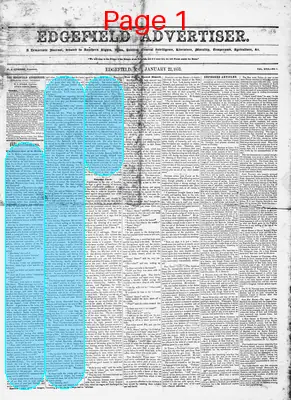
Literary
January 22, 1852
Edgefield Advertiser
Edgefield, Edgefield County, South Carolina
What is this article about?
During his exile on St. Helena, Napoleon befriends orphaned flower seller Henrietta, finding solace in her company amid shared themes of loss and isolation. Their bond deepens through visits and conversations until his death in 1821, when she collapses and dies beside him.
Clipping
OCR Quality
98%
Excellent
Full Text
MISCELLANEOUS.
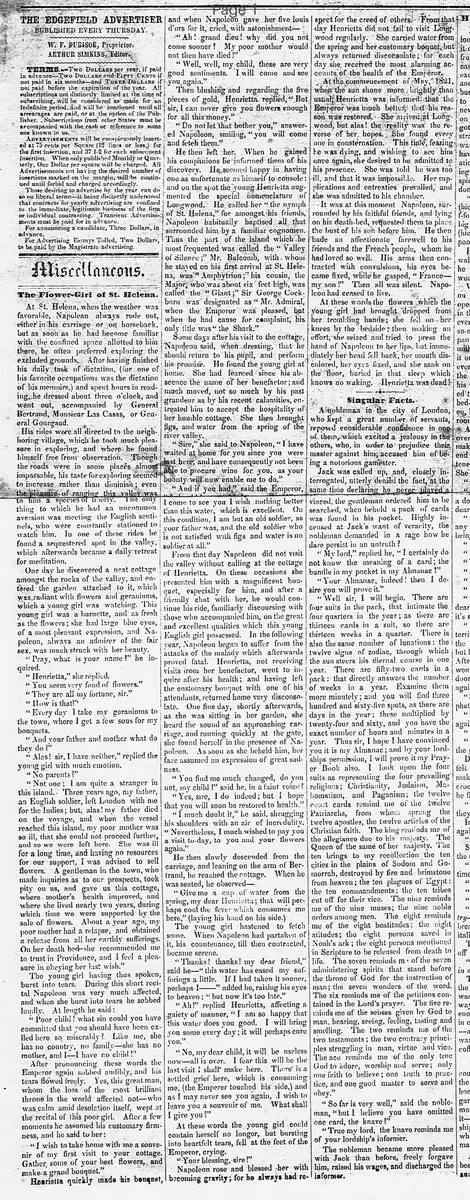
The Flower-Girl of St. Helena.
At St. Helena, when the weather was favorable, Napoleon always rode out either in his carriage or on horseback, but as soon as he had become familiar with the confined space allotted to him there, he often preferred exploring the excluded grounds. After having finished his daily task of dictation, (one of his favorite occupations was the dictation of his memoirs, and spent hours in reading,) he dressed about three o'clock, and went out, accompanied by General Bertrand, Monsieur Las Cases, or General Gourgaud.
His rides were all directed to the neighboring village, which he took much pleasure in exploring, and where he found himself free from observation. Though the roads were in some places almost impassable, his taste for exploring seemed to increase rather than diminish; even the pleasure of ranging this valley was to him a species of liberty. The only thing to which he had an uncommon aversion was meeting the English sentinels, who were constantly stationed to watch him. In one of these rides he found a sequestered spot in the valley, which afterwards became a daily retreat for meditation.
One day he discovered a neat cottage amongst the rocks of the valley, and entered the garden attached to it, which was radiant with flowers and geraniums, which a young girl was watching. This young girl was a brunette, and as fresh as the flowers; she had large blue eyes, of a most pleasant expression, and Napoleon, always an admirer of the fair sex, was much struck with her beauty.
"Pray, what is your name?" he inquired.
"Henrietta," she replied.
"You seem very fond of flowers."
"They are all my fortune, sir."
"How is that?"
"Every day I take my geraniums to the town, where I get a few sous for my bouquets."
"And your father and mother what do they do?"
Alas! sir, I have neither," replied the young girl with much emotion.
"No parents?"
"Not one; I am quite a stranger in this island. Three years ago, my father, an English soldier, left London with me for the Indies; but, alas! my father died on the voyage, and when the vessel reached this island, my poor mother was so ill, that she could not proceed further, and so we were left here. She was ill for a long time, and having no resources for our support, I was advised to sell flowers. A gentleman in the town, who made inquiries as to our prospects, took pity on us, and gave us this cottage, where mother's health improved, and where she lived nearly two years, during which time we were supported by the sale of flowers. About a year ago, my poor mother had a relapse, and obtained a release from all her earthly sufferings. On her death bed she recommended me to trust in Providence, and I feel a pleasure in obeying her last wish."
The young girl having thus spoken, burst into tears. During this short recital Napoleon was very much affected, and when she burst into tears he sobbed loudly. At length he said:
"Poor child! what sin could you have committed that you should have been exiled here so miserably? Like me, she has no country, no family—she has no mother, and I—I have no child!"
After pronouncing these words the Emperor again sobbed audibly, and his tears flowed freely. Yes, this great man, whom the loss of the most brilliant throne in the world affected not—who was calm amid desolation itself, wept at the recital of this poor girl. After a few moments he assumed his customary firmness, and he said to her:
"I wish to take home with me a souvenir of my first visit to your cottage. Gather some of your best flowers, and make a grand bouquet."
Henrietta quickly made his bouquet, and when Napoleon gave her five louis d'ors for it, cried, with astonishment—
"Ah! grand Dieu! why did you not come sooner? My poor mother would not then have died!"
"Well, well, my child, these are very good sentiments. I will come and see you again."
Then blushing and regarding the five pieces of gold, Henrietta replied, "But sir, I can never give you flowers enough for all this money."
"Do not let that bother you," answered Napoleon, smiling, "you will come and fetch them."
He then left her. When he gained his companions he informed them of his discovery. He seemed happy in having one as unfortunate as himself to console; and on the spot the young Henrietta augmented the special nomenclature of Longwood. He called her "the nymph of St. Helena," or amongst his friends, Napoleon habitually baptized all that surrounded him by a familiar cognomen. Thus the part of the island which he most frequented was called the "Valley of Silence;" Mr. Balcombe, with whom he stayed on his first arrival at St. Helena, was Amphitryon; his cousin, the Major who was about six feet high, was called the "Giant;" Sir George Cockburn was designated as "Mr. Admiral," when the Emperor was pleased, but when he had cause for complaint, his only title was "the Shark."
Some days after his visit to the cottage, Napoleon said, when dressing, that he should return to his pupil, and perform his promise. He found the young girl at home. She had learned since his absence the name of her benefactor; and much moved, not so much by his past grandeur as by his recent calamities, entreated him to accept the hospitality of her humble cottage. She then brought figs, and water from the spring of the river valley.
"Sire," she said to Napoleon, "I have waited at home for you since you were last here, and have consequently not been able to procure wine for you, as your bounty will now enable me to do."
"And if you had," said the Emperor, "I come to see you I wish nothing better than this water, which is excellent. On this condition, I am but an old soldier, as your father was, and the old soldier who is not satisfied with figs and water is no soldier at all."
From that day Napoleon did not visit the valley without calling at the cottage of Henrietta. On these occasions she presented him with a magnificent bouquet, especially for him, and after a friendly chat with her, he would continue his ride, familiarly discoursing with those who accompanied him, on the great and excellent qualities which this young English girl possessed. In the following year, Napoleon began to suffer from the attacks of the malady which afterwards proved fatal. Henrietta, not receiving visits from her benefactor, went to inquire after his health; and having left the customary bouquet with one of his attendants, returned home very disconsolate. One fine day, shortly afterwards, as she was sitting in her garden, she heard the sound of an approaching carriage, and running quickly to the gate, she found herself in the presence of Napoleon. As soon as she beheld him, her face assumed an expression of great sadness.
"You find me much changed, do you not, my child?" said he, in a faint voice?
"Yes, sire, I do indeed; but I hope that you will soon be restored to health."
"I much doubt it," he said, shrugging his shoulders with an air of incredulity.
"Nevertheless, I much wished to pay you a visit to-day, to you and your flowers again."
He then slowly descended from the carriage, and leaning on the arm of Bertrand, he reached the cottage. When he was seated, he observed—
"Give me a cup of water from the spring, my dear Henrietta; that will perhaps cool the fever which consumes me here," (laying his hand on his side.)
The young girl hastened to fetch some. When Napoleon had partaken of it, his countenance, till then contracted, became serene.
"Thanks! thanks! my dear friend," said he—"this water has eased my sufferings a little. If I had taken it sooner, perhaps I"—added he, raising his eyes to heaven; "but now it's too late."
"Ah!" replied Henrietta, affecting a gaiety of manner, "I am so happy that this water does you good. I will bring you some every day; it will perhaps cure you."
"No, my dear child, it will be useless now—all is over. I fear this will be the last visit I shall make here. There is a settled grief here, which is consuming me, (the Emperor touched his side,) and as I may never see you again, I wish to leave you a souvenir of me. What shall I give you?"
At these words the young girl could contain herself no longer, but bursting into heartfelt tears, fell at the feet of the Emperor, crying.
"Your blessing, sire!"
Napoleon rose and blessed her with becoming gravity; for he always had respect for the creed of others. From that day Henrietta did not fail to visit Longwood regularly. She carried water from the spring and her customary bouquet, but always returned disconsolate; for each day she received the most alarming accounts of the health of the Emperor.
At the commencement of May, 1821, when the sun shone more brightly than usual, Henrietta was informed that the Emperor was much better, that his reason was restored. She arrived at Longwood, but alas! the reality was the reverse of her hopes. She found every one in consternation. This time, fearing he was dying, and wishing to see him once again, she desired to be admitted to his presence. She was told he was too ill, and that it was impossible. Her supplications and entreaties prevailed, and she was admitted to his chamber.
It was at this moment Napoleon, surrounded by his faithful friends, and lying on his death-bed, requested them to place the bust of his son before him. He then bade an affectionate farewell to his friends and the French people, whom he had loved so well. His arms then contracted with convulsions, his eyes became fixed, while he gasped, "France—my son!" Then all was silent. Napoleon had ceased to live.
At these words the flowers which the young girl had brought dropped from her trembling hands; she fell on her knees by the bedside; then making an effort, she seized and tried to press the hand of Napoleon to her lips, but immediately her head fell back, her mouth discolored, her eyes fixed, and she sank on the floor, buried in that sleep which knows no waking. Henrietta was dead!
The Flower-Girl of St. Helena.
At St. Helena, when the weather was favorable, Napoleon always rode out either in his carriage or on horseback, but as soon as he had become familiar with the confined space allotted to him there, he often preferred exploring the excluded grounds. After having finished his daily task of dictation, (one of his favorite occupations was the dictation of his memoirs, and spent hours in reading,) he dressed about three o'clock, and went out, accompanied by General Bertrand, Monsieur Las Cases, or General Gourgaud.
His rides were all directed to the neighboring village, which he took much pleasure in exploring, and where he found himself free from observation. Though the roads were in some places almost impassable, his taste for exploring seemed to increase rather than diminish; even the pleasure of ranging this valley was to him a species of liberty. The only thing to which he had an uncommon aversion was meeting the English sentinels, who were constantly stationed to watch him. In one of these rides he found a sequestered spot in the valley, which afterwards became a daily retreat for meditation.
One day he discovered a neat cottage amongst the rocks of the valley, and entered the garden attached to it, which was radiant with flowers and geraniums, which a young girl was watching. This young girl was a brunette, and as fresh as the flowers; she had large blue eyes, of a most pleasant expression, and Napoleon, always an admirer of the fair sex, was much struck with her beauty.
"Pray, what is your name?" he inquired.
"Henrietta," she replied.
"You seem very fond of flowers."
"They are all my fortune, sir."
"How is that?"
"Every day I take my geraniums to the town, where I get a few sous for my bouquets."
"And your father and mother what do they do?"
Alas! sir, I have neither," replied the young girl with much emotion.
"No parents?"
"Not one; I am quite a stranger in this island. Three years ago, my father, an English soldier, left London with me for the Indies; but, alas! my father died on the voyage, and when the vessel reached this island, my poor mother was so ill, that she could not proceed further, and so we were left here. She was ill for a long time, and having no resources for our support, I was advised to sell flowers. A gentleman in the town, who made inquiries as to our prospects, took pity on us, and gave us this cottage, where mother's health improved, and where she lived nearly two years, during which time we were supported by the sale of flowers. About a year ago, my poor mother had a relapse, and obtained a release from all her earthly sufferings. On her death bed she recommended me to trust in Providence, and I feel a pleasure in obeying her last wish."
The young girl having thus spoken, burst into tears. During this short recital Napoleon was very much affected, and when she burst into tears he sobbed loudly. At length he said:
"Poor child! what sin could you have committed that you should have been exiled here so miserably? Like me, she has no country, no family—she has no mother, and I—I have no child!"
After pronouncing these words the Emperor again sobbed audibly, and his tears flowed freely. Yes, this great man, whom the loss of the most brilliant throne in the world affected not—who was calm amid desolation itself, wept at the recital of this poor girl. After a few moments he assumed his customary firmness, and he said to her:
"I wish to take home with me a souvenir of my first visit to your cottage. Gather some of your best flowers, and make a grand bouquet."
Henrietta quickly made his bouquet, and when Napoleon gave her five louis d'ors for it, cried, with astonishment—
"Ah! grand Dieu! why did you not come sooner? My poor mother would not then have died!"
"Well, well, my child, these are very good sentiments. I will come and see you again."
Then blushing and regarding the five pieces of gold, Henrietta replied, "But sir, I can never give you flowers enough for all this money."
"Do not let that bother you," answered Napoleon, smiling, "you will come and fetch them."
He then left her. When he gained his companions he informed them of his discovery. He seemed happy in having one as unfortunate as himself to console; and on the spot the young Henrietta augmented the special nomenclature of Longwood. He called her "the nymph of St. Helena," or amongst his friends, Napoleon habitually baptized all that surrounded him by a familiar cognomen. Thus the part of the island which he most frequented was called the "Valley of Silence;" Mr. Balcombe, with whom he stayed on his first arrival at St. Helena, was Amphitryon; his cousin, the Major who was about six feet high, was called the "Giant;" Sir George Cockburn was designated as "Mr. Admiral," when the Emperor was pleased, but when he had cause for complaint, his only title was "the Shark."
Some days after his visit to the cottage, Napoleon said, when dressing, that he should return to his pupil, and perform his promise. He found the young girl at home. She had learned since his absence the name of her benefactor; and much moved, not so much by his past grandeur as by his recent calamities, entreated him to accept the hospitality of her humble cottage. She then brought figs, and water from the spring of the river valley.
"Sire," she said to Napoleon, "I have waited at home for you since you were last here, and have consequently not been able to procure wine for you, as your bounty will now enable me to do."
"And if you had," said the Emperor, "I come to see you I wish nothing better than this water, which is excellent. On this condition, I am but an old soldier, as your father was, and the old soldier who is not satisfied with figs and water is no soldier at all."
From that day Napoleon did not visit the valley without calling at the cottage of Henrietta. On these occasions she presented him with a magnificent bouquet, especially for him, and after a friendly chat with her, he would continue his ride, familiarly discoursing with those who accompanied him, on the great and excellent qualities which this young English girl possessed. In the following year, Napoleon began to suffer from the attacks of the malady which afterwards proved fatal. Henrietta, not receiving visits from her benefactor, went to inquire after his health; and having left the customary bouquet with one of his attendants, returned home very disconsolate. One fine day, shortly afterwards, as she was sitting in her garden, she heard the sound of an approaching carriage, and running quickly to the gate, she found herself in the presence of Napoleon. As soon as she beheld him, her face assumed an expression of great sadness.
"You find me much changed, do you not, my child?" said he, in a faint voice?
"Yes, sire, I do indeed; but I hope that you will soon be restored to health."
"I much doubt it," he said, shrugging his shoulders with an air of incredulity.
"Nevertheless, I much wished to pay you a visit to-day, to you and your flowers again."
He then slowly descended from the carriage, and leaning on the arm of Bertrand, he reached the cottage. When he was seated, he observed—
"Give me a cup of water from the spring, my dear Henrietta; that will perhaps cool the fever which consumes me here," (laying his hand on his side.)
The young girl hastened to fetch some. When Napoleon had partaken of it, his countenance, till then contracted, became serene.
"Thanks! thanks! my dear friend," said he—"this water has eased my sufferings a little. If I had taken it sooner, perhaps I"—added he, raising his eyes to heaven; "but now it's too late."
"Ah!" replied Henrietta, affecting a gaiety of manner, "I am so happy that this water does you good. I will bring you some every day; it will perhaps cure you."
"No, my dear child, it will be useless now—all is over. I fear this will be the last visit I shall make here. There is a settled grief here, which is consuming me, (the Emperor touched his side,) and as I may never see you again, I wish to leave you a souvenir of me. What shall I give you?"
At these words the young girl could contain herself no longer, but bursting into heartfelt tears, fell at the feet of the Emperor, crying.
"Your blessing, sire!"
Napoleon rose and blessed her with becoming gravity; for he always had respect for the creed of others. From that day Henrietta did not fail to visit Longwood regularly. She carried water from the spring and her customary bouquet, but always returned disconsolate; for each day she received the most alarming accounts of the health of the Emperor.
At the commencement of May, 1821, when the sun shone more brightly than usual, Henrietta was informed that the Emperor was much better, that his reason was restored. She arrived at Longwood, but alas! the reality was the reverse of her hopes. She found every one in consternation. This time, fearing he was dying, and wishing to see him once again, she desired to be admitted to his presence. She was told he was too ill, and that it was impossible. Her supplications and entreaties prevailed, and she was admitted to his chamber.
It was at this moment Napoleon, surrounded by his faithful friends, and lying on his death-bed, requested them to place the bust of his son before him. He then bade an affectionate farewell to his friends and the French people, whom he had loved so well. His arms then contracted with convulsions, his eyes became fixed, while he gasped, "France—my son!" Then all was silent. Napoleon had ceased to live.
At these words the flowers which the young girl had brought dropped from her trembling hands; she fell on her knees by the bedside; then making an effort, she seized and tried to press the hand of Napoleon to her lips, but immediately her head fell back, her mouth discolored, her eyes fixed, and she sank on the floor, buried in that sleep which knows no waking. Henrietta was dead!
What sub-type of article is it?
Prose Fiction
Dialogue
What themes does it cover?
Political
Death Mortality
Friendship
What keywords are associated?
Napoleon
St Helena
Henrietta
Flower Girl
Exile
Orphan
Death
Friendship
Literary Details
Title
The Flower Girl Of St. Helena.
Subject
Napoleon's Exile And Encounters With The Orphaned Flower Girl Henrietta On St. Helena
Key Lines
"Poor Child! What Sin Could You Have Committed That You Should Have Been Exiled Here So Miserably? Like Me, She Has No Country, No Family—She Has No Mother, And I—I Have No Child!"
"Ah! Grand Dieu! Why Did You Not Come Sooner? My Poor Mother Would Not Then Have Died!"
"Give Me A Cup Of Water From The Spring, My Dear Henrietta; That Will Perhaps Cool The Fever Which Consumes Me Here," (Laying His Hand On His Side.)
"Your Blessing, Sire!"
"France—My Son!" Then All Was Silent. Napoleon Had Ceased To Live.