Thank you for visiting SNEWPapers!
Sign up free
Editorial
February 20, 1955
Atlanta Daily World
Atlanta, Fulton County, Georgia
What is this article about?
Editorial consoles struggling minorities, highlights voting rights issues in Georgia where colored people outnumber whites in some counties but fail to unite votes, criticizes registration challenges and suppression, urges political participation and exposure of grievances.
Clipping
OCR Quality
98%
Excellent
Full Text
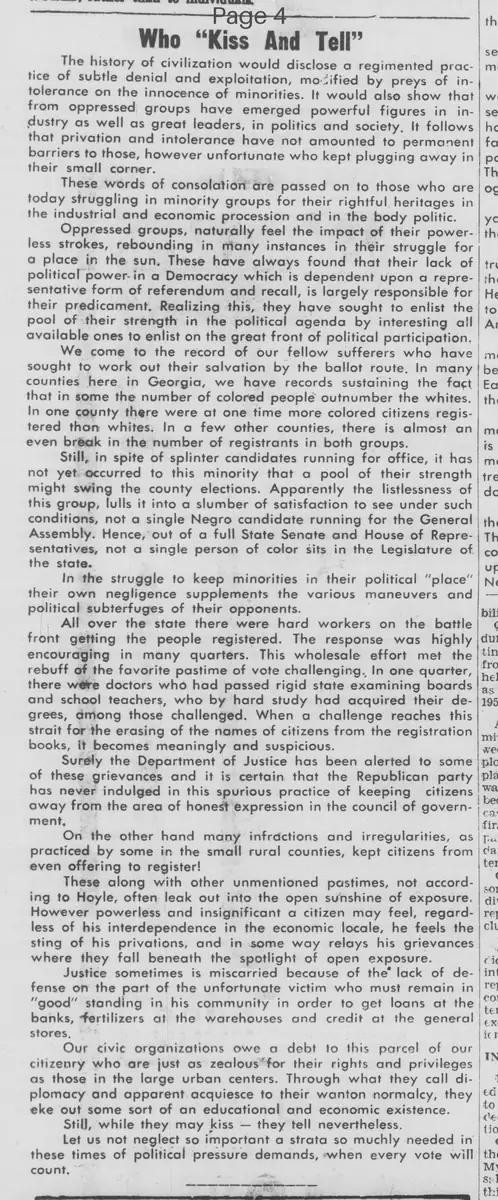
Who "Kiss And Tell"
The history of civilization would disclose a regimented practice of subtle denial and exploitation, modified by preys of intolerance on the innocence of minorities. It would also show that from oppressed groups have emerged powerful figures in industry as well as great leaders, in politics and society. It follows that privation and intolerance have not amounted to permanent barriers to those, however unfortunate who kept plugging away in their small corner.
These words of consolation are passed on to those who are today struggling in minority groups for their rightful heritages in the industrial and economic procession and in the body politic.
Oppressed groups, naturally feel the impact of their powerless strokes, rebounding in many instances in their struggle for a place in the sun. These have always found that their lack of political power-in a Democracy which is dependent upon a representative form of referendum and recall, is largely responsible for their predicament. Realizing this, they have sought to enlist the pool of their strength in the political agenda by interesting all available ones to enlist on the great front of political participation.
We come to the record of our fellow sufferers who have sought to work out their salvation by the ballot route. In many counties here in Georgia, we have records sustaining the fact that in some the number of colored people outnumber the whites. In one county there were at one time more colored citizens registered than whites. In a few other counties, there is almost an even break in the number of registrants in both groups.
Still, in spite of splinter candidates running for office, it has not yet occurred to this minority that a pool of their strength might swing the county elections. Apparently the listlessness of this group, lulls it into a slumber of satisfaction to see under such conditions, not a single Negro candidate running for the General Assembly. Hence, out of a full State Senate and House of Representatives, not a single person of color sits in the Legislature of the state.
In the struggle to keep minorities in their political "place" their own negligence supplements the various maneuvers and political subterfuges of their opponents.
All over the state there were hard workers on the battle front getting the people registered. The response was highly encouraging in many quarters. This wholesale effort met the rebuff of the favorite pastime of vote challenging. In one quarter, there were doctors who had passed rigid state examining boards and school teachers, who by hard study had acquired their degrees, among those challenged. When a challenge reaches this strait for the erasing of the names of citizens from the registration books, it becomes meaningfully and suspicious.
Surely the Department of Justice has been alerted to some of these grievances and it is certain that the Republican party has never indulged in this spurious practice of keeping citizens away from the area of honest expression in the council of government.
On the other hand many infractions and irregularities, as practiced by some in the small rural counties, kept citizens from even offering to register!
These along with other unmentioned pastimes, not according to Hoyle, often leak out into the open sunshine of exposure.
However powerless and insignificant a citizen may feel, regardless of his interdependence in the economic locale, he feels the sting of his privations, and in some way relays his grievances where they fall beneath the spotlight of open exposure.
Justice sometimes is miscarried because of the lack of defense on the part of the unfortunate victim who must remain in "good" standing in his community in order to get loans at the banks, fertilizers at the warehouses and credit at the general stores.
Our civic organizations owe a debt to this parcel of our citizenry who are just as zealous for their rights and privileges as those in the large urban centers. Through what they call diplomacy and apparent acquiesce to their wanton normalcy, they eke out some sort of an educational and economic existence.
Still, while they may kiss - they tell nevertheless.
Let us not neglect so important a strata so muchly needed in these times of political pressure demands, when every vote will count.
The history of civilization would disclose a regimented practice of subtle denial and exploitation, modified by preys of intolerance on the innocence of minorities. It would also show that from oppressed groups have emerged powerful figures in industry as well as great leaders, in politics and society. It follows that privation and intolerance have not amounted to permanent barriers to those, however unfortunate who kept plugging away in their small corner.
These words of consolation are passed on to those who are today struggling in minority groups for their rightful heritages in the industrial and economic procession and in the body politic.
Oppressed groups, naturally feel the impact of their powerless strokes, rebounding in many instances in their struggle for a place in the sun. These have always found that their lack of political power-in a Democracy which is dependent upon a representative form of referendum and recall, is largely responsible for their predicament. Realizing this, they have sought to enlist the pool of their strength in the political agenda by interesting all available ones to enlist on the great front of political participation.
We come to the record of our fellow sufferers who have sought to work out their salvation by the ballot route. In many counties here in Georgia, we have records sustaining the fact that in some the number of colored people outnumber the whites. In one county there were at one time more colored citizens registered than whites. In a few other counties, there is almost an even break in the number of registrants in both groups.
Still, in spite of splinter candidates running for office, it has not yet occurred to this minority that a pool of their strength might swing the county elections. Apparently the listlessness of this group, lulls it into a slumber of satisfaction to see under such conditions, not a single Negro candidate running for the General Assembly. Hence, out of a full State Senate and House of Representatives, not a single person of color sits in the Legislature of the state.
In the struggle to keep minorities in their political "place" their own negligence supplements the various maneuvers and political subterfuges of their opponents.
All over the state there were hard workers on the battle front getting the people registered. The response was highly encouraging in many quarters. This wholesale effort met the rebuff of the favorite pastime of vote challenging. In one quarter, there were doctors who had passed rigid state examining boards and school teachers, who by hard study had acquired their degrees, among those challenged. When a challenge reaches this strait for the erasing of the names of citizens from the registration books, it becomes meaningfully and suspicious.
Surely the Department of Justice has been alerted to some of these grievances and it is certain that the Republican party has never indulged in this spurious practice of keeping citizens away from the area of honest expression in the council of government.
On the other hand many infractions and irregularities, as practiced by some in the small rural counties, kept citizens from even offering to register!
These along with other unmentioned pastimes, not according to Hoyle, often leak out into the open sunshine of exposure.
However powerless and insignificant a citizen may feel, regardless of his interdependence in the economic locale, he feels the sting of his privations, and in some way relays his grievances where they fall beneath the spotlight of open exposure.
Justice sometimes is miscarried because of the lack of defense on the part of the unfortunate victim who must remain in "good" standing in his community in order to get loans at the banks, fertilizers at the warehouses and credit at the general stores.
Our civic organizations owe a debt to this parcel of our citizenry who are just as zealous for their rights and privileges as those in the large urban centers. Through what they call diplomacy and apparent acquiesce to their wanton normalcy, they eke out some sort of an educational and economic existence.
Still, while they may kiss - they tell nevertheless.
Let us not neglect so important a strata so muchly needed in these times of political pressure demands, when every vote will count.
What sub-type of article is it?
Suffrage
Social Reform
Partisan Politics
What keywords are associated?
Minority Rights
Voting Participation
Georgia Politics
Voter Registration
Vote Challenging
Political Power
Democracy
Ballot Route
Negro Candidates
Electoral Reform
What entities or persons were involved?
Colored People
Negroes
Department Of Justice
Republican Party
Georgia Counties
Editorial Details
Primary Topic
Encouragement For Minority Political Participation In Georgia
Stance / Tone
Supportive Of Minority Voting Rights And Critical Of Suppression
Key Figures
Colored People
Negroes
Department Of Justice
Republican Party
Georgia Counties
Key Arguments
Oppressed Minorities Have Risen To Power Despite Barriers
Lack Of Political Power Hinders Minority Progress In Democracy
In Some Georgia Counties, Colored People Outnumber Whites In Registration
Minorities Fail To Pool Votes To Influence Elections
No Negro Candidates Or Representatives In Georgia Legislature
Vote Challenging Targets Educated Minorities Suspiciously
Republican Party Does Not Engage In Voter Suppression
Irregularities Prevent Registration In Rural Counties
Citizens Relay Grievances Despite Economic Dependencies
Civic Organizations Should Support Rural Minorities' Rights