Thank you for visiting SNEWPapers!
Sign up free
The Enquirer
Richmond, Henrico County, Virginia
What is this article about?
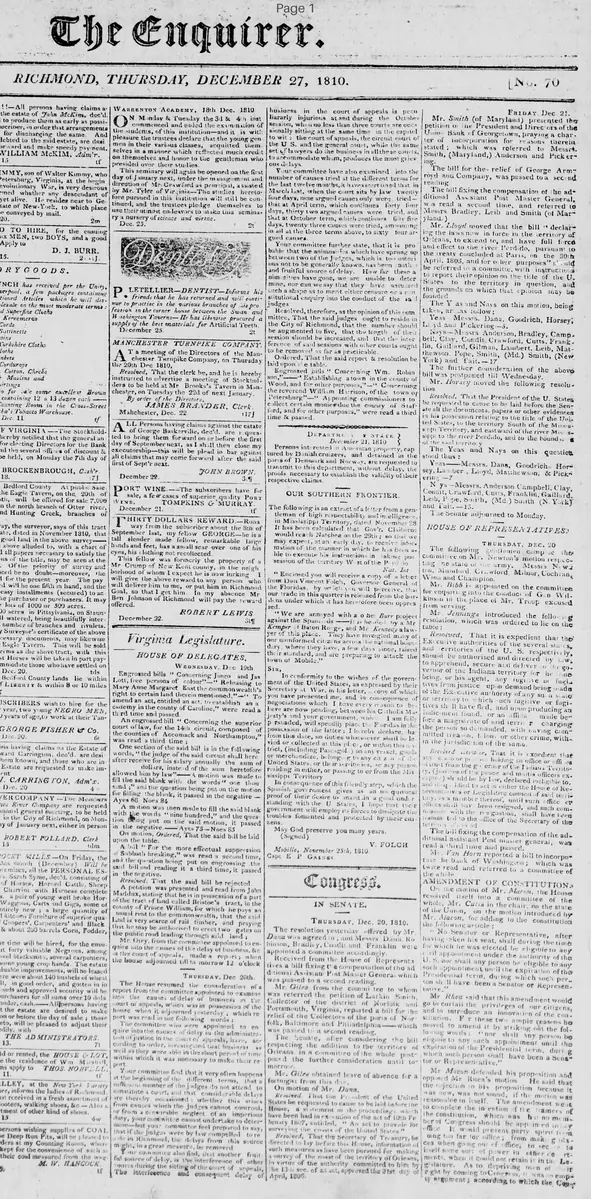
Proceedings of the U.S. Senate and House of Representatives on December 20-21, 1810, covering resolutions on coastal surveys, petitions for relief and charters, bills on postmaster compensation and territorial extensions, debates on a constitutional amendment restricting congressional members from civil appointments, and various other legislative matters including hemp culture and bank charters.
Merged-components note: Continuation of federal Congress proceedings across pages, including Senate and House discussions on bills and constitutional amendment.
Clippings
1 of 2
OCR Quality
Full Text
IN SENATE.
THURSDAY. Dec. 20. 1810.
The resolution yesterday offered by Mr. Dana was agreed to, and Messrs. Dana, Robinson, Bradley, Condit and Franklin were appointed a committee accordingly.
Received from the House of Representatives a bill fixing the compensation of the additional Assistant Post Master General which was passed to a second reading.
Mr. Giles, from the committee to whom was referred the petition of Larkin Smith, Collector of the district of Norfolk and Portsmouth, Virginia, reported a bill for the relief of the Collectors of the ports of Norfolk, Baltimore and Philadelphia—which was passed to a second reading.
The Senate, after considering the bill respecting the addition to the territory of Orleans in a Committee of the whole postponed the further consideration until to-morrow.
Mr. Giles obtained leave of absence for a fortnight from this day.
On motion of Mr. Dana.
Resolved That the President of the United States be requested to cause to be laid before the House, a statement of the proceedings, which have been had in execution of the act of 10th February 1807, entitled, "An act to provide for surveying the coasts of the United States"
Resolved, That the Secretary of the Treasury, be directed to lay before this House, information of such measures as have been pursued for making survey of the coast of the territory of Orleans, in virtue of the authority committed to him by the 13th sec. of an act, approved the 1st day of April, 1806.
FRIDAY. Dec. 21.
Mr. Smith (of Maryland) presented the petition of the President and Directors of the Union Bank of Georgetown, praying a charter of incorporation for reasons therein stated: which was referred to Messrs. Smith, (Maryland,) Anderson and Pickering
The bill for the relief of George Armroyd and Company, was passed to a second reading
The bill fixing the compensation of the additional Assistant Post Master General, was read a second time, and referred to Messrs. Bradley, Leib and Smith (of Maryland.)
Mr. Lloyd moved that the bill "declaring the laws now in force in the territory of Orleans, to extend to, and have full force and effect to the river Perdido, pursuant to the treaty concluded at Paris, on the 30th April, 1803, and for other purposes" should be referred to a committee, with instructions to report their opinion on the title of the U. States to the territory in question, and the grounds on which that opinion may be founded
The Yeas and Nays on this motion, being taken, are as follow:
Yeas Messrs. Dana, Goodrich, Horsey, Lloyd and Pickering—5.
Nays—Messrs. Anderson, Bradley, Campbell, Clay, Condit, Crawford, Cutts, Franklin, Gaillard, Gilman, Lambert, Leib, Matthews, Pope, Smith, (Md.) Smith, (N. Y.) and Tait.—17
The further consideration of the above bill was postponed till Wednesday.
Mr. Horsey, moved the following resolution.
Resolved, That the President of the U. States be requested to cause to be laid before the Senate all the documents, papers or other evidences in his possession relating to the title of the United States, to the territory South of the Mississippi Territory, and eastward of the river Mississippi: to the river Perdido, and to the boundaries of the said territory
The Yeas and Nays on this question stood thus:
Yeas—Messrs. Dana, Goodrich, Horsey, Lambert, Lloyd, Matthewson, & Pickering—7
Nays—Messrs. Anderson, Campbell, Clay, Condit, Crawford, Cutts, Franklin, Gaillard, Leib, Pope, Smith, (Md.) Smith (N. Y.) and Tait.—15.
The Senate adjourned to Monday.
HOUSE OF REPRESENTATIVES:
THURSDAY. Dec. 20
The following gentlemen compose the committee on Mr. Newton's motion respecting the state of the army. Messrs. Newton, Mumford, Crawford, Milnor, Cochran, Winn and Champion.
Mr. Bibb is appointed on the committee for enquiring into the Conduct of Gen. Wilkinson in the place of Mr. Troup excused from serving
Mr. Jennings introduced the following resolution, which was ordered to lie on the table:
Resolved, That it is expedient that the Executive authorities of the several states, and territories of the U. S. respectively, should be authorised and directed by law: to apprehend, secure and deliver over to the governor of the Indiana territory for the time being, or his agent, any fugitive or fugitives from justice upon demand being made of the Executive authority of any such state or territory to which such fugitive or fugitives shall have fled, and upon producing an indictment found, or an affidavit made before a magistrate of said territory, charging the person so demanded, with having committed treason, felony or other crime, within the jurisdiction of the said.
Resolved likewise, That it is expedient that any person or persons holding an office or offices of trust from the governor of the Indiana Territory, (justices of the peace and militia officers excepted) should be by law, declared ineligible to, and disqualified to act in either the House of Representatives or Legislative council of said territory, as a member thereof, until such office or offices shall have been resigned, and such commission with the resignation, shall have been transmitted to the office of the Secretary of the territory does ad
The bill fixing the compensation of the additional assistant Post master general, was read a third time and passed.
Mr. Van Horn reported a bill to incorporate the bank of Washington; which was twice read and referred to a committee of the whole
AMENDMENT OF CONSTITUTION:
On the motion of Mr. Macon, the House resolved itself into a committee of the whole, Mr. Cutts in the chair, on the state of the Union, on the motion introduced by Mr. Macon, for adding to the constitution the following article:
"No Senator or Representative, after having taken his seat, shall during the time for which he was elected be eligible to any civil appointment under the authority of the U. S. nor shall any person be eligible to any such appointment until the expiration of the Presidential term, during which such person shall have been a Senator or Representative."
Mr. Rhea said that this amendment would go to curtail the privileges of our citizens, and to introduce an innovation of the constitution. For these two simple reasons he moved to amend it by striking out the following words: "nor shall any person be eligible to any such appointment until the expiration of the Presidential term, during which such person shall have been a Senator or Representative."
Mr. Macon defended his proposition and opposed Mr. Rhea's motion He said that the objection to his proposition because it was new, was not sound, if the motion was reasonable in itself. The amendment went to complete the intention of the framers of the constitution, which was his no member of Congress should be appointed to any office It would prevent party spirit from going too far for office; from making offices when going out of office, to secure to itself some sort of power in other departments, when it could not retain it in the Legislature. As to depriving men of their right by coming to Congress, it was an empty argument; according to which the Congress
The constitution deprived men of their right by prohibiting a member from holding an office whilst in that capacity, or from serving in any office created whilst he was a member. But in what respect would this restriction affect the community? Could not offices as well be filled out of Congress as in it? Congress had already legislated as far as in their power on this subject by passing a law to prevent contractors from holding a seat on this floor.
The independence of the Legislature was the object. If there was no covetousness of office, if human nature was perfect, we should want no laws. But laws have become necessary to check the frailties of our nature, and this provision would serve to repress the inordinate desire of man for office. Indeed, said he, it is almost as necessary to guard against a virtue as against a vice. Take the case of a man who has long been in Congress, whose worth all acknowledge, about to retire, and we know that he has not wherewithal to support himself—we should almost, forgetting our duty to the constitution, be willing to make a place expressly for him.
Mr. M. said, it appeared to him that nothing could be more incorrect, as related to the independence of the Legislature, than for men to be sitting here, knowing that when they retired they were to have an office. Knowing that they were to have it was not worse than wishing to have it; because in either case the independence of the expectant was destroyed. The practice of bestowing offices on members of the Legislature had already attained to an extent not before known. It was a practice pleasing to members, and it would grow.
Suppose any member wanted an appointment, and should go to his friends and get recommendations from twenty, thirty, or forty of them. Would it not operate almost as a command on the Executive, when he saw a majority of the Legislature declaring that this man ought to have an office? If he were to refuse he would soon feel the consequences.
Believing the purity of the Legislature to depend on the existence of such a provision as he had proposed, Mr. M. said he could not consent to strike it out. Every thing, said he, depends on the Legislature. Make the members of the Legislature office-hunters, and you make the nation so. If the Executive archives could be consulted, it would be seen that the applications for office in the nation at large had progressed much in the same proportion as those from the members of Congress. And is it not natural, sir, that the people who send a man to Congress, seeing him provided with a snug place would want the same thing?
I am willing to extend the principle; I am almost willing to go as far as upon the jury principles in trials for life. I am willing not only to exclude ourselves, but to exclude our kindred.
Could any thing be more mortifying, Mr. M asked than to see every little appointment in the nation given to the Legislature? To him it was a mortifying circumstance. He could mention names; but that it was always painful for him to do so. He had seen this practice growing with our growth; and, if not checked, it would come to be one of the greatest of evils. If the gentleman from Tennessee could demonstrate that there was such a poverty of talent in the nation, that, by the exclusion of members of Congress from office, the business of the nation would be arrested, he would vote for his motion; and not otherwise.
It had been said that the proposed amendment to the constitution, went to deprive the citizen of his right. It appeared to Mr. Macon, that this right of office was not a good thing. He knew that no man in the House was farther from office hunting than the gentleman who made the motion—his remark applied to the subject, and had no particular application to men.
If experience had not convinced gentlemen that something wanted doing, he despaired of convincing them. He hoped the motion would not be agreed to.
Mr. Boyd said that of the Republican principles of the gentleman last up, he had no doubt; but these principles might be carried too far to support themselves. The gentleman's argument supposed that the ability of those persons sent here being known to the president, they therefore ought not to be appointed to office. The argument was, because a person was recommended to office by the best men in the nation, he ought therefore not to be appointed. It went upon the supposition that the President, an officer chosen from the people for his superior virtue, would appoint venally.
But let us beware, said Mr. B. of tinkering the constitution. From the very innovation which the amendment proposes, I should oppose it; because it is necessary to the life and vigor of the constitution that we meddle with it as little as possible. By so frequently altering the constitution, we shall keep the people in a perpetual ferment, not knowing whether they have a polar star or not.
Mr. Burwell considered the part proposed to be struck out as the most valuable part of the amendment. If that were struck out, there would be hardly any part of it worth retaining. This question, he said, was particularly fortunate for those composing the majority of Congress. It furnished them an opportunity to convince the world at large, that they were not governed by mercenary motives; that the course they pursued was dictated by their judgment alone. What could tend more to reconcile all parties in the nation, than a perfect confidence that no sinister motives governed the vote of any member of this House? And who would charge any member with corrupt motives when the constitution had precluded him from office?
This was indeed an occasion at which gentlemen ought to rejoice, as it would shew the disinterestedness with which they supported the present or future President of the United States; and that, in giving their suffrage for a President, they were not influenced by interested motives. Mr. B was willing himself to give this pledge.
The objection of the gentleman from Tennessee that this provision would abridge the privileges of the members, was entitled to very little weight indeed. The constitution had already in this way abridged their privileges. It had already disqualified the members of Congress in a certain degree from holding office; this proposition merely went to extend the principle. The strength of a government like this depends in a great degree on the confidence of the people in the administration for the time being. He trusted that a majority of this House would prove to the people and to the world, that they were governed by the purest motives. He called the attention of the House to the British government. Was it not notorious, he asked, that whoever was prime minister, could always command a majority in Parliament? Had it not been frequently seen that men one day in a small minority, could the next day, when raised to office, wield a majority of the same men as had before opposed them?
What did this arise from? Was it not from the influence of the Treasury, not only on the borough part of the House of Commons, but on that part elected by the people themselves, the government in the latter case acting not only on the Representative, but on the people whom he represented?
This example shewed the importance of guarding at as early day against a similar corruption here.
There was but a single objection, in the opinion of Mr. B. to the adoption of the resolution—that gentlemen who were members of the House, whose talents & personal deportment might be known to the Executive, might advantageously be selected to office. But could the Executive have a thorough knowledge of such persons? Were there not reasons to induce them to hide their real motives and character, and desiring office, to regulate every thing they said or did by their views to that object?
Mr. Burwell said, he had himself supposed that talents were dispersed in every part of the Union, and that nothing was more absurd than to suppose that only one individual in the nation was competent to fill any office.
Characters for office might be found in every part of the nation equally as fit and well qualified as those who came here. Another consideration had great weight with him. However the constitution might have guarded against the influence of members of Congress, it was nevertheless a fact that members, from their situation and knowledge of the nation at large had more influence than any individuals scattered through the country. There were few men of so much celebrity, so great talents, whose transcendent worth were so generally acknowledged that they were extensively known through the community.
There was scarcely an individual, that had not been in Congress, that was known out of the state in which he resided. What was more important, he asked, in the selection of a person to fill the Chief Magistracy, than to make the members of Congress as impartial as possible, and to induce them to enquire accurately into the character of the person proposed for that high office.
This was a time, in his opinion, when they should fortify themselves against the danger apprehended, and justly apprehended, by the gentleman from N Carolina. Mr. B. said he hoped there was virtue enough in this House to sanction this principle, although the gentleman from Tennessee supposed it would abridge the privileges of the citizen. It was a principle which might secure the purity of this House for many years to come. He hoped therefore the amendment would not succeed.
Mr. Rhea said he felt himself under considerable obligations to the gentleman from North Carolina for exempting him from the charge of office-hunting. He did not know that he should ever ask for or hold an office under the government; but that would not prevent him from saying what he thought on this subject. A material objection against this proposition was one which had not yet been noticed. If it became a part of the constitution, it would constantly create a powerful league among influential citizens against the President of the United States, combined to get him out as soon as possible. The framers of the constitution had completed this matter, as far as necessary, by declaring that no member of congress should be eligible to any office created or the emoluments whereof had been raised during the time for which he was elected. He had no objections to that part of the resolution which went on that ground; but he believed it should be with serious deliberation that any thing like the remainder of the proposition was adopted.
He was willing, without sacrificing his ideas of propriety and expediency, to leave to the world to judge of the propriety of his motives. The vote on this proposition would be but a bad criterion. His conduct should be judged by his votes in general, and not on this proposition. If such a vote as this was to purify all bad qualities, the Legislature which had taken the head of Charles the 1st, alluded to by the gentleman from N. C. might have passed this vote, and thus absolved themselves of the wrong they had done. If they went on in this way altering the constitution, its form would in time be so much changed that the people would not recognize it. Instead of strengthening the principles of freedom, they might be frittered away till they were lost in chaos.
Amendments ought to be made with a sparing hand. In the opinion of Mr. Rhea the present mode of election secured the purity of the House as far as the gentleman could desire. There were but two states in the Union, in which Representatives were not elected long before their term of service commenced; during the whole of which time of probation they were excluded from office.
Mr. Smilie made some observations favorable to the motion of Mr. Macon. He thought the purity of the representative body was essential to the existence of the government; that the exclusion from office established by the constitution was not sufficient, the abuses now being nearly as great as if no such exclusion existed—for there was but little difference in principle between a man's accepting an office, while a member, and his expecting to receive it at the end of the years he had to serve.
The motion of Mr. Rhea was negatived, Ayes 12.
Mr. Bacon suggested some amendment in the phraseology of the resolution; and doubts existing on the subject—
On motion, the committee rose, and the resolution was, on the suggestion of Mr. Sheffey, referred to a select committee, with directions to report their opinion thereon.
The resolution was then, referred to a select committee composed of Messrs. Macon, Burwell, Bacon, Sheffey and Mitchill.
Mr. Bassett reported a bill for incorporating the Protestant Episcopal Church of Alexandria.—Twice read and committed.
Friday Dec. 21.
Mr. Jones and Mr. Clopton took their seats.
Mr. M'Kinley, the member chosen in the place of Mr. John G. Johnson resigned, appeared, was qualified, and took his seat.
Mr. Gardner moved that the petition of the inhabitants of Nantucket, praying that it be made a port of entry for vessels trading beyond the Cape of Good Hope presented at the last session, be referred to the committee of Commerce and Manufactures. Agreed to.
Mr. Poindexter introduced several petitions respecting lands in the Mississippi territory: which were referred to the committee on public lands.
Mr. Southard introduced the following resolution, which was agreed to:
Resolved, that a committee be appointed to enquire into the propriety of passing a law to prescribe the mode of taking evidence in contested elections, for members of the House of Representatives of the United States, and to compel the attendance of witnesses, and that the committee have leave to report by bill or otherwise.
Mr. Seybert presented the petition of sundry merchants of Philadelphia, praying relief from the operation of the non-intercourse law. Referred to the committee on foreign relations.
CULTURE OF HEMP.
Mr. Sheffey remarked that the interruption of commerce to the Baltic had given a spring to the culture of hemp in this country, which would be much relaxed if the commerce should be opened. He was, he said, one of those who had always considered the encouragement of agriculture as one of the first objects of a good government. He therefore proposed, with a view to ascertain how far it was proper to encourage the culture of hemp, to offer a resolution to enquire into the subject.
He did not know how far it would be proper to adopt the measure which he contemplated; he was not advised whether the culture in the U S. was sufficient for the consumption. If so, he should feel disposed to restrict the importation from abroad.
The Committee of Commerce and Manufactures would be best able to ascertain how far it was proper to protect the culture of our own raw material. He therefore submitted the following resolution:
Resolved That the committee of Commerce and Manufactures be instructed to enquire into the expediency of encouraging the culture of hemp, by protecting impost duties, or prohibiting the importation of that article into the U. States, and that the committee have leave to report by bill or otherwise.
Mr. Mitchill said he had no inclination to oppose the passage of the resolution, its object being merely to enquire; and resolutions for enquiry, generally speaking, were those which, of all others, the House ought to pass. He would just mention, however, his perfect conviction that the resources for the supply of this article were ample, and that enough could be raised on the Genessee flats and Wallkill river in the state of New York, to supply the north, and in the state of Kentucky, to supply the south. The interruption of commerce with the Baltic, created an extraordinary price, which was bounty enough for the present. How far it might be necessary to extend the principle during free commerce, he did not say.
The resolution was agreed to without a division.
Mr. Van Horn presented the memorial of the United Wabash and Illinois Company, stating, that they purchased certain lands from the Indians in the year 1773, and praying from the U.S. a confirmation of their title to such part of the same as Congress shall deem expedient. Mr. Van Horn moved to refer the memorial to the committee of Public Lands.
Mr. M'Kee objected to the reference on the ground that it was a subject on which Congress had frequently legislated, and had shewn their indisposition to comply with the wishes of the memorialists; and that it therefore would be a waste of time to refer a petition on the principle of which the House had so frequently decided.
Mr. Van Horn replied, that the right of petition was one which was secured to every citizen by the constitution; and that the House was bound to listen to their prayers; that this was a subject of great importance to the petitioners, and their claim was one which a committee of Congress had so far recognized in 1791, as to recommend a compromise of it. Besides the reference of every petition was a matter of course.
The reference proposed was agreed to.
On motion of Mr. Jennings, the House took up for consideration the resolution offered by him yesterday.
On the suggestion of Messrs. Quincy & Pearson, the resolution was so varied as to refer the subject to a select committee, with a view to embrace an enquiry into the general state of the laws relative to fugitives from justice; which it now stated, were very defective.
The resolution was so referred.
The bill for the relief of George Armroyd & Co. was read a third time and passed.
BANK OF ALEXANDRIA.
On motion of Mr. Van Horn, the House resolved itself into a committee of the whole, 44 to 43, Mr. Desha in the Chair, on the bill to continue the charter of the Bank of Alexandria. A desultory discussion arose on the bill, it being objected to it that it barely recited the title of the law which it was proposed to continue, without specifying any of its provisions; and that a law on such a subject, giving exclusive privileges to a corporate body, should be enacted with the greatest precision and caution.
After an hour's discussion, in which Messrs. Love, Taylor, Munroe, Van Horn, Quincy, Tallmadge, Bacon, Smilie & Lewis partook; on motion of Mr. Taylor, the committee rose and reported progress; and leave to sit again being refused, the bill was re-committed to the committee on the District of Columbia.
On motion of Mr. Eppes, the House resolved itself into a committee of the whole, Mr. Cutts in the Chair, on the bill making up the deficiency in the appropriation of 1810, for the relief of distressed American seamen in foreign countries. After some detailed statements from Mr. Eppes of the objects of this expenditure, the blank in the bill for the appropriation was filled with $75,559 89 cents.
The committee rose and reported the bill, which was ordered to be engrossed for a third reading.
MEDITERRANEAN FUND.
On motion of Mr. Eppes the House resolved itself into a Committee of the whole, Mr. Bassett in the chair, on the bill for continuing in force the first section of the act entitled "An act further to protect the commerce and seamen of the U.S. against the Barbary powers."
The committee rose and reported the bill without amendment, which was passed to a third reading without opposition.
On motion of Mr. Bacon,
Resolved, That the Secretary of the Treasury be directed to lay before this House a statement of all such sums as may have been paid to the Consuls, Vice Consuls and Commercial Agents or Vice Commercial Agents of the United States in foreign countries by the masters or commanders of American vessels for the purpose of constituting a fund for the relief of destitute American seamen in foreign parts, under the 3d section of the act "supplementary to the act concerning Consuls and Vice Consuls," passed 28th February, 1803.
What sub-type of article is it?
What keywords are associated?
What entities or persons were involved?
Where did it happen?
Domestic News Details
Primary Location
Washington
Event Date
Dec. 20 21, 1810
Key Persons
Event Details
The Senate and House of Representatives conducted proceedings including appointments to committees, receipt and referral of bills on postmaster compensation, relief for port collectors, territorial extensions to the river Perdido, coastal surveys, bank charters, and petitions; the House debated and referred a constitutional amendment proposed by Mr. Macon to restrict members from civil appointments post-service, with speeches by Messrs. Macon, Rhea, Boyd, Burwell, and others; resolutions on hemp culture, fugitives from justice, and other matters were introduced and referred.