Thank you for visiting SNEWPapers!
Sign up free
The Massachusetts Spy, And Worcester County Advertiser
Worcester, Worcester County, Massachusetts
What is this article about?
Count Rostopchin, Russian nobleman and former Governor of Moscow, died lately in Moscow. He is credited with ordering the city's destruction by fire during Napoleon's 1812 invasion to deny it to the French, leading to its devastation and the Emperor's retreat.
Clipping
OCR Quality
Full Text
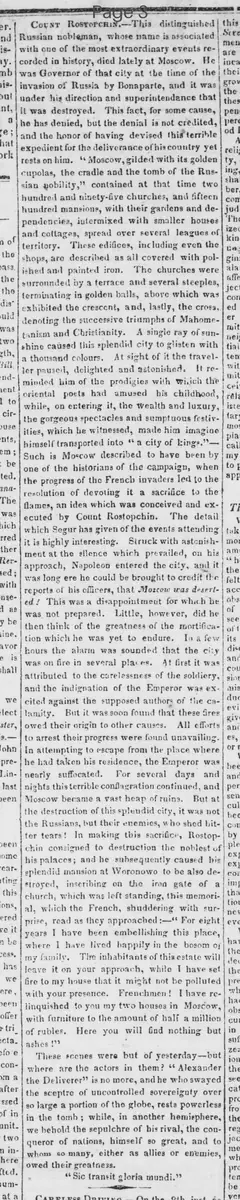
Such is Moscow described to have been by one of the historians of the campaign, when the progress of the French invaders led to the resolution of devoting it a sacrifice to the flames, an idea which was conceived and executed by Count Rostopchin. The detail which Segur has given of the events attending it is highly interesting. Struck with astonishment at the silence which prevailed, on his approach, Napoleon entered the city, and it was long ere he could be brought to credit the reports of his officers, that Moscow was deserted! This was a disappointment for which he was not prepared. Little, however, did he then think of the greatness of the mortification which he was yet to endure. In a few hours the alarm was sounded that the city was on fire in several places. At first it was attributed to the carelessness of the soldiery, and the indignation of the Emperor was excited against the supposed authors of the calamity. But it was soon found that these fires owed their origin to other causes. All efforts to arrest their progress were found unavailing. In attempting to escape from the place where he had taken his residence, the Emperor was nearly suffocated. For several days and nights this terrible conflagration continued, and Moscow became a vast heap of ruins. But at the destruction of this splendid city, it was not the Russians, but their enemies, who shed bitter tears! In making this sacrifice, Rostopchin consigned to destruction the noblest of his palaces; and he subsequently caused his splendid mansion at Woronowo to be also destroyed, inscribing on the iron gate of a church, which was left standing, this memorial, which the French, shuddering with surprise, read as they approached:—“For eight years I have been embellishing this place, where I have lived happily in the bosom of my family. The inhabitants of this estate will leave it on your approach, while I have set fire to my house that it might not be polluted with your presence. Frenchmen! I have relinquished to you my two houses in Moscow, with furniture to the amount of half a million of rubles. Here you will find nothing but ashes!”
These scenes were but of yesterday—but where are the actors in them? “Alexander the Deliverer” is no more, and he who swayed the sceptre of uncontrolled sovereignty over so large a portion of the globe, rests powerless in the tomb; while, in another hemisphere, we behold the sepulchre of his rival, the conqueror of nations, himself so great, and to whom so many, either as allies or enemies, owed their greatness.
“Sic transit gloria mundi.”
What sub-type of article is it?
What keywords are associated?
What entities or persons were involved?
Where did it happen?
Foreign News Details
Primary Location
Moscow
Event Date
Lately
Key Persons
Outcome
moscow destroyed by fire, becoming a vast heap of ruins; french forces suffered mortification and retreat; rostopchin's palaces and mansion also destroyed
Event Details
Count Rostopchin, Governor of Moscow during Bonaparte's invasion, died lately. He is credited with ordering the city's destruction by fire to prevent its use by the French. Napoleon entered the deserted city, then fires broke out, continuing for days and nights, nearly suffocating the Emperor. The conflagration turned Moscow into ruins, causing greater suffering to the invaders than the Russians.