Thank you for visiting SNEWPapers!
Sign up free
Editorial
May 18, 1859
Alexandria Gazette
Alexandria, Alexandria County, District Of Columbia
What is this article about?
The editorial, citing Sydney Smith, criticizes overeating as a common vice causing dyspepsia, financial waste, and societal harm, advocating moderation in diet for better health and self-control over appetites.
Clipping
OCR Quality
95%
Excellent
Full Text
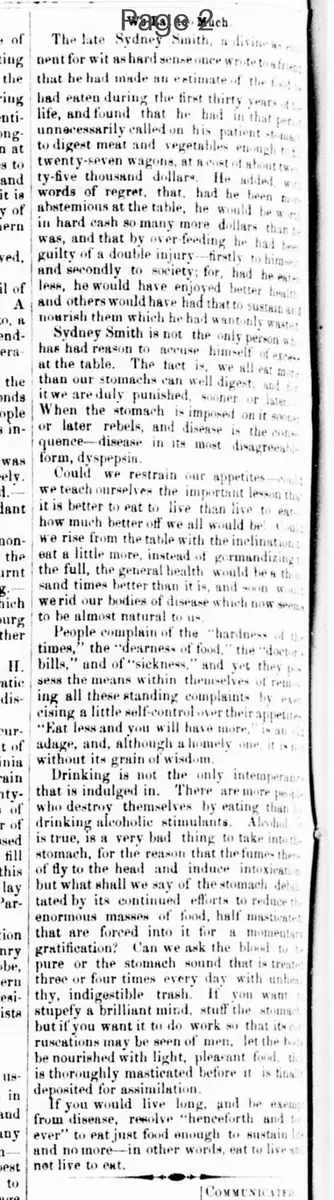
The late Sydney Smith, a divine eminent for wit as hard sense once wrote that he had made an estimate of the quantity of food he had eaten during the first thirty years of his life, and found that he had in that part unnecessarily called on his patient stomach to digest meat and vegetables enough: twenty-seven wagons, at a cost of about twenty-five thousand dollars. He added, in words of regret, that, had he been more abstemious at the table, he would be worth so many more dollars than he was, and that by over-feeding he had been guilty of a double injury—firstly to himself, and secondly to society; for, had he eaten less, he would have enjoyed better health and others would have had that to sustain and nourish them which he had wantonly wasted.
Sydney Smith is not the only person who has had reason to accuse himself of excess at the table. The fact is, we all eat more than our stomachs can well digest and we are duly punished, sooner or later. When the stomach is imposed on it sooner or later rebels, and disease is the consequence—disease in its most disagreeable form, dyspepsia.
Could we restrain our appetites—we teach ourselves the important lesson that it is better to eat to live than live to eat—how much better off we all would be. If we rise from the table with the inclination to eat a little more, instead of gormandizing till full, the general health would be a thousand times better than it is, and soon we would rid our bodies of disease which now seems to be almost natural to us.
People complain of the "hardness of the times," the "dearness of food," the "doctor bills," and of "sickness," and yet they possess the means within themselves of remedying all these standing complaints by exercising a little self-control over their appetites. Eat less and you will have more, is an adage, and, although a homely one it is not without its grain of wisdom.
Drinking is not the only intemperance that is indulged in. There are more people who destroy themselves by eating than by drinking alcoholic stimulants. Alcohol, it is true, is a very bad thing to take into the stomach, for the reason that the fumes thereof fly to the head and induce intoxication; but what shall we say of the stomach debilitated by its continued efforts to reduce enormous masses of food, half masticated, that are forced into it for a momentary gratification? Can we ask the blood to be pure or the stomach sound that is treated three or four times every day with unwholesome, indigestible trash. If you want to stupefy a brilliant mind, stuff the stomach; but if you want it to do work so that its productions may be seen of men, let the body be nourished with light, pleasant food that is thoroughly masticated before it is hit deposited for assimilation.
If you would live long, and be exempt from disease, resolve "henceforth and forever" to eat just food enough to sustain life and no more—in other words, eat to live and not live to eat.
Sydney Smith is not the only person who has had reason to accuse himself of excess at the table. The fact is, we all eat more than our stomachs can well digest and we are duly punished, sooner or later. When the stomach is imposed on it sooner or later rebels, and disease is the consequence—disease in its most disagreeable form, dyspepsia.
Could we restrain our appetites—we teach ourselves the important lesson that it is better to eat to live than live to eat—how much better off we all would be. If we rise from the table with the inclination to eat a little more, instead of gormandizing till full, the general health would be a thousand times better than it is, and soon we would rid our bodies of disease which now seems to be almost natural to us.
People complain of the "hardness of the times," the "dearness of food," the "doctor bills," and of "sickness," and yet they possess the means within themselves of remedying all these standing complaints by exercising a little self-control over their appetites. Eat less and you will have more, is an adage, and, although a homely one it is not without its grain of wisdom.
Drinking is not the only intemperance that is indulged in. There are more people who destroy themselves by eating than by drinking alcoholic stimulants. Alcohol, it is true, is a very bad thing to take into the stomach, for the reason that the fumes thereof fly to the head and induce intoxication; but what shall we say of the stomach debilitated by its continued efforts to reduce enormous masses of food, half masticated, that are forced into it for a momentary gratification? Can we ask the blood to be pure or the stomach sound that is treated three or four times every day with unwholesome, indigestible trash. If you want to stupefy a brilliant mind, stuff the stomach; but if you want it to do work so that its productions may be seen of men, let the body be nourished with light, pleasant food that is thoroughly masticated before it is hit deposited for assimilation.
If you would live long, and be exempt from disease, resolve "henceforth and forever" to eat just food enough to sustain life and no more—in other words, eat to live and not live to eat.
What sub-type of article is it?
Moral Or Religious
Social Reform
Temperance
What keywords are associated?
Overeating
Dyspepsia
Self Control
Intemperance
Diet Moderation
Health Reform
What entities or persons were involved?
Sydney Smith
Editorial Details
Primary Topic
Moderation In Eating To Avoid Disease And Waste
Stance / Tone
Moral Exhortation For Self Control In Diet
Key Figures
Sydney Smith
Key Arguments
Overeating Leads To Dyspepsia And Poor Health
Excess Consumption Wastes Resources That Could Benefit Society
Eating Less Improves Personal Wealth And Well Being
Intemperance In Eating Is More Destructive Than Drinking
Proper Mastication And Light Food Nourish The Mind And Body
Resolve To Eat Only Enough To Sustain Life