Thank you for visiting SNEWPapers!
Sign up free
Gazette Of The United States, & Philadelphia Daily Advertiser
Philadelphia, Philadelphia County, Pennsylvania
What is this article about?
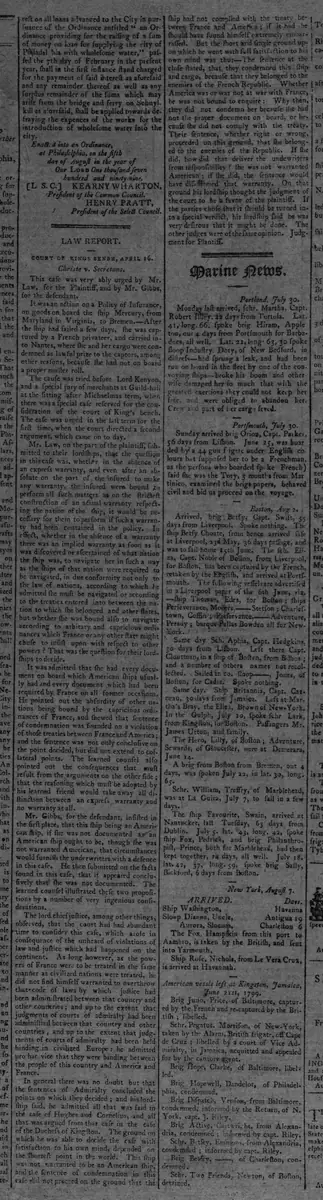
In the Court of King's Bench on April 16, the case Christie v. Secretan ruled in favor of the plaintiff on an insurance policy for goods on the ship Mercury, captured by a French privateer and condemned in Nantes due to lacking a proper muster roll, despite no express warranty of American nationality.
Clipping
OCR Quality
Full Text
COURT OF KING'S BENCH, APRIL 16.
Christie v. Secretan.
This case was very ably argued by Mr.
Law, for the Plaintiff, and by Mr. Gibbs,
for the defendant.
It was an action on a Policy of Insurance,
on goods on board the ship Mercury, from
Maryland in Virginia, to Bremen. After
the ship had sailed a few days, she was captured by a French privateer, and carried into Nantes, where she and her cargo were condemned as lawful prize to the captors, among
other reasons, because she had not on board
a proper muster roll.
The cause was tried before Lord Kenyon,
and a special jury of merchants at Guildhall
at the sitting after Michaelmas term, when
there was a special case reserved for the consideration of the court of King's bench.
The case was argued in the last term for the
first time, when the court directed a second
argument, which came on this day.
Mr. Law, on the part of the plaintiff, submitted to their lordships, that the question
in this case was, whether in the absence of
an express warranty, and even after an absolute opinion on the part of the insured to make
any warranty, the insured were bound to
perform all such matters as on the strictest
construction of an actual warranty respecting the navigation of the ship, it would be necessary for them to perform if such a warranty had been contained in the policy. In
effect, whether in the absence of a warranty
there was an implied warranty as soon as it
was discovered or ascertained of what nation
the ship was, to navigate her in such a way
as the ships of that nation were required to
be navigated, in due conformity not only to
the law of nations, according to which she
must be navigated or according to the treaties entered into between the nation to which she belonged and other states.
but whether she was bound also to navigate
according to arbitrary and capricious ordinances which France or any other state might
choose to insist upon with respect to other
powers? That was the question for their lordships to decide.
It was admitted that she had every document on board which American ships usually
had and every document which had been
required by France on all former occasions.
He pointed out the absurdity of other nations being bound by the capricious ordinances of France, and shewed that sentence
of condemnation was founded on a violation
of those treaties between France and America;
and the sentence was not only conclusive on
the point decided, but did not extend to collateral points. The learned counsel also
pointed out the consequences that must
result from the arguments on the other side:
that the reasoning which must be adopted by
his learned friend would take away all distinction between an express warranty and
no warranty at all.
Mr. Gibbs, for the defendant, insisted in
the first place, that this ship being an American ship, if she was not documented as an
American ship ought to be, though she was
not warranted American, that circumstance
would furnish the underwriters with a defence
in this case. He then submitted on the facts
found in this case, that it appeared conclusively that she was not documented. The
learned counsel illustrated these two propositions by a number of very ingenious considerations.
The Lord Chief Justice, among other things,
observed, that the court had had abundant
time to consider this case, which arose in
consequence of the unheard of violations of
law and justice which had happened on the
continent. As long however, as the powers
of France were to be treated in the same
manner as civilized nations were treated, he
did not find himself warranted to overthrow
that code of laws by which justice had
been administered between that country and
other countries; and up to the extent that
judgments of courts of admiralty had been
administered between that country and other
countries, and up to the extent that judgments of courts of admiralty had been held
binding in civilized Europe: he admitted
pro hac vice that they were binding between
the people of this country and America and
France.
In general there was no doubt but that
the sentences of Admiralty concluded the
points on which they decided; and his lordship said, he admitted all that was said in
the case of Hughes and Cornelius, and all
that was argued from that case in the case
of the Duchess of Kingston. The ground on
which he was able to decide the case with
satisfaction to his own mind, depended on
the shortest point in the world. This ship
was not warranted to be an American ship,
and the sentence of condemnation in this
case had not proceeded on the ground that the
ship had not complied with the treaty between France and America; if it had he
should have found himself extremely embarrassed. But the short and single ground upon which he went with full satisfaction to his
own mind was thus The sentence at the
close stated, that they condemned this ship
and cargo, because that they belonged to the
enemies of the French Republic. Whether
America was or was not at war with France,
he was not bound to enquire: Why then,
they did not condemn her because she had
not the proper document on board, or because she did not comply with the treaty.
Their sentence, whether right or wrong,
proceeded on this ground, that she belonged
to the enemies of the Republic. If she
did, how did that deliver the underwriters
from responsibility? she was not warranted
American'; if she did, the sentence would
have disaffirmed that warranty. On that
ground his lordship thought the judgment of
the court to be in favor of the plaintiff. If
the parties chose that it should be turned into a special verdict, his lordship said he was
very desirous that it might be done. The
other judges were of the same opinion. Judgment for Plaintiff.
What sub-type of article is it?
What keywords are associated?
What entities or persons were involved?
Where did it happen?
Foreign News Details
Primary Location
Nantes
Key Persons
Outcome
ship mercury and cargo condemned as lawful prize in nantes; judgment for plaintiff in insurance case.
Event Details
The ship Mercury, sailing from Maryland in Virginia to Bremen, was captured by a French privateer shortly after departure and taken to Nantes, where condemned for lacking a proper muster roll among other reasons. The Court of King's Bench ruled in favor of the insured plaintiff, as the ship was not warranted American and the condemnation was based on enemy ownership rather than treaty violations.