Thank you for visiting SNEWPapers!
Sign up free
Richmond Palladium
Richmond, Wayne County, Indiana
What is this article about?
General Winfield Scott reports the siege and bombardment of Vera Cruz, Mexico, from March 23-29, 1847, involving U.S. army and navy forces under Commodore Perry. After effective artillery fire, the city and San Juan de Ulloa castle capitulated, with Mexican garrison surrendering as prisoners.
Merged-components note: Continuation of Gen. Scott's report on the capitulation of Vera Cruz.
Clipping
OCR Quality
Full Text
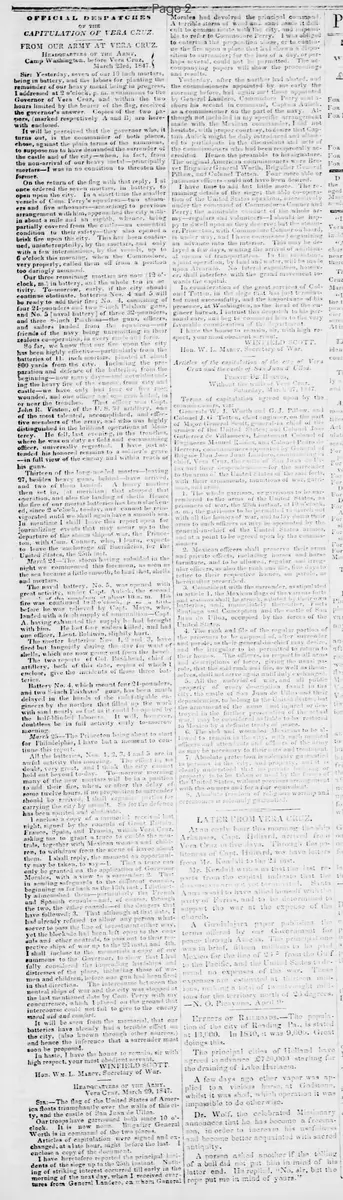
FROM OUR ARMY AT VERA CRUZ.
HEADQUARTERS OF THE ARMY,
Camp Washington, before Vera Cruz,
March 23rd, 1847.
Sir: Yesterday, seven of our 10 inch mortars,
being in battery, and the labors for planting the
remainder of our heavy metal being in progress,
I addressed at 2 o'clock, p. m. a summons to the
Governor of Vera Cruz, and within the two
hours limited by the bearer of the flag, received
the governor's answer. Copies of the two pa-
pers, (marked respectively A and B, are here-
with enclosed.
It will be perceived that the governor who, it
turns out, is the commander of both places,
chose, against the plain terms of the summons,
to suppose me to have demanded the surrender of
the castle and of the city—when, in fact, from
the non-arrival of our heavy metal—principally
mortars—I was in no condition to threaten the
former.
On the return of the flag with that reply. I at
once ordered the seven mortars, in battery, to
open upon the city. In a short time the smaller
vessels of Com. Perry's squadron—two steam-
ers and five schooners—according to previous
arrangement with him, approached the city with-
within about a mile and an eighth, whence, being
partially covered from the castle—an essential
condition to their safety—they also opened a
brisk fire upon the city. This has been contin-
ued, uninterruptedly, by the mortars, and only
with a few intermissions, by the vessels, up to
6 o'clock this morning, when the Commodore,
very properly, called them off from a position
too daringly assumed.
Our three remaining mortars are now (1 o'-
clock, m.) in battery, and the whole ten in ac-
tivity. To-morrow, early, if the city should
continue obstinate. batteries Nos. 4 and 5 will
be ready to add their fire; No. 4, consisting of
four 24-pounders and two 8-inch Paixhan guns,
and No.5 [naval battery] of three 32-pounders,
and three 8-inch Paixhans—the guns, officers,
and sailors landed from the squadron—our
friends of the navy being unremitting in their
zealous co-operation, in every mode and form.
So far, we know that our fire upon the city
has been highly effective—particularly from the
batteries of 10 inch mortars, planted at about
800 yards from the city. Including the pre-
paration and defence of the batteries, from the
beginning—now many days—and notwithstanding
the heavy fire of the enemy, from city and
castle—we have only had four or five men
wounded, and one officer or man killed, in
or near the trenches. That officer was Capt.
John R. Vinton, of the U. S. 3d artillery. one
of the most talented, accomplished, and effec-
tive members of the army, and who was highly
distinguished in the brilliant operations at Mon-
terey. He fell, last evening, in the trenches,
where he was on duty as field and commanding
officer, universally regretted. I have just at-
tended his honored remains to a soldier's grave
—in full view of the enemy and within reach of
his guns.
Thirteen of the long-range mortars—leaving
27, besides heavy guns, behind—have arrived.
and two of them landed. A heavy norther
then set in, (at meridian) that stopped that
operation, and also the landing of shells. Hence
the fire of our mortar batteries has been slacken-
ed, since 2 o'clock, to-day, and cannot be rein-
vigorated until we shall again have a smooth sea.
In meantime I shall leave this report open for
journalizing events that may occur up to the
departure of the steam ship-of war, the Prince-
ton, with Com. Conner, who, I learn, expects
to leave the anchorage off Sacrificios, for the
United States, the 25th inst.
March 24—The storm having subsided in the
night we commenced this forenoon, as soon as
the sea became a little smooth, to land shot, shells
and mortars.
The naval battery, No. 5, was opened with
great activity, under Capt. Aulick, the second
in command of the squadron at about 9 a. m. Its
fire was continued to 4 o'clock p. m. a little
before he was relieved by Capt. Mayo, who,
landed with a fresh supply of ammunition—Capt.
A. having exhausted the supply he had brought
with him. He lost four sailors killed, and had
one officer, Lieut. Baldwin, slightly hurt.
The mortar batteries Nos. 1, 2 and 3, have
fired but languidly during the day for want of
shells, which are now going out from the beach.
The two reports of Col. Bankhead, chief of
artillery, both of this date, copies of which: I
enclose, give the incidents of those three bat-
teries.
Battery No. 4, which mounts four 24-pounders.
and two 8-inch Paixhans' guns, has been much
delayed in the hands of the indefatigable en-
gineers by the norther that filled up the work
with sand nearly as fast as it could be opened by
the half-blinded laborers. It will, however.
doubtless be in full activity early to-morrow
morning.
March 25—The Princeton being about to start
for Philadelphia. I have but a moment to con-
tinue this report.
All the batteries, Nos. 1, 2, 3. 4 and 5 are in
awful activity this morning. The effect is, no
doubt, very great, and I think the city cannot
hold out beyond to-day. To-morrow morning
many of the new mortars will be in a position
to add their fire, when, or after the delay of
some twelve hours, if no proposition to surrender
should be received, I shall organize parties for
carrying the city by assault. So far the defence
has been spirited and obstinate.
I enclose a copy of a memorial received last
night, signed by the consuls of Great Britain.
France, Spain, and Prussia, within Vera Cruz.
asking me to grant a truce to enable the neu-
trals, together with Mexican women and child-
ren. to withdraw from the scene of horrors about
then. I shall reply, the moment an opportuni-
ty may be taken, to say—1. That a truce can
only be granted on the application of Governor
Morales. with a view to a surrender: 2. That
in sending safeguards to the different consuls.
beginning as far back as the 18th inst, I distinct-
ly admonished them—particularly the French
and Spanish consuls—and, of course, through
the two, the other consuls—of the dangers that
have followed; 3. That although at this date, I
had already refused to allow any person what-
soever to pass the line of investment either way,
yet the blockade had been left open to the con-
suls and other neutrals, to pass on to their res-
pective ships of war up to the 22 inst.; and 4th.
I shall inclose to the memorials a copy of my
summons to the Governor, to show that I had
fully considered the impending hardships and
distresses of the place. including those of wo-
men and children, before one gun had been fired
in that direction. " The intercourse between the
neutral ships of war and the city was stopped at
the last mentioned date by Com. Perry with my
concurrence, which I plead on the ground that
intercourse could not fail to give to the enemy
moral aid and comfort.
It will be seen from the memorial, that our
batteries have already had a terrible effect on
the city. (also known through other sources.)
and hence the inference that a surrender must
soon be proposed.
In haste, I have the honor to remain, sir with
high respect, your most obedient servant.
WINFIELD SCOTT.
Hon. Wm. L. Marcy, Secretary of War.
HEADQUARTERS OF THE ARMY.
Vera Cruz, March 29. 1847.
Sir:—The flag of the United States of Amer-
ica floats triumphantly over the walls of this ci-
ty, and the castle of San Juan de Ulloa.
Our troops have garrisoned both since 10 o'-
clock. It is now noon. Brigadier General
Worth is in command of the two places.
Articles of capitulation were signed and ex-
changed, at a late hour, night before the last. I
enclose a copy of the document.
I have heretofore reported the principal inci-
dents of the siege up to the 25th instant. Noth-
ing of striking interest occurred till early in the
morning of the next day. when I received overtures from General Landero, on whom General
Morales had devolved the principal command.
A terrible storm of wind and sand made it difficult to communicate with the city, and impossible
to refer to Commodore Perry. I was obliged
to entertain the proposition alone. or to contin-
ue the fire upon a place that had shown a dispo-
sition to surrender; for the loss of a day, or per-
haps several, could not be permitted. The ac-
companying papers will show the proceedings
and results.
Yesterday. after the norther had abated, and
the commissioners appointed by me early the
morning before, had again met those appointed
by General Landero. Commodore Perry sent
shore his second in command, Captain Aulick,
as a commissioner on the part of the navy. Al-
though not included in my specific arrangement
made with the Mexican commander. I did not
hesitate, with proper courtesy. to desire that Cap-
tain Aulick might be duly introduced and allow-
ed to participate in the discussions and acts of
the commissioners who had been reciprocally ac-
credited Hence the preamble to his signature.
The original American commissioners were Bre-
vet Brigadier General Worth, Brigadier General
Pillow, and Colonel Totten. Four more able or
judicious officers could not have been desired.
I have time to add but little more. The re-
remaining details of the siege; the able co-operi-
tion of the United States squadron, successively
under the command of Commodores Conner and
Perry; the admirable conduct of the whole ar-
my—regulars and volunteers—I should be hap-
py to dwell upon as they deserve: but the steam-
er, Princeton, with Commodore Conner on board.
Is under way, and I have commenced organizing
an advance into the interior. This may be de-
layed a few days, waiting the arrival of artificial
means of transportation. In the meantime,
a joint operation, by land and water, will be made
upon Alvarado. No later expedition. however,
shall interfere with the grand movement to-
wards the capital.
In consideration of the great services of Col-
nel Totten, in the siege that has just terminated most successfully, and the importance of his
presence, at Washington, as the head of the en-
gineer bureau, I entrust this despatch to his per-
sonal care, and beg to commend him to the very
favorable consideration of the department
I have the honor to remain, sir, with high re-
spect, your most obedient servant,
WINFIELD SCOTT.
Hon. W. L. Marcy, Secretary of War.
Articles of the capitulation of the city of Vera
Cruz and the castle of San Juan de Ulloa.
INTE DE HOGAROS,
Without the walls of Vera Cruz.
Saturday, March 27, 1847.
Terms of capitulation agreed upon by the
commissioners, viz:
Generals W. J. Worth and G. J. Pillow. and
Colonel J. G. Totten. chief engineer, on the part
of Major General Scott, general-in-chief of the
armies of the United States; and Colonel Jos
Gutierrez de Villanuova, Lieutenant Colonel of
Engineers Manuel Reyes. and Colonel Pedro
Herrera, commissioners appointed by General of
Brigade Don Jose Juan Landero, commanding
chief, Vera Cruz, the castle of San Juan de U-
loa and their dependencies—for the surrender
to the arms of the United States of the said forts,
with their armaments, munitions of war, garri-
sons, and arms.
1. The whole garrison. or garrisons to be sur-
rendered to the arms of the United States, as
prisoners of war, the 29th instant, at 10 o'clock.
a. m.; the garrisons to be permitted to march out
with all the honors of war, and to lay down their
arms to such officers as may be appointed by the
general-in-chief of the United States armies,
and at a point to be agreed upon by the commis-
sioners
2. Mexican officers shall preserve their arms
and private effects, including horses and horse
furniture. and to be allowed, regular and irreg-
ular officers, as also the rank and file, five days to
retire to their respective homes, on parole, as
hereinafter prescribed.
3. Coincident with the surrender. as stipulated
in article 1. the Mexican flags of the various forts
and stations shall be struck. salute by their own
batteries; and. immediately thereafter. Forts
Santiago and Conception and the castle of San
Juan de Ulloa, occupied by the forces of the
United States.
4. The rank and file of the regular portion of
the prisoners to be disposed of, after surrender
and parole, as their general-in-chief may desire,
and the irregular to be permitted to return to
their homes. The officers, in respect to all arms
and descriptions of force, giving the usual pa-
role, that the said rank and file, as well as them-
themselves. shall not serve again until duly exchanged.
5. All the material of war. and all public
property of every description found in this
city. the castle of San Juan de Ulloa and their
dependencies. to belong to the United States: but
the armament of the same not lost are or des-
troyed in the further prosecution of the actual
war. may be considered as liable to be restored
to Mexico by a definite treaty of peace.
6. The sick and wounded Mexicans to be al-
lowed to remain in the city. with such medical
officers and attendants and officers of their army
as may be necessary to their care and treatment
7. Absolute protection is solemnly guaranteed
to persons in the city. and property. and it is
clearly understood that no private building or
property is to be taken or used by those of
the United States, without previous arrangement
with the owners and for a fair equivalent.
8. Absolute freedom of religious worship and
ceremonies is solemnly guaranteed.
What sub-type of article is it?
What keywords are associated?
What entities or persons were involved?
Where did it happen?
Foreign News Details
Primary Location
Vera Cruz
Event Date
March 23 29, 1847
Key Persons
Outcome
u.s. losses: four or five men wounded, one officer (capt. vinton) killed, four sailors killed, one officer slightly hurt. mexican garrison surrendered as prisoners of war; city and castle of san juan de ulloa capitulated to u.s. forces on march 29, 1847.
Event Details
General Scott summoned the surrender of Vera Cruz on March 23, 1847, but received a refusal. Bombardment began with mortars and naval vessels under Com. Perry. Despite a norther storm, batteries were completed and fired effectively. On March 26, overtures from General Landero led to negotiations. Capitulation terms signed March 27; U.S. flag raised March 29, with Worth in command. Mexican forces paroled, public property ceded to U.S.