Thank you for visiting SNEWPapers!
Sign up free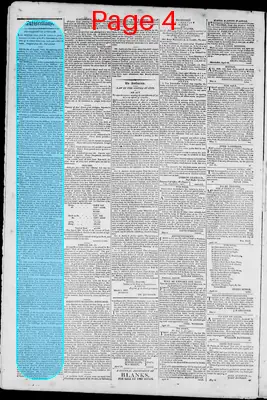
The Enquirer
Richmond, Henrico County, Virginia
What is this article about?
Account of Lieut. Pike's 1805-1806 expedition up the Mississippi from St. Louis to its source, under War Department orders. Describes river bends, landmarks, Native American villages, rapids, potential military sites, and encounters with traders and Indians.
Clipping

OCR Quality
Full Text
AN ACCOUNT OF A VOYAGE up the Mississippi river, from St. Louis to its source: made under the orders of the War Department, by Lieuts. Pike, of the United States army, in the years 1805 and 1806. Compiled from Mr. Pike's journal.
On the 9th of August, 1805, the exploring party, consisting of Lieut. Pike, one sergeant, two corporals and seventeen privates, left their encampment near St. Louis in a keel boat, seventy feet long, provisioned for four months: in order to make a survey of the river Mississippi to its source.
The Mississippi river makes a remarkable bend immediately above the mouth of the Missouri: and where it receives the waters of the Illinois, that river might be mistaken for a branch or part of the principal stream. The land on the east side appears hilly, rocky and barren; the opposite side is low and flat, over which the Sioux portage passes between the Mississippi and the Missouri rivers.
Near the mouth of the Illinois river is the big cave; above it the river turns to the southward in order to pass round some rocky hills, or a bluff, one hundred feet in height, beyond which it has a north westerly direction to the mouth of Buffalo, or Boeuf river, running in from the west. Five miles farther, on the eastern side, is a beautiful cedar cliff; above which, the river is nearly two miles in width. Some islands, which occur at this place, having their lower ends nearly in a line, received from the party the appellation of the Four Brothers. The first hills which appear on the west side. are some distance below Salt river; the land on that side, from Boeuf river changes its quality from low and rich, with cotton wood growing thereon, to a light soil. as it approaches the hills. On the other side a handsome rocky bluff had been passed, and high lands are observable back from the river.
Salt river is a considerable stream, and in high water is navigable for boats, at least 200 miles above its mouth.
About 150 miles from the Missouri, is the house of a French settler, situated on the west side of the river, opposite to Hurricane island. His cattle appeared in fine order, but his cornfields were badly cultivated. A mile above this house there is a beautiful hill, level on the top, with an easy ascent on each side, and a fountain of fine water. Five miles from the Hurricane settlement, Jefferson creek falls in from the west; and about twenty miles farther, two rivers on the same side; the northernmost of which is the W yaconda, one hundred yards in width. The Mississippi is here a mile and a half wide. Several islands present themselves immediately above this place. Seventy-five miles above the Frenchman's, and two hundred & thirty two from the Missouri. the riviere des Moines comes in from the north west. The width of the Mississippi is here three-fourths of a mile.
Immediately above the confluence of the riviere des Moines with the Mississippi, the falls or rapids of that name commence. These rapids extend eleven miles up the river, are formed by successive ledges, or shoals, which cross its bed. The first fall is the most difficult to ascend: the channel which is a bad one, is on the east side at the two first falls, after which, it crosses to the west, and continues near that shore, to the Sac village. Here the United States have an agent (Mr. William Ewing) appointed to instruct this nation in agriculture. The country on both sides of the river at these rapids is hilly, but the soil is rich. This establishment is in latitude 40 deg. 32 min. north.
Thirty-five miles above the establishment of the Sac village, a very handsome site for a garrison presents itself on the west bank of the river. The channel passes close under the hill, which is about sixty feet in perpendicular height: the top of the hill is level for about four hundred yards; and, in the rear, there is a prairie of eight or ten acres well adapted for gardens. This hill commands an extensive prospect, over a large prairie on the east side of the river, on which is scattered a few small groves of trees. At the foot of the hill, from a limestone rock, issues a spring which would afford an ample supply of water to a regiment of men. The landing is bold and safe; and a road for a team to ascend the hill, may be easily made at the south end. This hill continues about two miles; is covered with black and white oak, and gives rise to five springs in that distance.
On the morning of the 27th, the party reached the mouth of Rock-river, ninety-eight miles above the site mentioned as proper for a military post. In this distance they passed a large prairie, called the hay way to the prairie des Chiens, and several sand banks, on the east: the Iowa village and creek is on the opposite side. Islands occur very frequently in the river along its whole course. The country on each side is prairie or covered with timber, alternately. Near the mouth of Rock river, in a large prairie on the east side, stands the largest village of Sac Indians. Just above the Rock river, the rapids of that name commence; formed by a series of rocks which in some places cross the river from shore to shore. These rapids extend about eighteen miles along the river: they afford more water than the rapids of la riviere des Moines, but are more rapid and difficult to pass. A few miles up the river than the rapids, the first village of the Reynards is situated on its west bank.
The lead mines which belongs to Monsieur Dubuque, are on the west side of the Mississippi, about one hundred and twenty miles above the first villages of the Foxes. The dwelling house of the proprietor is near the Mississippi, but the mines are about six miles from it, in a south west direction. Indisposition prevented Mr. Pike from visiting those mines, as he had proposed.
Near the mouth of the Turkey river, on which another village of the Fox Indians is situated, the exploring party of the United States met a war party of Indians consisting of Sacs, Reynards, and Puants, returning. They appeared anxious to avoid the Americans: Indeed great pains seem to have been taken to impress on the minds of all the Indians in this quarter, that we are a vindictive, ferocious and warlike people. Although these impressions seem to have been made with evil intentions towards us, they will have a contrary effect when the Indians find our conduct towards them to be magnanimous and just: reverence will then be joined with fear, in estimating the American character. These Indians stated, that they had been as high as lake Pepin, without effecting any thing.
The mouth of the Ouisconsin river, which enters the Mississippi from the east, is in latitude 43 deg. 44 min. 8 sec. N. In the fork made by these rivers, and above the Wisconsin, is the prairie des Chiens backed by a high ridge of hills. Gayard and Yellow river enter the Mississippi on the west side opposite to this prairie.
At the village of the prairie des Chiens, the exploring party were received with attention by captains Fisher and Mr. Frazer. Accompanied by judge Fisher, Mr. Frazer and Mr. Wood, lieut. Pike ascended the hill on the—side of the Mississippi, and made choice of an eligible site for a fort: it was level on the top, had a spring in the rear, and commanded a view of the surrounding country. He designated the spot by marking four trees with the letters A, B, C, and D, and squared the sides of one in the center.
On the day following (the 6th of September,) he held a council with a small number of the Puants, and a chief of the lower band of the Sioux, visited and laid out the position of a hill called the Petit Gris, near the Ouisconsin, and three miles above its mouth. At the village of the prairie de Chiens, they changed their large boat for others better adapted to the prosecution of their voyage. The party here received an addition to their number of two interpreters; one of which was to go as far as the falls of St. Anthony, and paid by Mr. Frazer; the other was engaged for the whole distance. Mr. Frazer, who was going on a trading expedition, to winter with some of the bands of Sioux, also embarked with them.
(To be Continued.)
What sub-type of article is it?
What themes does it cover?
What keywords are associated?
What entities or persons were involved?
Literary Details
Title
An Account Of A Voyage Up The Mississippi River, From St. Louis To Its Source: Made Under The Orders Of The War Department, By Lieuts. Pike, Of The United States Army, In The Years 1805 And 1806. Compiled From Mr. Pike's Journal.
Author
Compiled From Mr. Pike's Journal
Subject
Made Under The Orders Of The War Department, By Lieuts. Pike, Of The United States Army, In The Years 1805 And 1806
Form / Style
Narrative Expedition Journal
Key Lines