Thank you for visiting SNEWPapers!
Sign up free
Alexandria Advertiser And Commercial Intelligencer
Alexandria, Virginia
What is this article about?
In the House of Commons on March 11, Mr. Fox concludes his speech defending the Treaty of Amiens, criticizing ministerial secrecy on potential war causes with France, advocating clear war objectives, and expressing confidence in British naval and land forces while warning of war's calamities.
Merged-components note: Sequential reading orders (35,36,37) with continuous flowing text from parliamentary debate speech; merge into single foreign_news component.
Clipping
OCR Quality
Full Text
IMPERIAL PARLIAMENT
HOUSE OF COMMONS.
Friday, March 11.
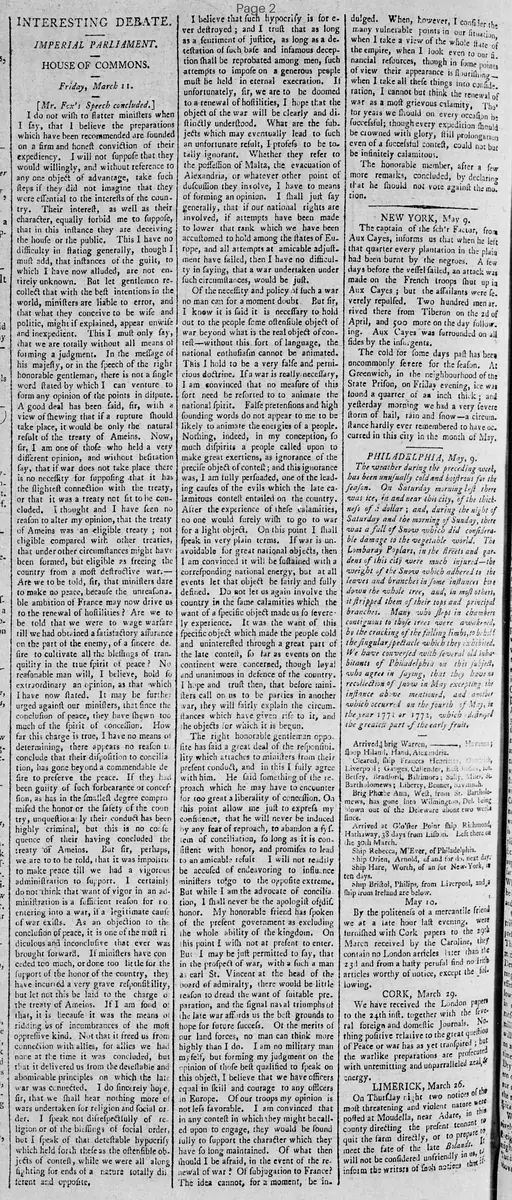
[Mr. Fox's Speech concluded.]
I do not wish to flatter ministers when
I say, that I believe the preparations
which have been recommended are founded
on a firm and honest conviction of their
expediency. I will not suppose that they
would willingly, and without reference to
any one object of advantage, take such
steps if they did not imagine that they
were essential to the interests of the coun-
try. Their interest, as well as their
character, equally forbid me to suppose,
that in this instance they are deceiving
the house or the public. This I have no
difficulty in stating generally, though I
must add, that instances of the guilt, to
which I have now alluded, are not en-
tirely unknown. But let gentlemen re-
collect that with the best intentions in the
world, ministers are liable to error, and
that what they conceive to be wise and
politic, might if explained, appear unwise
and inexpedient. This I must only say,
that we are totally without all means of
forming a judgment. In the message of
his majesty, or in the speech of the right
honorable gentleman, there is not a single
word stated by which I can venture to
form any opinion of the points in dispute.
A good deal has been said, sir, with a
view of showing that if a rupture should
take place, it would be only the natural
result of the treaty of Amiens. Now,
sir, I am one of those who held a very
different opinion, and without hesitation
say, that if war does not take place there
is no necessity for supposing that it has
the slightest connection with the treaty,
or that it was a treaty not fit to be con-
cluded. I thought and I have seen no
reason to alter my opinion, that the treaty
of Amiens was an eligible treaty; not
eligible compared with other treaties,
that under other circumstances might have
been formed, but eligible as freeing the
country from a most destructive war.
Are we to be told, sir, that ministers dare
not make no peace, because the unreasona-
ble ambition of France may now drive us
to the renewal of hostilities? Are we to
be told that we were to wage warfare
till we had obtained a satisfactory assurance
on the part of the enemy, of a sincere de-
sire to cultivate all the blessings of tran-
quility in the true spirit of peace? No
reasonable man will, I believe, hold so
extraordinary an opinion, as that which
I have now stated. It may be further
urged against our ministers, that since the
conclusion of peace, they have shewn too
much of the spirit of concession. How
far this charge is true, I have no means of
determining, there appears no reason to
conclude that their disposition to conciliate
has gone beyond a commendable de-
sire to preserve the peace. If they had
been guilty of such forbearance or conces-
sion, as has in the smallest degree compro-
mised the honor or the safety of the coun-
try, unquestionably their conduct has been
highly criminal, but this is no conse-
quence of their having concluded the
treaty of Amiens. But sir, perhaps,
we are not to be told, that it was impolitic
to make peace till we had a vigorous
administration to support. I certainly
do not think that want of vigor in an ad-
ministration is a sufficient reason for re-
entering into a war, if a legitimate cause
of war exists. As an objection to the
conclusion of peace, it is one of the most ri-
diculous and inconclusive that ever was
brought forward. If ministers have con-
ceded too much, or done too little for the
support of the honor of the country, they
have incurred a very grave responsibility,
but let not this be laid to the charge of
the treaty of Amiens. If I am fond of
that, it is because it was the means of
ridding us of incumbrances of the most
oppressive kind. Not that it freed us from
connection with allies, for allies we had
none at the time it was concluded, but
that it delivered us from the detestable and
abominable principles on which the late
war was connected. I do sincerely hope,
sir, that we shall hear nothing more of
wars undertaken for religion and social or-
der. I speak not disrespectfully of re-
ligion or of the blessings of social order,
but I speak of that detestable hypocrisy
which held forth these as the ostensible ob-
jects of contest, while we were all along
fighting for ends of a nature totally dif-
ferent and opposite.
I believe that such hypocrisy is for e-
ver destroyed; and I trust that as long
as a sentiment of justice, as long as a de-
testation of such base and infamous decep-
tion shall be reprobated among men, such
attempts to impose on a generous people
must be held in eternal execration. If
unfortunately, sir, we are to be doomed
to a renewal of hostilities, I hope that the
object of the war will be clearly and dis-
tinctly understood. What are the sub-
jects which may eventually lead to such
an unfortunate result, I profess to be to-
tally ignorant. Whether they refer to
the possession of Malta, the evacuation of
Alexandria, or whatever other point of
discussion they involve, I have no means
of forming an opinion. I shall just say
generally, that if our national rights are
involved, if attempts have been made
to lower that rank which we have been
accustomed to hold among the states of Eu-
rope, and all attempts at amicable adjust-
ment have failed, then I have no difficul-
ty in saying, that a war undertaken under
such circumstances, would be just.
Of the necessity and policy of such a war
no man can for a moment doubt. But sir.
I know it is said it is necessary to hold
Out to the people some ostensible object of
war beyond what is the real object of con-
text--without this sort of language, the
national enthusiasm cannot be animated.
This I hold to be a very false and perni-
cious doctrine. If a war is really necessary,
I am convinced that no measure of this
sort need be resorted to to animate the
national spirit. False pretensions and high
sounding words do not appear to me to be
likely to animate the energies of a people.
Nothing, indeed, in my conception, so
much dispirits a people called upon to
make great exertions, as ignorance of the
precise object of contest; and this ignorance
was, I am fully persuaded, one of the lead-
ing causes of the evils which the late ca-
lamitous contest entailed on the country.
After the experience of these calamities,
no one would surely wish to go to war
for a light object. On this point I shall
speak in very plain terms. If war is un-
avoidable for great national objects, then
I am convinced it will be sustained with a
corresponding national energy, but at all
events let that object be fairly and fully
defined. Do not let us again involve the
country in the same calamities which the
want of a specific object made us so severe-
ly experience. It was the want of this
specific object which made the people cold
and uninterested through a great part of
the late contest, so far as events on the
continent were concerned, though loyal
and unanimous in defence of the country.
I hope and trust then, that before mini-
sters call on us to be parties in another
war, they will fairly explain the circum-
stances which have given rise to it, and
the objects for which it is begun.
The right honorable gentleman oppo-
site has said a great deal of the responsibility
which attaches to ministers from their
present conduct, and in this I fully agree
with him. He said something of the re-
proach which he may have to encounter
for too great a liberality of concession. On
this point allow me just to express my
confidence, that he will never be induced
by any fear of reproach, to abandon a sys-
tem of conciliation, so long as it is con-
sistent with honor, and promises to lead
to an amicable result I will not readily
be accused of endeavoring to influence
ministers to go to the opposite extreme.
But while I am the advocate of conciliation,
I shall never be the apologist of dis-
honor. My honorable friend has spoken
of the present government as excluding
the whole ability of the kingdom. On
this point I wish not at present to enter.
But I may be just permitted to say, that
in the prospect of war, with such a man
as earl St. Vincent at the head of the
board of admiralty, there would be little
reason to dread the want of suitable pre-
paration, and the signal naval triumphs of
the late war affords us the best grounds to
hope for future success. Of the merits of
our land forces, no man can think more
highly than I do. I am no military man
myself, but forming my judgment on the
opinion of those best qualified to speak on
this object, I believe that we have officers
equal in skill and courage to any officers
in Europe. Of our troops my opinion is
not less favorable. I am convinced that
in any contest in which they might be call-
ed upon to engage, they would be found
fully to support the character which they
have so long maintained. Of what then
should I be afraid, in the event of the re-
newal of war: Of subjugation to France?
The idea cannot, for a moment, be in-
dulged. When, however, I consider the
many vulnerable points in our situation
when I take a view of the whole state of
the empire, when I look even to our fi-
nancial resources, though in some points
of view their appearance is flourishing-
when I take all these things into conside-
ration, I cannot but think the renewal of
war as a most grievous calamity, Tho'
for years we should on every occasion be
successful; though every expedition should
be crowned with glory, till prolongation
even of a successful contest, could not but
be infinitely calamitous.
The honorable member, after a few
more remarks, concluded, by declaring
that he should not vote against the mo-
tion.
What sub-type of article is it?
What keywords are associated?
What entities or persons were involved?
Where did it happen?
Foreign News Details
Primary Location
France
Event Date
Friday, March 11
Key Persons
Outcome
mr. fox declares he shall not vote against the motion.
Event Details
Mr. Fox defends the Treaty of Amiens as eligible for ending a destructive war, criticizes ministerial secrecy on dispute points possibly involving Malta and Alexandria, argues against war without clear national objectives, rejects hypocrisy in past war justifications, expresses confidence in British forces under leaders like Earl St. Vincent, and warns of war's calamities despite potential successes.