Thank you for visiting SNEWPapers!
Sign up free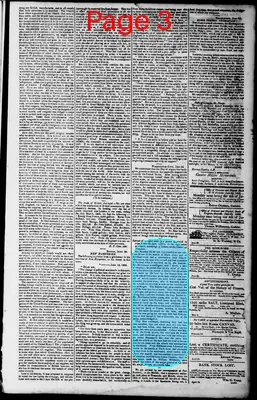
Domestic News
June 29, 1808
Norfolk Gazette And Publick Ledger
Norfolk, Virginia
What is this article about?
Inquiry report into Indian attack on boat on Tennessee River: On April 3, Creeks killed 2 and wounded 3 of 7 men aboard. Witness Famous Mortimore confirms details; Levi Colbert identifies attackers who confessed unauthorized action. William Meadows' statements proven false.
Clipping
OCR Quality
95%
Excellent
Full Text
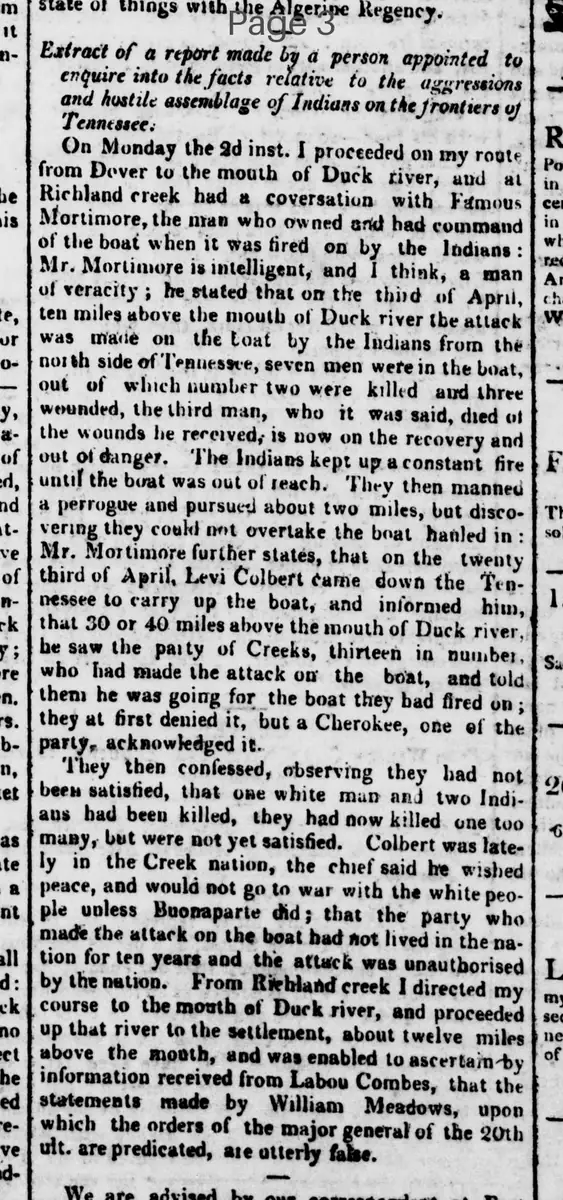
Extract of a report made by a person appointed to enquire into the facts relative to the aggressions and hostile assemblage of Indians on the frontiers of Tennessee: On Monday the 2d inst. I proceeded on my route from Dover to the mouth of Duck river, and at Richland creek had a conversation with Famous Mortimore, the man who owned and had command of the boat when it was fired on by the Indians : Mr. Mortimore is intelligent, and I think, a man of veracity; he stated that on the third of April, ten miles above the mouth of Duck river the attack was made on the boat by the Indians from the north side of Tennessee, seven men were in the boat, out of which number two were killed and three wounded, the third man, who it was said, died of the wounds he received; is now on the recovery and out of danger. The Indians kept up a constant fire until the boat was out of reach. They then manned a perrogue and pursued about two miles, but discovering they could not overtake the boat hauled in : Mr. Mortimore further states, that on the twenty third of April. Levi Colbert came down the Tennessee to carry up the boat, and informed him, that 30 or 40 miles above the mouth of Duck river, he saw the party of Creeks, thirteen in number, who had made the attack on the boat, and told them he was going for the boat they had fired on; they at first denied it, but a Cherokee, one of the party, acknowledged it. They then confessed, observing they had not been satisfied, that one white man and two Indians had been killed, they had now killed one too many, but were not yet satisfied. Colbert was lately in the Creek nation, the chief said he wished peace, and would not go to war with the white people unless Buonaparte did; that the party who made the attack on the boat had not lived in the nation for ten years and the attack was unauthorised by the nation. From Richland creek I directed my course to the mouth of Duck river, and proceeded up that river to the settlement, about twelve miles above the mouth, and was enabled to ascertain-by information received from Labou Combes, that the statements made by William Meadows, upon which the orders of the major general of the 20th inst. are predicated, are utterly false.
What sub-type of article is it?
Indian Affairs
Legal Or Court
What keywords are associated?
Indian Attack
Creek Nation
Tennessee River
Boat Assault
Unauthorized Aggression
What entities or persons were involved?
Famous Mortimore
Levi Colbert
Labou Combes
William Meadows
Where did it happen?
Frontiers Of Tennessee
Domestic News Details
Primary Location
Frontiers Of Tennessee
Event Date
Third Of April
Key Persons
Famous Mortimore
Levi Colbert
Labou Combes
William Meadows
Outcome
two killed and three wounded
Event Details
Attack on boat by Creeks ten miles above mouth of Duck river; seven men aboard, Indians pursued but failed to overtake; attackers confessed to unauthorized action, dissatisfied after prior killings; Meadows' statements false.