Thank you for visiting SNEWPapers!
Sign up free
The Key West Citizen
Key West, Monroe County, Florida
What is this article about?
Union General Daniel Butterfield composed the bugle call 'Taps' during the Civil War as a tender lights-out signal for his brigade, replacing the official call; it spread army-wide, symbolizing rest and later funerals. He also devised a distinctive brigade alert call remembered decades later.
Clipping
OCR Quality
Full Text
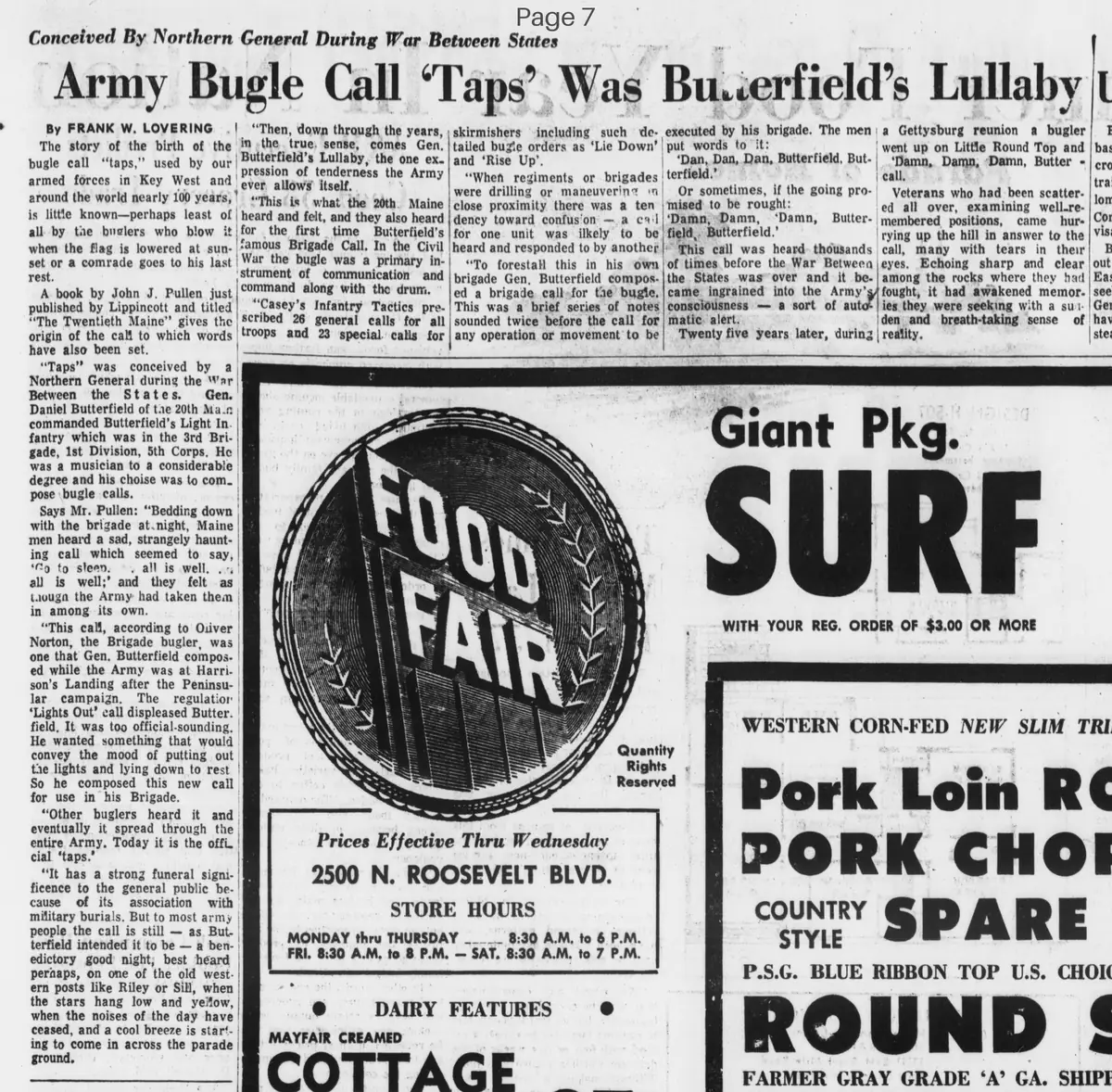
Army Bugle Call 'Taps' Was Butterfield's Lullaby
By FRANK W. LOVERING
The story of the birth of the bugle call "Taps," used by our armed forces in Key West and around the world nearly 100 years, is little known-perhaps least of all by the buglers who blow it when the flag is lowered at sunset or a comrade goes to his last rest.
A book by John J. Pullen just published by Lippincott and titled "The Twentieth Maine" gives the origin of the call to which words have also been set.
"Taps was conceived by a Northern General during the War Between the States.
Gen. Daniel Butterfield of the 20th Maine commanded Butterfield's Light Infantry which was in the 3rd Brigade, 1st Division, 5th Corps. He was a musician to a considerable degree and his choice was to compose bugle calls.
Says Mr. Pullen: "Bedding down with the brigade at night, Maine men heard a sad, strangely haunting call which seemed to say, 'Go to sleep. all is well. all is well;' and they felt as though the Army had taken them in among its own.
"This call, according to Oliver Norton, the Brigade bugler, was one that Gen. Butterfield composed while the Army was at Harrison's Landing after the Peninsular campaign. The regulation 'Lights Out' call displeased Butterfield. It was too official-sounding. He wanted something that would convey the mood of putting out the lights and lying down to rest So he composed this new call for use in his Brigade.
"Other buglers heard it and eventually it spread through the entire Army. Today it is the official 'Taps.
"It has a strong funeral significance to the general public because of its association with military burials. But to most army people the call is still - as Butterfield intended it to be - a benedictory good night, best heard perhaps, on one of the old western posts like Riley or Sill, when the stars hang low and yellow. when the noises of the day have ceased, and a cool breeze is starting to come in across the parade ground."
Then, down through the years, in the true sense, comes Gen. Butterfield's Lullaby. the one expression of tenderness the Army ever allows itself.
"This is what the 20th. Maine heard and felt, and they also heard for the first time Butterfield's famous Brigade Call. In the Civil War the bugle was a primary instrument of communication and command along with the drum.
"Casey's Infantry Tactics prescribed 26 general calls for all troops and 23 special. calls for skirmishers including such detailed bugle orders as 'Lie Down' and 'Rise Up'.
"When regiments or brigades were drilling or maneuvering in close proximity there was a tendency toward confusion - a call for one unit was likely to be heard and responded to by another
"To forestall this in his own brigade Gen. Butterfield composed a brigade call for the bugle. This was a brief series of notes sounded twice before the call for any operation or movement to be executed by his brigade. The men put words to it:
'Dan, Dan, Dan, Butterfield, Butterfield.'
Or sometimes, if the going promised to be rough:
'Damn, Damn, Damn, Butterfield. Butterfield.'
This call was heard thousands of times before the War Between the States was over and it became ingrained into the Army's. consciousness - a sort of automatic alert.
Twenty five years later, during a Gettysburg reunion a bugler went up on Little Round Top and 'Damn, Damn, Damn, Butterfield' call.
Veterans who had been scattered all over, examining well-remembered positions. came hurrying up the hill in answer to the call, many with tears in their eyes. Echoing sharp and clear among the rocks where they had fought, it had awakened memories they were seeking with a sudden and breath-taking sense of reality.
What sub-type of article is it?
What themes does it cover?
What keywords are associated?
What entities or persons were involved?
Where did it happen?
Story Details
Key Persons
Location
Harrison's Landing, Peninsular Campaign, Western Posts Like Riley Or Sill, Little Round Top At Gettysburg
Event Date
During The War Between The States, After The Peninsular Campaign, Twenty Five Years Later During A Gettysburg Reunion
Story Details
Gen. Daniel Butterfield composed the bugle call 'Taps' as a soothing alternative to the regulation lights-out call for his brigade during the Civil War, which spread through the army and gained funeral significance. He also created a unique brigade call that became ingrained in army consciousness, evoking strong memories even at later reunions.